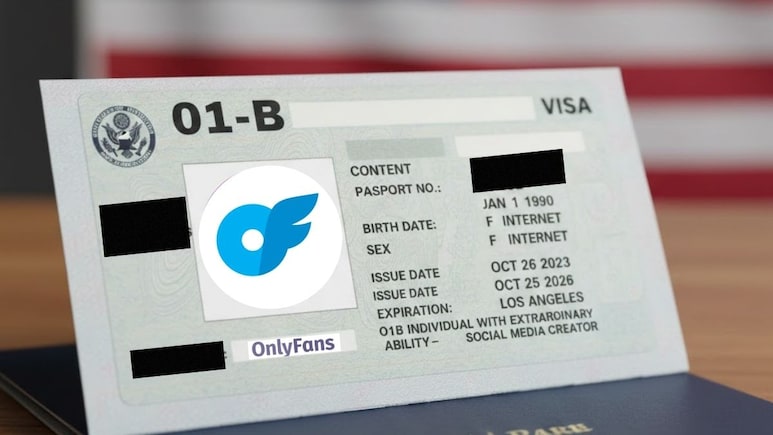
Influencers and OnlyFans creators are fast becoming the new face of America's ‘extraordinary ability' visas. Once designed for acclaimed artists, musicians and cultural icons, the US O-1 visa is now increasingly being secured by people whose primary proof of distinction lies in follower counts, subscriber numbers and online engagement.
According to a report by the Financial Times, immigration lawyers say social media influencers now make up more than half of their O-1 visa clientele, with applications surging since the pandemic. High follower numbers and brand deals have become easy, quantifiable markers of “exceptional ability”, quietly reshaping how artistic merit is assessed by US immigration authorities.
This shift is playing out in real time on social media.
Nine weeks ago, Indian singer and content creator Darshan Magdum posted an Instagram monologue that felt half-serious, half-satirical. “I am Darshan, I am also a member of boythrob, but I am in India, and our immigration lawyer said we need one million followers to get a visa. So I can sing and dance in America,” he said.
It sounds absurd, almost like a punchline. But for Darshan, an Indian singer and Internet personality whose offbeat song covers regularly go viral, this is not a joke. It is a very real immigration strategy.
What followed was a poetic, slightly chaotic Instagram post where Darshan and his other members of the boy band (they like to be called Boythrob) lays it all out as they sing, "Keep in one million on the gram, the tok, the vibes. Pledge allegiance to your band, your team, your guys... It's gonna be the greatest night you've been dreaming of, the fate of Darshan's visa." (yes Taylor Swift)"
Today, that slightly chaotic, very Internet-coded dream looks a lot closer to reality. Darshan and his boy band, Boythrob, have crossed one million followers on TikTok and racked up over six lakh followers on Instagram.
According to the group and their immigration lawyer, this digital milestone has significantly strengthened Darshan's case for an O-1 visa, the US's so-called 'extraordinary ability' visa.
Scroll through the comments on their videos and you will find people praying for Darshan's visa approval like it is a board exam result.
Darshan himself now has over seven lakh followers on Instagram, which only adds more 'weight to his application'.
"Boythrob needs to be more popular so that I can get a visa," Darshan shares openly on Instagram, citing advice from their immigration lawyer.
One Boy Band, Two Goals, One Visa
Boythrob is a TikTok-era boy band with a twist. There is choreography, pink velour tracksuits, bright yellow trainers and earnest pop ambition. The catch is that the band has never fully performed together in person.
While Evan Papier, Anthony Key and Zachary Sabania are in the US, Darshan is, in his words, "stuck in India", performing via Zoom from a laptop placed next to his bandmates.
A viral video of their first gig at a Hollywood retirement home last month sealed their cult status.
They smashed their one million TikTok target in just a month.
Speaking to BBC Newsbeat, the group admitted their two main goals are to win a Grammy and "get Darshan his visa". Still, they cannot escape comments asking whether the whole thing is satire or performance art taken too far.
Born on December 24, 2003, Darshan rose to fame by posting unpolished, karaoke-style covers of tracks like Hymn for the Weekend and Blinding Lights around 2021.
His humour-heavy, slightly chaotic and cringe singing sparked memes, debates and eventually endorsements from global stars like Bruno Mars, Rose; and Maroon 5, who shared his videos. He has since featured in Grazia's Cool List 2025 all while building a following that immigration lawyers increasingly love to see. And Darshan's case is far from alone.
How The O-1 Visa Came To Be
The O-1 visa was not designed for TikTok stars or OnlyFans creators.
In 1972, when the Nixon administration attempted to deport John Lennon, musician, activist and the member of the beatles, for his political activism, there was no specific visa for artists.
Immigration attorney Leon Wildes petitioned for Lennon as an "outstanding person in the arts and sciences". Years later, Congress formalised this idea while passing the Immigration Act of 1990, creating the O-1 visa category for individuals with extraordinary ability.
There are two main types. The O-1A is for those in science, education, business or athletics. The O-1B is for artists and those in the motion picture or television industries. The idea was simple on paper. Let in people whose work would substantially benefit American culture and the economy.
Initially, that meant opera singers, filmmakers, theatre artists and musicians with traditional credentials. That definition is now being stretched by the Internet.
Influencers And OnlyFans Models Take Over
According to a detailed report by the Financial Times, social media influencers and OnlyFans models now dominate applications for O-1B visas.
Immigration attorney Michael Wildes, whose father helped create the visa category, told the FT that a growing number of his clients are no longer actors or musicians but influencers and creators.
"I knew the days of representing iconic names like Boy George and Sinead O'Connor were over," Wildes said, describing the shift towards what he called "scroll kings and queens".
Since the Covid-19 pandemic, the number of influencers successfully applying for O-1B visas has exploded. Some immigration lawyers told the Financial Times that influencers now make up more than half their clientele.
The appeal is obvious. From a legal standpoint, follower counts and earnings are far easier to quantify than artistic merit.
"A lay person is very easily impressed by a large number of followers," said Elektra Yao, founding partner of the Yao Law Group. "You don't need to be a rocket scientist."
Data backs this up. The number of O-1 visas granted each year increased by over 50 percent between 2014 and 2024, while total non-immigrant visas grew by just 10 percent. Even so, O-1 visas remain a small slice of the system. Fewer than 20,000 were granted in 2024, compared to hundreds of thousands of H-1B visas.
When Likes Become Legal Evidence
Immigration attorneys say the criteria for O-1B visas have quietly adapted to fit online creators. High follower counts and substantial income can be used to prove commercial success.
Brand deals can qualify as endorsements of talent. Even appearing at a store opening might be framed as playing a leading role in a distinguished production.
Immigration attorneys say the criteria for O-1B visas have quietly adapted to fit online creators.
Photo Credit: Unsplash
Fiona McEntee, founding partner of the McEntee Law Group, told the Financial Times that when you consider how many people use social media daily versus how few actually make a living from it, influence itself can be viewed as a specialised skill.
But not everyone is convinced this is a healthy evolution.
Protima Daryanani, managing partner of the Daryanani Law Group, warned that the quality threshold is being diluted. "We have scenarios where people who should never have been approved are getting approved for O-1s," she said, adding that the system has been "watered down".
New York-based attorney Shervin Abachi echoed similar concerns. He warned that artistic merit is increasingly being reduced to algorithmic performance. "Officers are being handed petitions where value is framed almost entirely through algorithm-based metrics. Once that becomes normalised, the system moves towards treating artistic merit like a scoreboard," he told the FT.
This shift could disadvantage traditionally trained artists whose work does not naturally lend itself to virality. As immigration officials begin to equate reach with relevance, the question becomes less about cultural contribution and more about clicks.
Bottomline
Darshan Magdum's story sits right at the centre of this debate. On one hand, he is Internet-savvy, memeable and culturally relevant. On the other, experts say his visa journey openly hinges on follower counts, engagement metrics and collective Internet goodwill not "extraordinary talent".
Today, it is not just about how well you sing or dance. It is about how many people are watching while you do it.
Track Latest News Live on NDTV.com and get news updates from India and around the world
