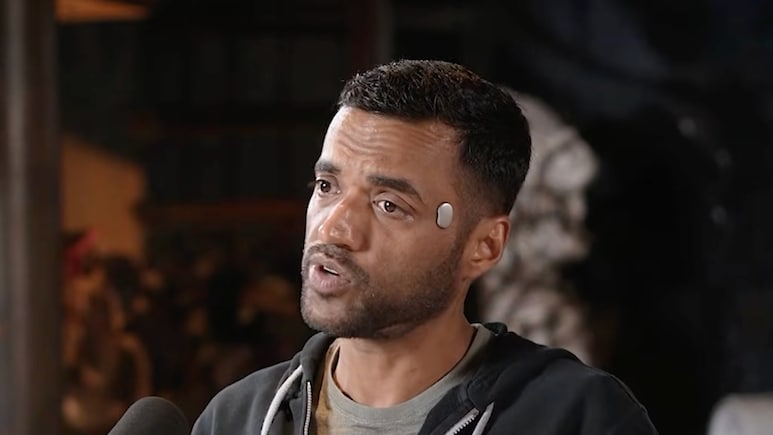
When the Zomato founder and Eternal CEO, Deepinder Goyal, appeared on Raj Shamani's Figuring Out podcast, viewers were quick to zoom in on a small metallic clip-like device on the side of his head.
The Internet within hours were trying to figure out one thing: what exactly was stuck to Deepinder Goyal's temple during his recent podcast appearance?
Within hours, social media was buzzing with guesses and memes. Was it 'chewing gum'? 'A charging pad? An external SSD'? Memes followed, reels took over, and searches for "Deepinder Goyal temple device" spiked overnight. The gadget, more than the four-hour-long conversation itself, became the episode's most talked-about moment.
postcast is fine, but what is this thing he's wearing?? pic.twitter.com/Oku16Oku1R
— priyanshu.sol (@priyanshudotsol) January 4, 2026
But the answer, as it turns out, is far more serious than the memes suggested.
What Exactly Was He Wearing?
The device Deepinder Goyal was wearing is called Temple. It is an 'experimental wearable' designed to monitor brain blood flow continuously and in real time.
Worn on the temple region of the head, it is intended to track cerebral blood flow, which many researchers, and Deepinder consider an important indicator of neurological health, cognition, ageing, and long-term brain function.
Temple is not a consumer gadget yet, and certainly is not a Zomato product.
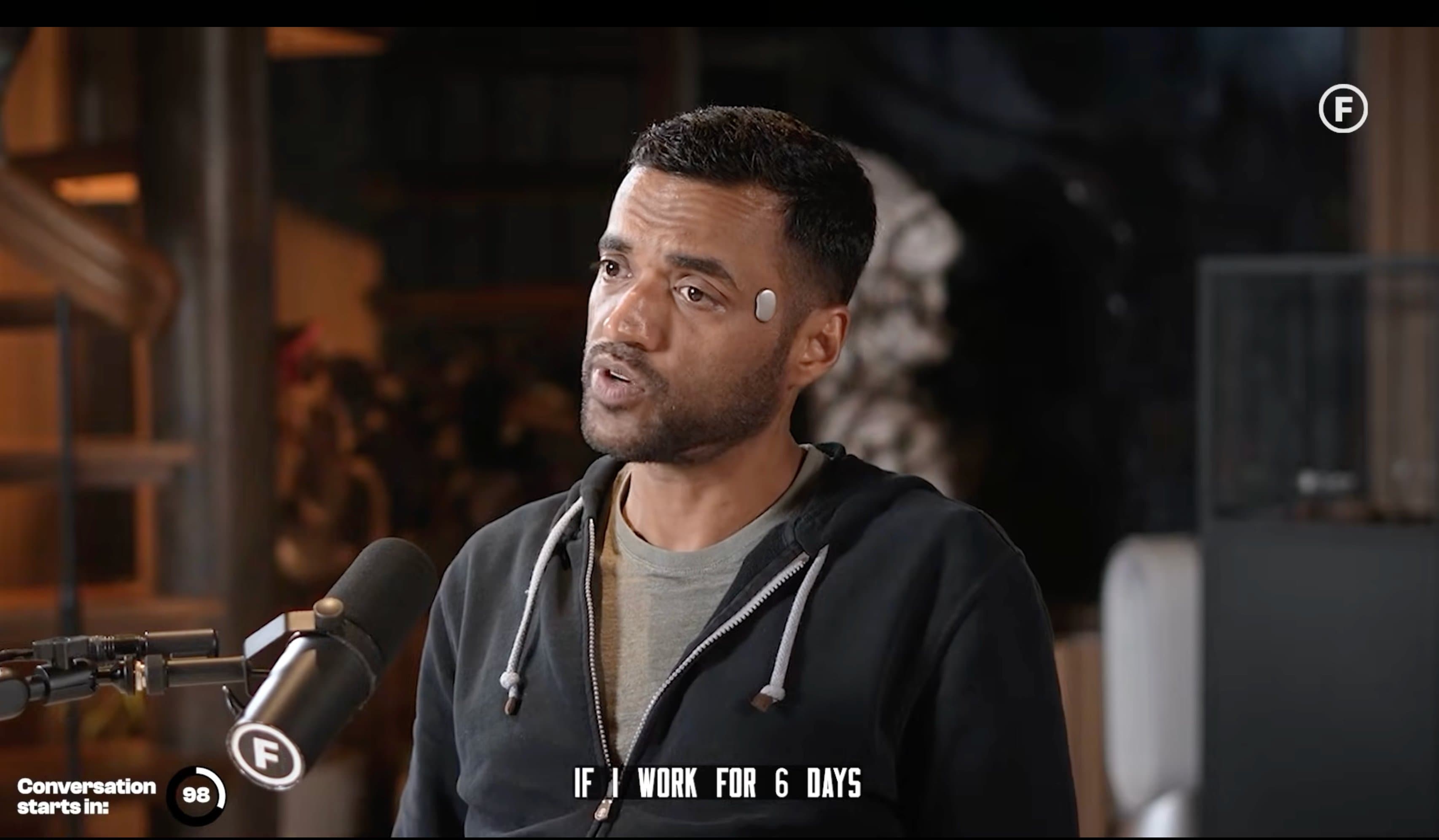
The device Deepinder Goyal was wearing is called Temple. Photo: YouTube
Currently, it is a research prototype being developed under a separate health-tech startup also called Temple, linked to Goyal's privately funded initiative, Continue Research.
Goyal has described it as an "experimental device to measure brain flow precisely, in real time, and continuously". The version seen on the podcast is a lightweight, metallic-coloured, clip-like sensor that he has reportedly been testing on himself for close to a year.
When And How Did The Idea Come About?
According to Goyal, the idea for Temple emerged from his long-running personal experiments with health optimisation. Over the years, this included tracking blood markers, fasting, meditation, hyperbaric chamber routines, supplements, and other longevity-focused practices.
This personal journey eventually led him to what he calls the 'Gravity Ageing Hypothesis', which he shared on X. In simple terms, the hypothesis suggests that gravity may chronically stress the heart's ability to pump enough blood upward to the brain, potentially accelerating aspects of ageing over decades.
Goyal has also repeatedly clarified that gravity is not being positioned as the only cause of ageing, nor is the hypothesis being presented as settled science. He says the work builds on over 100 existing scientific papers and two years of literature review and conversations with scientists globally.
Temple, according to him, is the tool designed to test whether long-term changes in brain blood flow could be a meaningful upstream driver or accelerator of ageing.
When Will Temple Launch
Temple is not available for sale, has no announced price, no confirmed launch timeline, and no publicly stated regulatory pathway. What has been released so far is only a teaser.
Goyal has hinted at a coming soon phase via a post on Instagram (Temple's page already has more then 9,000 followers), suggesting an early-access or limited research rollout before any wider availability.
Financially, also the commitment is serious. Reports indicate that Goyal has already invested around $25 million, roughly Rs 208 crore, into Continue Research. The Temple startup is also said to be exploring a $50 million seed round with interest from investors like Steadview Capital, Vy Capital, Info Edge, and Peak XV.
For now, Temple remains a research prototype, not a consumer product.
What Is Deepinder Goyal Exactly Saying About It?
Goyal has been careful to frame Temple as a research tool rather than a miracle solution. He has emphasised that cerebral blood flow naturally declines with age, citing studies that show annual reductions between 0.3 and 0.74 percent in healthy adults, with faster declines in conditions like Alzheimer's disease.
He has also pointed to established findings that link chronic low brain perfusion with cognitive decline, brain atrophy, dementia risk, and mortality. Changes in posture, such as prolonged sitting or standing upright, are known to reduce cerebral blood flow measurably.
I did not explain the Gravity Aging Hypothesis (GAH) well, the first time.
— Deepinder Goyal (@deepigoyal) November 20, 2025
I brought my consumer internet brain into a deep scientific field and I miscommunicated. I tried to compress years of research and thinking into a dramatic social media reveal.
That made the hypothesis… pic.twitter.com/I4dq0XkTPg
"None of this is our work. It is mainstream literature," he has stated on X, positioning Temple as a way to connect existing dots rather than invent new physics.
If Temple works as intended, Goyal believes it could eventually help a wide range of users, from students tracking focus and fatigue to athletes managing mental load, older adults monitoring cognitive decline, which in-turn can help people to live longer, and clinicians using additional data points for assessment.
What Medical Experts Are Saying About Temple
As the buzz around Temple grows louder, it is important to see what doctors and medical researchers are saying about the product. NDTV reached out to experts and while most agree that brain health and cerebral blood flow are crucial areas of study, others also say that current wearable technology has serious limitations.
Neurosurgeon Dr Vishwanathan Iyer from Zynova Shalby Hospital, Mumbai, says the first red flag is where the device sits. A sensor placed on the temple, he explains, can only capture surface-level signals.
"Such devices are designed to pick up surface-level signals, but they do not directly measure brain blood flow like an MRI," he says. According to him, MRI scans are complex hospital-based tests and cannot be replaced by a small wearable gadget.
Dr Iyer adds that while these sensors may record indirect indicators such as pulse or skin changes, that should not be confused with actual cerebral circulation. "This is not the same as measuring real brain activity or circulation," he explains. Until strong clinical evidence emerges, he believes Temple should be viewed strictly as a wellness experiment, not a medical device. "People should be careful before spending money on them, especially if they are expecting medical benefits," he adds.
Dr Sumol Ratna, Assistant Professor of Medicine at NIIMS Medical College and Hospital, echoes that caution. He clearly identifies Temple as an experimental brain blood-flow monitoring device, but stresses that the science behind its claims is still unsettled.
"CBF (cerebral blood flow) is measured using complex imaging like MRI, and fNIRS is a validated technique that estimates hemodynamic activity," he explains. In comparison, the idea that gravity significantly reduces brain blood flow over time and accelerates ageing is, in his words, "a hypothesis and not supported by mainstream clinical research at this time".
Dr Ratna however also adds that, "It [Temple] is not available in the market for commercial use, and it will be too early to recommend using this gadget without testing."
'Fancy Toys For Billionaires'
One of the most notable thing Deepinder Goyal mentions in the podcast is that how 'gravity is cause of ageing (like we told you above).' However, experts disagree.
Gaurav Tyagi, Medical Counsellor, Career Xpert, questions the idea that tracking "brain flow" through a wearable can meaningfully slow ageing.
As a physician-scientist and one of the earliest researchers in India in Arterial Stiffness and Pulse Wave Velocity (2017) which predicts cardiovascular mortality, I can assure you that this device currently has 0 scientific standing as a useful device and do not waste your hard… https://t.co/pm0pxGRycd
— Dr. Datta M.D. (AIIMS Delhi) (@DrDatta_AIIMS) January 4, 2026
"The notion that tracking or actively increasing 'brain flow' with a portable device has a substantial influence on long-term brain health or slows the rate of brain ageing is not yet supported by a significant number of scientific studies," he says, adding that traditional lifestyle habits remain the most reliable way to protect brain health.
Dr Datta, AIIMS Delhi, publicly called out the device on X. Drawing from his own research in arterial stiffness and cardiovascular mortality, he wrote, "I can assure you that this device currently has 0 scientific standing as a useful device and do not waste your hard earned money to buy fancy toys billionaires can afford to waste money on."
Dr Datta also questioned the scientific logic behind using the temporal artery as a proxy for brain circulation. "You cannot just use temporal artery as a surrogate because they aren't reflective and have many confounding factors," he said, stressing that such claims would require years of rigorous studies to prove. Until then, he added, calling out what he sees as pseudoscience is part of his responsibility as a researcher.
Neurologist Dr Madhukar Bhardwaj, Director and HOD of Neurology at Aakash Healthcare, challenges the Gravity Ageing Hypothesis at its core. "I would disagree with this statement that the cause of ageing can be attributed to gravity with time," he says.
According to him, brain ageing is driven by cellular, molecular, and vascular processes such as neuronal damage, protein accumulation, inflammation, and metabolic changes.
He also dismisses gravity as a primary ageing factor, pointing to real-world examples. "Astronauts do not stop aging even in the microgravity setting," he notes, explaining that gravity-related changes mostly affect posture and balance, not biological ageing itself.
Taken together, expert opinion paints a clear picture. Temple is an interesting and ambitious research experiment, but its claims currently run ahead of clinical proof. While brain blood flow is undeniably important, doctors agree that wearable technology has a long way to go before it can support medical-grade conclusions.
Track Latest News Live on NDTV.com and get news updates from India and around the world
