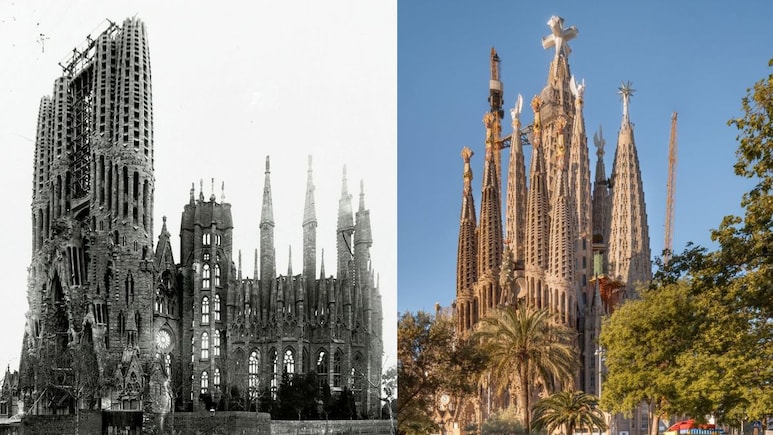
- Barcelona's Sagrada Familia Basilica was completed and inaugurated on June 10 after 144 years of construction
- The total construction cost is estimated between €600 million and €700 million
- The Temple attracted over 4.8 million visitors in 2025, generating €134.5 million income from private sources
Barcelona's Sagrada Familia Basilica is an architectural marvel of modern history. After 144 years and millions of dollars in expenditure, the church designed by Catalan architect Antoni Gaudi is finally complete and was inaugurated on June 10.
Pope Leo XIV officiated a solemn mass commemorating the 100th anniversary of Gaudi's death and blessed the tower of Jesus Christ. The tower was lit for the first time, and videos of the church illuminated in its glory are now viral on social media.
As the basilica is one of the most recognised religious landmarks in the world, here is a short history of why it remains a timeless icon, despite taking almost one and a half centuries to be constructed.
Sagrada Familia And Its Neo-Gothic Design
The Sagrada Familia is a Roman Catholic minor basilica in Barcelona, Spain, which originated as a project led by Josep Maria Bocabella, a book merchant and founder of the Spiritual Association of the Devotees of Saint Joseph, and his friend Father Josep Manyanet. They envisioned a church funded by donations offered in penance, honouring the namesake St Joseph and the Holy Family.
The construction of the basilica began in 1882 under architect Francisco de Paula del Villar, who initially envisioned a Neo-Gothic-style church. Interestingly, in the 19th century, Barcelona was undergoing reshaping, courtesy of the Industrial Revolution, which attracted workers, intellectuals, and artists.
144 Years Of Construction Of Barcelona's Sagrada Familia Basilica
Soon after the foundation stone was laid, disagreements between the architect and his patrons led De Villar to part ways with the project. In 1883, Gaudi took over the design and reimagined del Villar's vision. In 1885, the Chapel of Saint Joseph, located within the crypt, was inaugurated, and the Sagrada Família's first masses were held.
In 1891, work began on the Nativity Facade. From 1914 to 1926, Gaudi worked relentlessly and exclusively on the Temple. Before his disciple Domenec Sugranyes took over the project, Gaudi was able to finish the bell tower dedicated to the apostle Barnabas.
In 1936, the church building was embroiled in the Spanish Civil War. Not only was it vandalised, but the plaster models were destroyed, and plans and photographs were burnt.
In 1939, Francesc de Paula Quintana took over the management of the site and the construction continued because of the material that could be saved from Gaudi's workshops. The demolished parts were reconstructed from the published photographs and plans. In the next two decades, a staircase on the Nativity façade and a museum were constructed.
In 1986, the foundation of all naves, the columns, vaults, and facade on the main nave, transepts, crossing, and apse began. This chunk was completed in 2010. The Nativity facade and crypt were named a UNESCO World Heritage Site.
In 2018, the Cross was installed atop the pediment of the Passion facade. In 2020, the towers of Jesus Christ and the Virgin Mary passed the height of the towers on the Passion and Nativity facades.
But March 2020 brought the construction to a halt as COVID-19 hit and a lockdown was imposed. In October 2020, work resumed. In December 2021, the Sagrada Familia inaugurated the Tower of the Virgin Mary with a mass. In February 2026, the construction of the Tower of Jesus Christ culminated and reached its maximum height of 172.5 metres. And on June 10, the basilica was illuminated.
Financials Of Barcelona's Sagrada Familia Basilica
According to a report published in the Economic Times, the total cost of construction of Sagrada Familia, from 1882 to 2026, is estimated between euros 600 million and euros 700 million.
While millions of euros have been spent on the construction, the church also earns millions of euros every year. In its 2025 financial report, the basilica finished the year with an income of euros 134.5 million, all from private sources.
Of this, 51.7% was spent on the construction, and 31.8% was dedicated to the management of the Temple. For years, the church was never backed by state funding, but was funded through private donations and later through tourist revenue.
In 2025, the Temple witnessed a footfall of 4,877,567 visitors. In 2024, the number stood at 4,833,658. People from the US, China, Italy, France, South Korea, Britain, Germany, and the rest of the world continue to visit the epitome of this architectural marvel.
While the Sagrada Familia has reached its maximum height and the Tower of Jesus Christ is complete, there is still a lot of work that remains, including decorative elements and interiors. Reports suggest that final work might continue until 2035. The visible milestones have been achieved, but Barcelona's basilica remains unfinished.
Also Read | What 'Rs 370 Ki Biryani' Row Reveals About Modern Dating
Track Latest News Live on NDTV.com and get news updates from India and around the world
