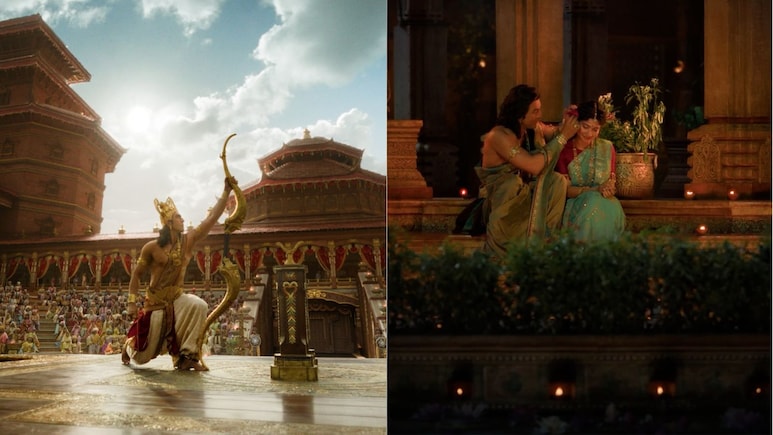
The wait is almost over. Nitesh Tiwari's magnum opus, Ramayana, is all set to hit theatres on November 5, just days before the auspicious occasion of Diwali. The Ranbir Kapoor-Sai Pallavi-Yash starrer, reportedly made on a staggering budget of over Rs 4,000 crore, took 10 years of aspiration to bring ancient India alive for audiences.
A post shared by the film's official handle read, "Ten years of Aspiration. Relentless Conviction to bring the Greatest Epic of all time to the World. An outcome through a collaboration of some of the world's best to ensure that Ramayana is presented with the greatest amount of Reverence and Respect. Welcome to the Beginning. Let's Celebrate the IMMORTAL story of Rama v/s Ravana. Our Truth. Our History."
Take a look:
As per a report by ETimes, Nitesh Tiwari and producer Namit Malhotra studied the Vashisht Yoga Shastras and consulted scholars and pandits to ensure the film accurately reflected Indian philosophical and cultural traditions.
Their research helped shape the story's themes, character development, and overall narrative, allowing the screenplay to connect with modern audiences while remaining rooted in traditional wisdom.
Speaking to host Suma, Nitesh Tiwari revealed why the project took so long to materialise.
He said as reported by The Indian Express, "The maximum time went into arriving at a structure, which we were convinced does justice to the base text, which is Valmiki's Ramayana, but also incorporates a lot of beautiful stories present in other versions of Ramayana. We have more than 300 Ramayanas and many small, beautiful stories that are part of the oral tradition, and every version of Ramayana is embraced by the people of the country."
He added, "Now, they all exist in absolute harmony. So many versions! Somewhere, certain characters are portrayed in a certain way, but we were looking at an optimum version which, in our opinion, does justice to the great story that we all have loved growing up with and allows us to create a cinematic spectacle that we can proudly present to the whole world."
"So, it was a very daunting and challenging task to arrive at something that worked on paper. After that came the real struggle of how to achieve it in the form we wanted on screen. That required intensive preparation and a lot of self-learning because developing the characters and assets takes a great deal of time," said the filmmaker.
Tiwari also spoke about the extensive work behind the film's visual effects, saying that the much-talked-about battle sequence between Ravana and Jatayu took around six and a half years to complete.
"Great VFX takes a lot of time. Just to give you a very basic idea, so that I can sum up in a precise manner how much effort has gone into it, I have read that the Ravana and Jatayu fight is looking absolutely stunning and that the Pushpak Vimaan looks out of this world. Do you know how much time it took us to finish the Ravana-Jatayu fight? From the time I briefed the visual artists to the time we finished the work on it, it was six and a half years."
Sharing more details about the film's development, Tiwari said the team spent nearly two years finalising the design of the Pushpak Vimaan. He added that the work continued even after the design was approved, as modifications to the aircraft's structure required the makers to redo parts of the Ravana-Jatayu battle sequence.
"It took us close to two years to arrive at the structure of the Pushpak Vimaan, but then a lot of things changed. That's why it took us such a long time to create the Ravana and Jatayu fight because, when we were working on the previous version, we had assumed the design of the Pushpak Vimaan would be something like that, and the fight was choreographed accordingly."
"Once we finalised the design of the Pushpak Vimaan, which was quite different from what we had already created, we had to go through several iterations to fit that design into the choreography. 'Now, Jatayu can't come from here, so what do we do because a dome-like structure has been created here?' You have to keep reworking things while pursuing the best possible output," he added.
"We created close to 40-50 designs of the Pushpak Vimaan before finalising this one because we did not want something that made people think, 'How can this fly?' We wanted some science behind it because we believe there was science behind everything that happened in that period. When you look at the Pushpak Vimaan, it feels believable. I can go into much more detail about what, in our opinion, makes it fly and move, and what exactly happens inside it. At least in our heads, we know how it works."
Speaking to Prakhar Gupta, producer Namit Malhotra revealed, "When we set out to make this six or seven years ago, people thought I was a lunatic because no Indian film comes close to this scale. Put simply, the budget will be around $500 million for both parts combined, which is over Rs 4,000 crore."
He added, "We're making the largest film in the world for the greatest epic, which deserves to be seen globally. Yet, I believe we're doing it more efficiently than some of the biggest Hollywood films. We're not being irresponsible; we're being ambitious, but grounded."
However, while creating a visual spectacle on an unprecedented scale, the makers said they were careful not to lose sight of the story's emotional core.
Speaking to the BBC, Namit Malhotra said, "Ramayana is ultimately about moral values, relationships and the emotions that come with them," while Tiwari added, "The biggest challenge was ensuring that those emotions were not overshadowed by the splendour of the world we were creating. However magnificent the world around the characters might be, the audience must remain emotionally connected to their journeys."
"From India, for the world," he told the BBC.
Also Read: Ramayana Producer Namit Malhotra Lost 90% Of His Wealth In 2008, Now Backs Rs 4,000 Crore Epic
Track Latest News Live on NDTV.com and get news updates from India and around the world
