





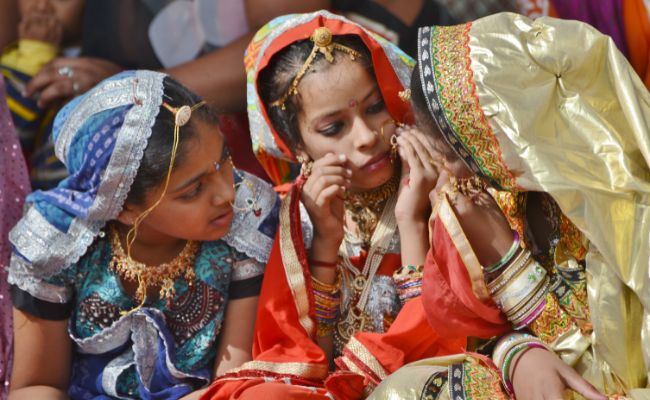
Child marriage is impending child rape. On International Women's Day, any conversation about the rights, dignity and future of women must begin by confronting this reality. Across the world, millions of girls are denied the chance to grow into women they would have dreamed of becoming because they are forced into marriage while still children. The future of a woman begins in childhood. The denial of childhood is the denial of equality. Child marriage alters the course of a girl's life long before she has the chance to discover her voice, build skills or claim independence. When a girl is forced into marriage, she is pulled out of school, thrust into pregnancy and burdened with responsibilities her body and mind are not ready to bear. What begins as a celebration is in fact a crime that leads to a lifetime of trauma, lost opportunity and violence that passes from one generation to the next.
A child cannot consent to sexual relations. The Supreme Court of India has made it clear that sexual intercourse by a man with his wife under 18 years of age constitutes rape, even within marriage. Calling this crime by its true name removes the veil of custom or tradition and compels institutions to act. When courts and enforcement agencies treat child marriage as sexual abuse, survivors gain access to rehabilitation, perpetrators face accountability and prevention becomes possible.
Why We Need To End Child Marriage With Urgency
A new report, “Accelerating Efforts to End Child Marriage”, by the Institute of Global Politics (IGP) Women's Initiative at Columbia University's School of International and Public Affairs (SIPA), lays out the harms and the interventions that work. It also emphasises that ending child marriage is core to economic development and a smart investment in long-term growth. During the launch of the report, Dr. Fatima Maada Bio, First Lady of Sierra Leone and recipient of Just Rights for Children's Champion for Change Award, called child marriage “legalised rape.” Dr Bio stressed that these girls are potential leaders. “They can change the world.
But we allow men to rape them freely and take away all their pride, their confidence and everything.” She added, “It doesn't matter how many times we go to court and get justice. Instead of looking for justice, why not just stop it?”
India's Progress Shows Ending Child Marriage Is Possible
Three years ago, when my book When Children Have Children: Tipping Point to End Child Marriage was released, United Nations Secretary-General António Guterres warned that eliminating child marriage globally could take 300 years.
Around the same time, projections suggested India might reach a prevalence rate of 10% only by 2050. Yet the last three years have shown that when governments, communities and institutions act together, change can accelerate faster than the world expects. As India ramps up efforts to end child marriage, it stands on the verge of ending one-third of the global problem. The prevalence of child marriage has declined from around 23% to below 15% and continues to fall.
Through the Government of India's Bal Vivah Mukt Bharat campaign, supported by Just Rights for Children partners, the country aims to reduce prevalence by another 10% by 2026 and end child marriage by 2030. Girls are staying in school and receiving scholarships to support their education until the age of 18. Vulnerable families are being identified and linked with welfare schemes so that economic distress does not push them to marry their children off. Frontline agencies and communities are on alert, reflecting a wider behaviour shift driven by a whole-of-government and whole-of-society approach to protect girls.
Working with law enforcement and local authorities, the Just Rights for Children network has stopped or prevented more than 500,000 child marriages across India. India's report card shows that change is possible. Ending child marriage is possible. But it is possible only when societies act together. Everyone has a role to play. Governments must create and update laws, policies and systems that protect children. Panchayats must uphold those laws in villages and communities. Child Marriage Prohibition Officers (CMPOs) must intervene before a child falls victim to this crime. Police and judicial officers must ensure accountability. Teachers must monitor attendance in schools. Faith leaders must stand firmly against child marriage. Parents must protect their children's dreams and ensure they receive education. Communities must refuse to normalise abuse.
The True Essence Of Justice Lies In Prevention
Justice delivered after a childhood has been destroyed is only a fraction of what is owed; the real test of a society lies in shutting the door on harm before it reaches our children. Every reported case, every arrest and every conviction sends a clear message that the law will act against those who harm children. Justice is not separate from prevention. In fact, justice lies in preventing crime. Without justice, rights remain words. With justice, rights become power. Access to justice determines what rights actually mean for women and girls. Laws that explicitly protect children, courts that treat child marriage as rape, survivor-centred services and protections that enable reporting without retraumatisation translate rights into safety.
The Future We Must Build
International Women's Day cannot be limited to celebration. It must be a moment when the movement for women's rights recognises that protecting childhood is central to achieving equality, and that ending child marriage sits at the heart of that struggle. Protecting girls from child marriage protects them from rape, safeguards their education and preserves their right to choose when and whom to marry.
When girls complete their education and enter the workforce, they build secure futures for themselves and contribute to the prosperity of their families, communities and ultimately the nation. Therefore, the most honest tribute to women on this day is to ensure that every girl has the freedom to choose and the freedom to consent.
The women of today do not need anyone to give them something. What they need is the assurance of the rule of law that their rights and their future will not be forcibly taken away from them. To truly honour a woman is to recognise her dignity, her rights and the respect that is due to her.
Track Latest News Live on NDTV.com and get news updates from India and around the world

