





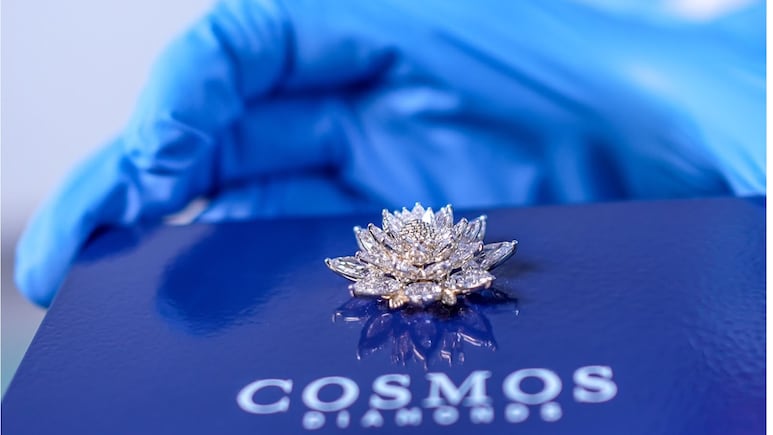
The lotus that has bloomed for centuries in India's culture, philosophy, imagination and even politics is now preparing for a far more extraordinary journey. If all goes to plan, a sparkling diamond lotus created by Bengaluru-based entrepreneur Sanjana T and her company Cosmos Diamonds will travel into space aboard Skyroot Aerospace's Vikram-1 rocket, giving India one of its most unusual payloads ever flown beyond Earth.
Called Cosmic Bloom, the artwork is no ordinary piece of jewellery. It is a carefully engineered lotus crafted from 32 lab-grown pear-cut diamonds with a total weight of 16.95 carats. The diamonds are mounted in gold and secured onto an aluminium plate designed to survive the intense conditions of a rocket launch. The artwork is valued at approximately Rs 10 lakh and represents an unusual fusion of art, technology, entrepreneurship and space exploration.
-

-
 NDTV World Summit 2026: Behind The Scenes As Ayush And Vedika Preview Two-Day Mega Event
 -
 Who Is Rajiv Mehta? Lilavati Hospital Trustee To Speak At NDTV World Summit 2026
 -
 Ex-CIA Director To Decode 'War In Times Of AI' At NDTV World Summit
 -
 From Call Centre To Billion-Dollar Disruptor: Nikhil Kamath At NDTV World Summit
 -
 'Every 5 Years, You'll See A New India': Swami Sarvapriyananda Ahead Of NDTV World Summit
 -
 AI Can Think, But Can It Be Conscious? Swami Sarvapriyananda Weighs In
 -
 Alain Ebobisse, Africa50 CEO, To Attend NDTV World Summit 2026. All About Him
 -
 Kriti Sanon At NDTV World Summit: A Look At Her Career And Business Ventures
 -
 Ex-CIA Director To Decode 'War In Times Of AI' At NDTV World Summit
 -
 Who Is Vikram Rai, CEO, South Asia GE Aerospace, Set To Attend The NDTV World Summit 2026
The choice of the lotus was deliberate.
For centuries, the flower has occupied a special place in Indian civilisation, appearing in temples, scriptures, art and mythology. Indian tradition often associates the flower with creation, purity and enlightenment. According to the creators of Cosmic Bloom, the lotus was chosen because it is among India's most enduring symbols and because some Indian creation stories describe the cosmos itself emerging from a lotus. In a poetic sense, a lotus that symbolises creation on Earth will now become part of humanity's exploration of the cosmos.
The journey of the diamond lotus began with a very personal story.
The idea behind Cosmos Diamonds was born in 2020 when founder Sanjana T was searching for jewellery for her own wedding. What she encountered left her frustrated. She notes that the pricing of diamonds varied dramatically from store to store, transparency was limited, and she became increasingly uncomfortable with the history and origins associated with some traditionally mined diamonds, often referred to as “blood diamonds”.
Coming from a family of entrepreneurs and with a background in research and design, she saw not just a problem, but an opportunity.
That experience led to the creation of one of India's early brands focused exclusively on lab-grown diamonds. The same desire for transparency, ethics and innovation that inspired the company is now taking one of its creations into orbit.
For Sanjana, the venture has always been about more than jewellery. It is about creating a brand that reflects individual expression, empowerment and transformation. The flight of Cosmic Bloom aboard Vikram-1 may become the most visible expression of that vision yet.
‘Test-Tube Babies'
Cosmos Diamonds argues that lab-grown diamonds are every bit as real as mined diamonds. According to the company, they are visually, physically and atomically identical to natural diamonds. The only difference lies in their origin. The company compares them to test-tube babies, saying that just as a child born through assisted reproduction is no less human, a cultivated diamond is no less real than one mined from the earth.
The diamonds used in Cosmic Bloom are classified as Type IIa diamonds, among the purest forms of diamonds available. According to the company, these represent only a small fraction of the world's diamonds and are produced using advanced crystal growth technologies. The mission, therefore, highlights not just jewellery craftsmanship but also advances in materials science and manufacturing.
The lotus will ride into space aboard Vikram-1, India's first privately developed orbital launch vehicle built by Hyderabad-based Skyroot Aerospace. The mission has been named ‘Mission Aagaman', symbolising the arrival of India's private sector into orbital spaceflight.
Skyroot Aerospace has already made history with the successful launch of the Vikram-S rocket in 2022. Its founders, former ISRO scientists Pawan Kumar Chandana and Naga Bharath Daka, have spent the last several years building Vikram-1 into a commercial orbital launch vehicle capable of carrying satellites and technology payloads into low Earth orbit.
Payloads
Vikram-1 is a four-stage rocket that uses solid propulsion in its first three stages and a liquid-propulsion upper stage for precise orbital insertion.
The rocket's maiden mission is expected to carry a mix of technology demonstrations, scientific payloads and symbolic artefacts. Among them, Cosmic Bloom stands out because it blends India's cultural identity with the ambitions of its emerging private space economy.
In many ways, the story mirrors the transformation taking place across India's space sector. Not long ago, launching anything into orbit was almost entirely the domain of national space agencies. Today, startups are creating rockets, robotic systems, miniature artworks and even diamond jewellery destined for space.
For Cosmos Diamonds, the mission is about proving that innovation can emerge from unexpected places.
For Skyroot Aerospace, it is another demonstration that India's private sector can dream big.
And for India, the sight of a diamond lotus travelling beyond Earth serves as a reminder that the country's future in space may be shaped as much by imagination and entrepreneurship as by science and engineering. If all goes well, Sanjana said, “A diamond lotus can sit in space, watching over the universe.”
Track Latest News Live on NDTV.com and get news updates from India and around the world

