





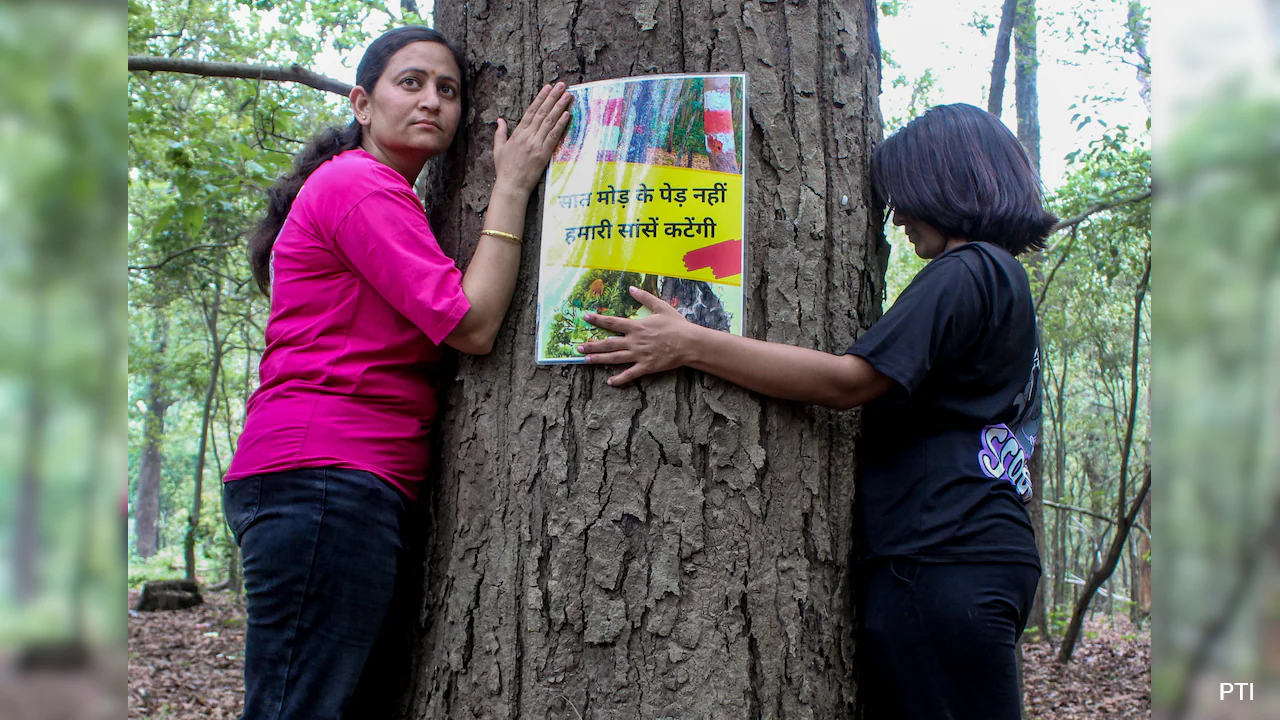
Uttarakhand Chief Minister Pushkar Singh Dhami on Saturday put a break on the proposed felling of around 3,000 trees for the Rishikesh-Bhaniyawala four-lane project, saying the exercise would remain suspended until "an atmosphere of trust and a satisfactory consensus among all parties is established." Dhami said that the government will move forward only after "dialogue, consensus and the larger public interest."
This came after days of protests by locals, including environmentlists, against the felling of more than 3,000 trees. To protect trees from being axed, people revived the 1970s 'Chipko Andolan' and wrapped their arms around the trunks, refusing to budge.
Development For Whom? The Local Grievance
For decades, the people of the hills have felt that while big infrastructure brings tourists and hotel businesses from outside, it is the locals left to bear the brunt. The proposed Dehradun-Rishikesh highway widening cuts directly through the sensitive Shivalik landscape to the crucial elephant corridor connecting the Rajaji National Park.
"I am a resident of Ghamuwala near Bhaniyawala," shared 17-year-old protester Devanash Sharma. "Amid soaring temperatures, we dread the road widening via our Shivalik forests because it will only bring us pollution of all categories."
Environmental activist Shilpi echoed this worry, questioning why nature must always be sacrificed. "Development should not come at the cost of our forests. Once old forests are destroyed, they cannot be recreated overnight," she stated.
The National Highways Authority of India (NHAI) defends the Rs 743 crore project, saying it is necessary to connect Dehradun, Jolly Grant Airport, and Rishikesh to ease traffic for the Char Dham Yatra. NHAI claims they have reduced the forest land needed by narrowing the road design from 60 metres to 23 metres. The Forest Research Institute (FRI) has also identified 754 trees that can be transplanted.
Why Is The Project Needed?
The existing two-lane road passing through the forest area currently handles around 18,456 vehicles every day, equivalent to nearly 15,088 Passenger Car Units (PCUs). These numbers are only expected to increase with growing tourism, rising passenger movement through Jolly Grant Airport, and the increasing number of Char Dham Yatra pilgrims, making the widening necessary.
The project was also proposed keeping in mind the need for better wildlife conservation. According to the Forest Department, 29 animals were killed in road accidents on the existing two-lane road under the Rishikesh and Barkot Forest Ranges in the last five years.
The Heavy Cost Of The Tourism Boom
Uttarakhand, beautifully known as 'Devbhoomi', is facing dangerous pressure from unregulated mass tourism.
Back in the year 2000, the state saw about 1.1 crore tourists. By 2025, that number crossed 6 crore, and it is expected to hit 6.7 crore by 2026. In 2018, the state government even gave the tourism sector "industry" status to boost hotel making and business.
While tourists are happy with better roads and hotels, experts are deeply worried because the daily crowds have crossed all safe limits.
According to an October 2025 study in the journal Scientific Reports, the absolute maximum number of daily visitors these holy places can safely handle are:
Badrinath: 15,778 people per day
Kedarnath: 13,111 people per day
Gangotri: 8,178 people per day
Yamunotri: 6,160 people per day
Even then, the study warns that these numbers are only safe if the government enforces strict waste management, limits vehicle access, and takes other green measures.
Ignored Warnings And Rising Disasters
The mountains are already cracking under pressure. The most shocking example is Joshimath, where unplanned construction, poor drainage, and heavy infrastructure projects caused the land to literally sink, damaging over 1,400 homes. A government panel called the Mishra Committee had warned about Joshimath's weak foundation 50 years ago, advising against blasting and digging on the hillsides.
Yet, warnings are repeatedly ignored. A 2010 and 2015 Comptroller and Auditor General (CAG) report criticised the government for allowing big projects without safety measures, and lacking a proper policy for using explosives in the fragile Himalayas.
According to the State Disaster Management Department, Uttarakhand saw a terrifying 2,900 per cent increase in landslides between 2015 and 2020. This destruction is also draining the state's wealth. A report by the Uttarakhand State Disaster Management Authority revealed that the state suffered a massive economic loss of Rs 15,103.52 crore in 2025 alone due to natural disasters.
The Deadly Side Effects Of Chopping Mountains
When we cut trees on steep 60-degree mountain slopes, we remove the natural roots that bind the soil together. An RTI response revealed that in Uttarakhand alone, nearly 83,000 trees some over 200 years old have been cut in the last five years for various projects.
The side effects of this deforestation are terrible:
- More Floods: Research shows every 1 per cent decrease in forest land can increase flood chances by up to 30 per cent.
- Water Crisis: The Himalayas are the "Water Tower of Asia." But rapid warming is melting glaciers fast. A 2023 report warned that Himalayan glaciers might lose 75 per cent of their ice by 2100.
- Loss of Natural Resources: In 2009, a tunnel boring machine for a power project accidentally punctured an underground water source near Joshimath. It leaked 60 to 70 million litres of fresh water daily-enough to sustain 3 million people-straight into the river, causing soil erosion and a permanent loss of a precious water reserve.
Is Cutting Trees The Only Way? Global Alternatives
Do we always have to cut trees to build roads? Engineers say tree-cutting is just the cheapest and fastest option, but better technology exists globally:
- Elevated Roads (Japan and Europe): Instead of cutting mountain slopes, highways are built on elevated pillars. The forest and soil remain untouched below.
- Green Bridges (Canada and Germany): Roads passing through forests have wide overpasses planted with trees so animals can cross safely without road designs destroying their habitat.
- Tree Relocation (Japan): Mature trees are carefully dug up and relocated. India has tried tree transplantation, but success is very poor. In Delhi's Satbari road-widening project, the Supreme Court panel noted the survival rate was "near zero".
Learning From Our Neighbour: The Bhutan Model
If we look at Bhutan, another Himalayan region, their approach to development is totally different.
Interestingly, Bhutan's population has grown a massive 47 times between 1950 and 2025, compared to Uttarakhand's population which grew only four to five times. Despite this huge population boom, Bhutan suffers far fewer disasters. While minor mudslides happen during the monsoon, major fatal incidents are rare such as a 2021 landslide that claimed 10 lives, and a 2023 disaster leaving 23 people missing. They have managed to grow their population without destroying their mountains.
Bhutan follows a "High Value, Low Volume" policy. They charge a Sustainable Development Fee (SDF) of roughly Rs 8,800 per night for international tourists (Rs 1,200 for Indians). By constitution, Bhutan must always keep 60 per cent of its land under forest cover. They strictly limit large-scale roads, dams, and resorts in fragile mountain zones, focusing purely on sustainable eco-tourism.
If Uttarakhand does not adopt a sustainable model soon, the short-term gains of tourism will cost us the very survival of our Devbhoomi.
Track Latest News Live on NDTV.com and get news updates from India and around the world

