





The Supreme Court on Wednesday extended the stay on its earlier verdict concerning the definition of the Aravalli Hills and directed that status quo be maintained until further orders.
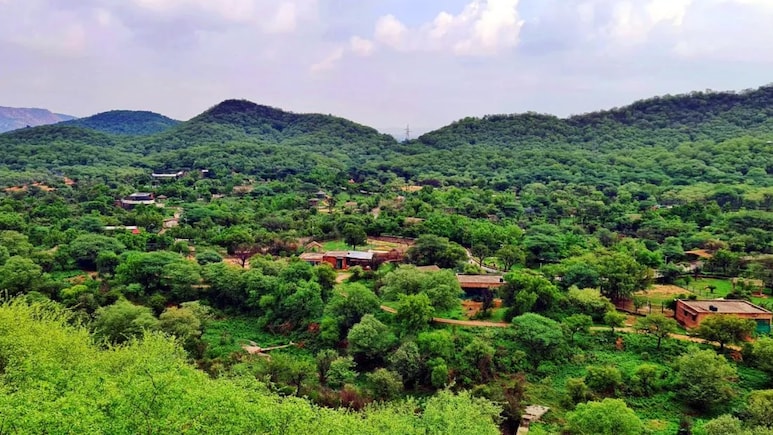
The Aravalli Range, one of the oldest mountain systems globally, is a critical natural barrier and life-sustaining ecosystem for the National Capital Region (NCR) and the Indo-Gangetic Plains of India. It faces increasing threats due to deforestation, mining, grazing, and human encroachment.
A three-judge Bench headed by Chief Justice of India (CJI) Surya Kant said that the interim direction - keeping in abeyance the earlier judgment prescribing a revised definition of the Aravalli Hills - would continue to operate.
Amid the outcry over the new definition of Aravallis, the top court on December 29 last year had kept in abeyance its November 20 directions that accepted a uniform definition of these hills and ranges, saying there is a need to resolve "critical ambiguities" including whether the 100-metre elevation and the 500-metre gap between hills criteria will strip significant portion of the range of environment protection.
The Bench directed Additional Solicitor General Aishwarya Bhati, appearing for Rajasthan, amicus curiae K Parameshwar, to suggest in four weeks the names of environmentalists and scientists who have expertise in mining so that an expert body can be constituted to look into the aspects.
The committee will work under the direction and supervision of this court, the bench said.
"We need experts from different walks of life so that a body can be constituted to look into and examine all the aspects," the top court said.
Taking note of submissions that illegal mining activities are continuing at scattered locations, the Supreme Court directed the Rajasthan government to ensure that no such unlawful extraction takes place in the Aravalli region.
It stressed that the law must take its own course against those indulging in illegal mining.
Additional Solicitor General KM Nataraj assured the top court that the state government would ensure that no illegal mining activities are carried out.
The Supreme Court further directed all parties to place on record a comprehensive note outlining the legal questions involved in the case.
The matter has been listed for further hearing after four weeks.
Track Latest News Live on NDTV.com and get news updates from India and around the world

