





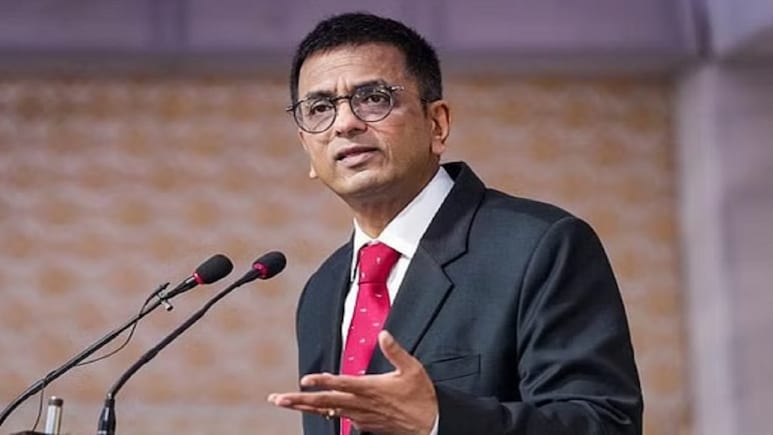
Calling it a sensitive and compassionate exercise of constitutional power, former chief justice of India DY Chandrachud praised the Supreme Court on Wednesday after it delivered its first-ever order allowing passive euthanasia for a 31-year-old who has been in a comatose state for over 12 years.
The top court permitted the withdrawal of artificial life support to Harish Rana noting that prospects of his recovery are negligible.
A student of Panjab University, Rana suffered head injuries after falling from the fourth floor of his paying guest accommodation in 2013 and has been in a coma since.
Passive euthanasia is the intentional act of letting a patient die by withholding or withdrawing life support or the treatment necessary to keep him alive.
"This decision by the Supreme Court is a sensitive and compassionate exercise of constitutional power to ensure complete justice. This decision advances the meaning of human dignity in accordance with constitutional values," DY Chandrachud, who was part of the Constitution Bench that issued landmark guidelines on passive euthanasia in 2018, told NDTV in an off camera but on record interview.
"This decision provides final relief to the family of the 31-year-old man who has been in a permanent vegetative state for decades. By affirming the earlier decision in Common Cause, the Supreme Court has demonstrated that this court is the court of the people of India," the ex-chief justice said.
In 2018, the Supreme Court recognised the right to die with dignity as a fundamental right and prescribed guidelines for terminally ill patients to enforce the right.
Rana's family, in their plea to the Supreme Court, had said that allowing withdrawal of artificial life support will restore his dignity after years of irreversible suffering.
The family pleaded that passive euthanasia and the withdrawal of life-support systems are legally permissible when medical experts certify that the patient has no chance of recovery.
According to the submissions, two medical boards constituted at the direction of the Supreme Court found Rana's condition to be irreversible and confirmed that he has remained in a permanent vegetative state for more than a decade.
The family told the court that their request was not motivated by a desire to cause death but by the belief that it was not in Rana's best interests to continue living in such a condition.
Rana, the top court noted, survived only through clinically administered nutrition via 'percutaneous endoscopic gastrostomy' tubes, and medical boards had unanimously concluded that continuation of treatment merely prolonged biological existence without any possibility of recovery.
The top court said among the manifold truths about human existence that this case reveals, the most enduring is the resilience of love.
"In our considered opinion, the greatest tragedy in life is not death, but abandonment. Despite the catastrophic tragedy that struck the applicant, his family never left his side. He has been cared for, protected, and cherished at every moment. To us, this unwavering vigil is a testament to the true meaning of love.
"To love someone is to care for them not just in times of joy, but in their saddest and darkest hours. It is to care for them even when the horizon is devoid of hope. It is to stand by them as they prepare to cross the threshold into the beyond. Ultimately, to love is nothing but to care deeply, softly, and endlessly," the bench said.
Observing that its decision does not neatly fit "within logic and reason" but between "love, loss, medicine and mercy", the bench said its order is not about choosing death, but is rather one of not artificially prolonging life.
"It is the decision to withdraw life sustaining treatment when that treatment no longer heals, restores, or meaningfully improves life. It is allowing nature to take its course when medicine can only delay the inevitable because survival is not always the same as living.
"To Harish's family, we want to acknowledge the deep emotional weight this decision carries. This decision can feel like an act of surrender, but we believe it is, in truth, an act of profound compassion and courage. You are not giving up on your son. You are allowing him to leave with dignity. It reflects the depth of your selfless love and devotion towards him," the bench said.
Track Latest News Live on NDTV.com and get news updates from India and around the world

