





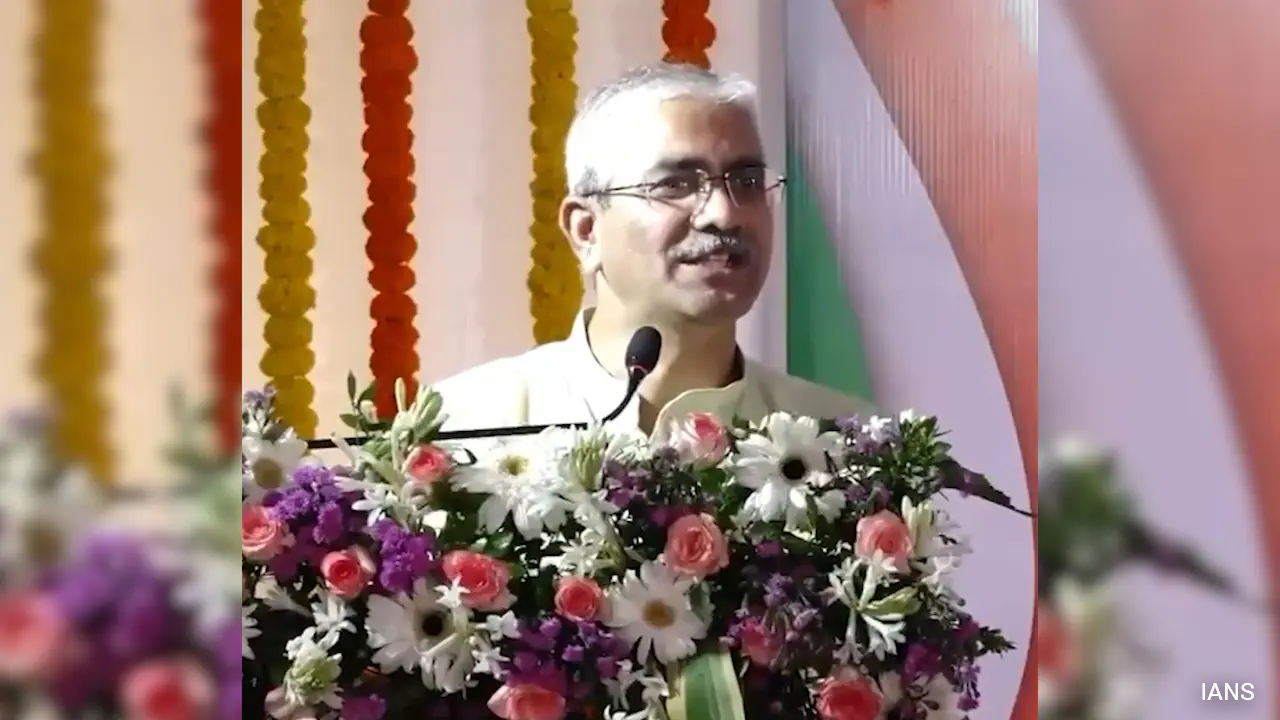
- RSS leader Atul Limaye urged youth to study the Cockroach Janta Party movement in depth and context
- He highlighted the role of diverse organizations supporting the protest at Jantar Mantar
- Limaye questioned the rise of leftist ideology and political influence in the student-led movement
Atul Limaye, the Joint General Secretary of the Rashtriya Swayamsevak Sangh (RSS), called upon the nation's youth to conduct an in-depth case study of the recent 'Cockroach Janta Party (CJP) movement' that forced the resignation of Dharmendra Pradhan as Union Education Minister.
He stated that the role of organisations working with a national perspective has become extremely crucial in the present times.
Addressing students at an Akhil Bharatiya Vidyarthi Parishad (ABVP), the student wing of the RSS, event held in Chhatrapati Sambhajinagar in Maharashtra, Atul Limaye spoke about the CJP protest held at Jantar Mantar.
He emphasised that instead of viewing any movement merely as an isolated, immediate event, the youth need to understand the entire process, methodology, support system, and ideological background behind it.
According to Atul Limaye, the emergence of the CJP-related movement highlighted just "how essential it is for organizations with a national perspective to have a presence among the youth".
He stressed that to understand this movement, one must objectively analyse the sequence of events, methodology, support systems, networks, innovative approaches, and the underlying ideology driving it.
Shedding light on the sequence of events, he noted that Abhijeet Dipke, the founder of CJP, had initially launched the initiative online.
It received good support during the first two or three days, he noted. Subsequently, Dipke arrived in India on June 6 and launched the movement on June 7, Limaye said.
Although he visited several cities across the country between June 7 and June 19, Limaye said, Dipke did not receive the expected level of public support.
Atul Limaye pointed out that the nature of the movement began to shift dramatically once the sit-in protest began at Delhi's Jantar Mantar on June 20.
How exactly did this transformation occur? Limaye asked.
The answer lies in examining the detailed list of entities and organizations associated with the movement, which reveals the layers of the support system operating behind the scenes, Limaye said.
"Since this was primarily a movement led by youth and students, several Left-wing student organisations-such as All India Students' Association (AISA) and Students' Federation of India (SFI)-became actively involved in it. Numerous organisations associated with human rights, tribal issues, women's rights, Muslim and Christian communities, farmers, labourers, environmental causes, journalism, and legal aid also participated - either directly or indirectly," Limaye said.
Who exactly brought together organisations from such diverse and distinct fields onto a single platform? Limaye said.
"Without understanding the operational dynamics of this network, it is impossible to grasp the movement's true objective," the RSS leader said.
According to Atul Limaye, a study of the speeches delivered from the movement's platform, the slogans raised, and the backgrounds of the participants reveals several unanswered questions that require analysis.
"Why anti-Hindu voices were heard from certain platforms. Why were individuals who raised-or supported-controversial and anti-national slogans present there? How did the influence of Leftist ideology suddenly increase within the movement? How did various political parties and their interests become intertwined with it? How did a purely student-led movement transform into a political one almost overnight? How was the coordination of similar activities and protests achieved across the country? How did the movement expand and garner support even abroad?" Limaye asked.
The RSS leader though did not provide proof of any anti-Hindu or anti-India slogans raised from the CJP platform.
According to him, Indian culture teaches one to view women with a sense of reverence akin to that for a mother, yet the language and behaviour witnessed during the movement were contrary to this.
He cited a statement by political analyst Yogendra Yadav, which asserted that "the democracy of the future will be determined not just by Parliament, but by the streets; not merely by elections, but by resistance."
Atul Limaye emphasised the importance of understanding the ideological mindset underlying this statement.
While a movement may originate from a genuine or local issue, it is crucial to analyse into whose hands the leadership and control eventually pass, Limaye underscored.
"Leftist ideology regards such movements as successful models of alternative politics. Under this mindset, the democratic system itself is challenged from within by utilising fundamental rights granted by democracy - such as freedom of expression and the right to stage sit-ins and protests," Limaye said.
He linked this to the concept of the "subversion of democracy through democratic means."
During his address, the RSS leader referred to Italian thinker Antonio Gramsci's theory of 'cultural hegemony.'
According to this concept, economic struggle alone is insufficient; instead, a society's cultural identity, traditions, and established beliefs are challenged. To achieve this, established symbols are questioned by employing theories such as 'deconstruction.'
This strategy typically involves certain defined stages.
The first step involves ideological infiltration into various educational and social institutions. The second is to undermine the credibility of established institutions and constitutional frameworks. The third entails waging a "narrative war" (a battle of ideas) by cultivating an alternative mindset through education, literature, media, cinema, and universities. Ultimately, the goal is to exert pressure on the government and society through mass movements.
Limaye expressed concern that the influence of such ideologies is not limited to politics alone but also corrupts social conduct.
While Indian culture teaches one to view women with reverence - akin to a mother figure - platforms associated with certain movements have witnessed the use of indecorous language and behaviour that stands in stark contrast to these values, Limaye said.
Recalling the historic final speech delivered by the architect of the Constitution, Dr Bhimrao Ambedkar, in the Constituent Assembly on November 25, 1949, Atul Limaye noted that Dr Ambedkar had emphasised the importance of adhering strictly to constitutional methods in independent India. Warning against unconstitutional or violent movements, Dr Ambedkar had famously termed them the "Grammar of Anarchy," Limaye stressed.
The RSS leader emphasised that if India is to become a developed and empowered nation, the immense energy of its youth must be channeled in the right and positive direction.
Instilling values of patriotism, service, social responsibility, and leadership in the youth is the need of the hour, he asserted.
"The most effective response to such movements is not merely opposition or criticism; rather, the solution lies in maintaining a continuous, positive dialogue with the youth, fostering a spirit of nationalism, and expanding the scope of nation-building activities," Limaye said.
CPI(M) MP V Sivadasan said India is aware of RSS' history, and accused the organisation of "serving colonial masters" during the national movement.
"We all know their history. They did not participate in our freedom struggle and stood against the national movement... they tried to divide the unity of the people during the time of the national movement. They served their colonial masters, stood against the interests of the Indian people. At Jantar Mantar, the students started the movement because of paper leaks. More than 20 students have died by suicide. The demand of the students is to invest more finance and more money into the education sector," CPI(M) MP V Sivadasan said.
Track Latest News Live on NDTV.com and get news updates from India and around the world

