





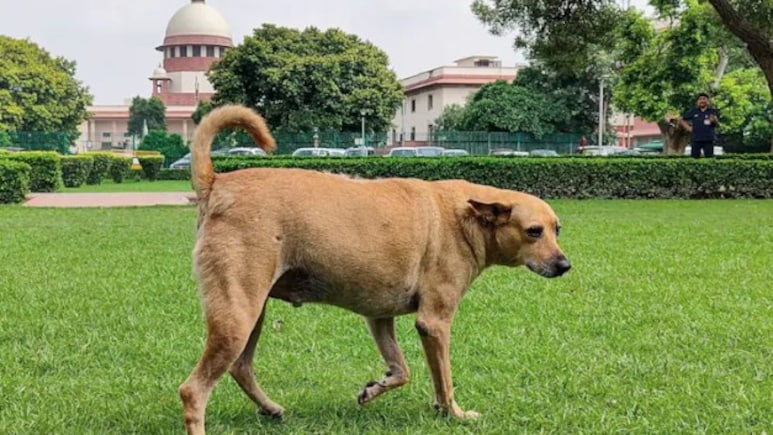
The Supreme Court on Tuesday heard a number of interlocutory applications in the stray dogs case, with a three-judge bench flagging safety concerns over the animals on highways. A bench of Justices Vikram Nath, Sandeep Mehta, and NV Anjaria said that no one can read the animal's mind when he is in a "mood to bite or not", adding that "prevention is better than cure".
"The roads have to be clear and clean of dogs. They might not bite, but they still cause accidents. Why do we need dogs on streets, schools, and institutional areas?" the bench said.
"We issued directions in 2018 to implement the ABC rules. What has happened till now?" the bench asked a counsel who was mentioning scientific reasons behind the rules. "Just because the government is not working properly implementing the ABC rules, should the common man be left to suffer?" the bench further said, and posted the matter for Thursday.
Senior advocate Kapil Sibal - who is representing the petitioners - told the top court that if there's a possible dog that is unruly and is likely to bite somebody, then people can call up a centre where the dog can be taken, sterilised, and released back in the area. To this, the court said, "The Only thing missing is providing counselling to the dogs so that they do not bite when released back."
"It's not only that the dog would bite and chase somebody, but an accident can occur. While they are running on the road, it is a problem. Roads where there are moving vehicles. It's just not biting," the court said.
Sibal replied: "But dogs are not on roads; they are on compounds."
The three-judge bench told him, "Your information seems to be outdated. Prevention is always better than a cure. The roads have to be clear and cleaned of dogs. They might not bite, but they still cause accidents."
What the Centre said
Solicitor General Tushar Mehta, during the hearing, said there should be a provision for the Residents Welfare Association (RWA) to decide whether dogs should be allowed in gated societies.
"While we're all animal lovers, we're also human lovers. One day, someone might want to bring in a buffalo to drink its milk. Should that be allowed? Others would be inconvenienced," he said.
Amid the rising dog bite incidents, the Supreme Court, on November 7, last year, ordered the removal of stray dogs from educational institutions, hospitals, bus stands, sports complexes, and railway stations, directing that the canines be sent to designated dog shelters. The bench, which is monitoring stray dog-bite incidents through a suo motu proceeding, directed the authorities to prevent the dogs from entering the premises of government and public institutions. It also said that they must not be released back to the same place where they were picked up.
The court had directed the local municipal authorities to carry out regular inspections of all premises to ensure no stray dog habitat exists. It had said recurrence of dog bite incidents within institutional areas, including sports complexes, reflected not only administrative indifference but also a "systemic failure" to secure these premises from preventable hazards.
Supreme Court's Delhi verdict
The top court, in July last year, had ruled that all stray dogs in Delhi and adjoining regions must be shifted away from residential localities to shelters, given the rising cases of dog bites leading to rabies deaths. According to the court, the dog shelters must have professionals who can tackle dogs, carry out sterilisation and immunisation, and not let the canines out. Terming the stray dog menace in the city as "extremely grim", the Supreme Court had warned that any individual or organisation blocking the picking up of stray dogs by authorities will face the "strictest action".
In another hearing, it had directed that the animals would be released back into the same area after sterilisation and immunisation. However, the three-judge bench of Justices Vikram Nath, Sandeep Mehta, and NV Anjaria had made it clear that the relocation would not apply to dogs infected with rabies or suspected to be infected with rabies and those displaying aggressive behaviour.
The court had also directed the municipal authorities to create a dedicated feeding space where people can feed stray dogs, adding that public feeding will not be allowed - and if violated, strict action would follow.
Track Latest News Live on NDTV.com and get news updates from India and around the world

