





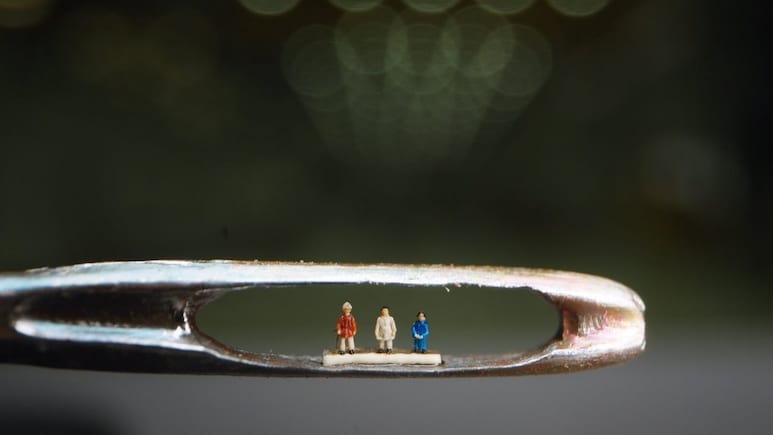
When Skyroot Aerospace's Vikram-1 rocket rises from Sriharikota on its maiden orbital mission on Saturday, it will carry more than satellites and technology demonstrations. Tucked inside the rocket will be three microscopic sculptures so small that they can fit inside the eye of a sewing needle. Yet they represent some of the biggest names in Indian science.
Created by internationally acclaimed micro artist Ajay Kumar Mattewada of Telangana's Warangal, the tiny sculptures portray Nobel laureate Dr C V Raman, Indian space pioneer Dr Vikram Sarabhai and former President Dr A P J Abdul Kalam. Each sculpture measures just 800 microns, or 0.8 millimetres, making them smaller than a grain of rice and invisible to the naked eye.
If the mission succeeds, Vikram-1 could become the first Indian rocket to carry micro art into space, creating a unique fusion of art, science and space exploration.
The symbolism is striking.
Raman helped unlock the secrets of light and won India's first Nobel Prize in science. Most bomb detection machines at airports use Raman spectroscopy to detect chemical signatures of explosives. Sarabhai laid the foundations of India's space programme and is regarded as the father of the nation's space effort. Kalam guided India's missile programme and played a key role in the making of India's atom bomb at Pokharan before becoming one of its most beloved presidents.
One could describe them as a detector of nature's mysteries, a maker of rockets, a messenger of peace and a bomb maker. Now, all three will travel together aboard a rocket built by India's newest generation of space entrepreneurs.
The artist behind the extraordinary creations, Mattewada, is a goldsmith's son who has spent decades mastering an art form practised by only a handful of people worldwide.
Born in Warangal in 1973, Ajay learnt jewellery making and miniature craftsmanship from his father at the age of fourteen. More than two decades ago, he became fascinated with micro sculpture and began developing his own techniques, tools and materials to work at scales that most people can scarcely imagine.
His work requires complete concentration. The slightest movement can destroy weeks or months of effort. At times he must hold his breath while working. He practises yoga and breathing exercises daily to steady his hands as he writes. According to Ajay, each micro-sculpture can take anywhere from one month to five months to complete.
Over the years his miniature creations have earned national and international acclaim. His works have been viewed and appreciated by several Indian prime ministers, including PV Narasimha Rao, Atal Bihari Vajpayee and Narendra Modi.
In fact, Ajay became widely known for creating remarkable micro artworks, including portraits so tiny that they could be displayed within the eye of a needle. Now he is taking that art form to an entirely new destination: outer space.
The current space project began in 2023 and was completed in February 2026.
Nearly 140 hours of painstaking work went into sculpting the three scientists. The sculptures were crafted using a combination of stainless steel, pure silver, 24-carat gold, ceramic powder and carbon fibre particles. Achieving recognisable facial details at a scale smaller than a millimetre demanded extraordinary patience and technical skill.
After completing the sculptures inside the eye of a sewing needle, Ajay mounted them inside a miniature rocket specially manufactured from 18-carat gold.
The miniature rocket and sculptures had to satisfy the stringent engineering requirements needed for a space mission. The artwork was built according to specifications provided by Skyroot Aerospace engineers and successfully underwent vibration, heating and environmental qualification testing before being cleared for launch.
The entire assembly was then integrated into a specially designed protective payload housing that will fly aboard Vikram-1.
For Ajay, this mission represents the culmination of a lifelong artistic journey.
"I consider this the highest honour bestowed upon the micro-sculpture art that I have pursued with unwavering dedication for the past 40 years. Knowing that my creations will become a part of the history of space exploration fills me with indescribable joy, pride, and satisfaction," he said.
He added that it is a matter of immense pride that miniature sculptures of Raman, Sarabhai and Kalam will travel into space together. "This mission is also a tribute to three generations of visionary scientific leadership that helped shape modern India."
The launch vehicle carrying these tiny artworks is itself an important milestone in India's space story.
Vikram-1 is Skyroot Aerospace's maiden orbital launch vehicle and the first privately developed Indian rocket designed to place satellites into orbit. The approximately 30-metre-tall vehicle uses three solid propulsion stages and a liquid fuel upper stage for precise orbital insertion.
The rocket incorporates advanced technologies, including carbon composite structures, miniaturised avionics, high-thrust motors, a 3D-printed engine and an orbital adjustment module capable of multiple restarts.
Named after Dr Vikram Sarabhai, Vikram-1 is intended to serve the rapidly growing small satellite market and represents a major step in India's emerging private space sector.
For Skyroot, the mission is about proving a new generation of Indian launch capability.
For Mattewada, it is about proving that art can travel wherever humanity goes.
In the history of space art, projects such as the Moon Museum and Fallen Astronaut gained international recognition for carrying artistic expression beyond Earth, says Mattewada. Now a tiny piece of Indian creativity, created inside the eye of a needle in Warangal, is preparing to join that distinguished list.
When Vikram-1 lifts off, it will carry not only technology and ambition but also a tribute to three scientific giants, crafted by an artist whose imagination works at a scale measured in microns and whose latest gallery happens to be space itself.
Track Latest News Live on NDTV.com and get news updates from India and around the world

