





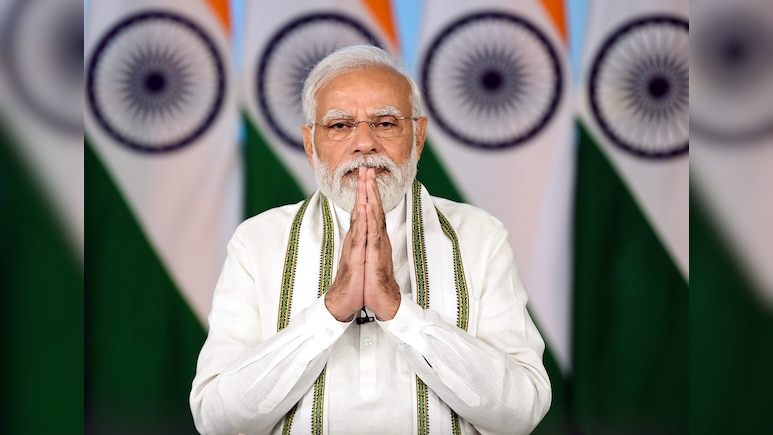
- Prime Minister will flag off India's first hydrogen-powered train between Jind and Sonipat on Friday
- The hydrogen train is designed and developed in India using zero-emission fuel cell technology
- PM Modi will launch development projects worth over Rs 14,700 crore in Jind and Rs 4,700 crore in Chandigarh
Prime Minister will flag off India's first hydrogen-powered train between Jind and Sonipat at Jind railway station on Friday.
With this, India would join a select group of countries that have operational hydrogen-powered trains.
The prime minister will lay the foundation stone and launch various development projects worth around Rs 14,700 crore at Eklavya Stadium, Jind. He will also address the gathering on the occasion.
On Friday, after his Jind visit, PM Modi will also travel to Chandigarh in the afternoon where he will lay the foundation stone and inaugurate various development projects worth over Rs 4,700 crore, an official statement said. He will also address the gathering on the occasion.
Later, he will visit Jalandhar in Punjab where he will lay the foundation stone and inaugurate multiple development projects worth over Rs 5,470 crore.
During his Haryana visit, the prime minister will flag off India's first hydrogen-powered train between Jind and Sonipat (89-km stretch), marking an important step towards the adoption of clean and sustainable mobility in the railway sector.
Designed, engineered and integrated in India, the train has been developed using indigenous technology, reflecting the country's growing capabilities in advanced railway engineering.
The train is powered by hydrogen fuel cell technology, which converts hydrogen into electricity to propel the train. The process produces only water vapour as a by-product, resulting in zero carbon emissions during operation.
Compared to diesel trains, they eliminate tailpipe emissions, lower dependence on fossil fuels and fossil fuel imports, and operate with significantly less noise.
Unlike conventional electric trains, they do not require continuous overhead electrification infrastructure, as electricity is generated onboard through hydrogen fuel cells, making them a clean and efficient solution.
The use of green hydrogen also reduces dependence on electricity generated from fossil fuel-based thermal power plants, supporting India's transition to sustainable transport.
India's hydrogen train features a 10-coach configuration, making it among the longest hydrogen-powered passenger trains developed so far. Its 3,200 HP propulsion system makes it one of the most powerful hydrogen-powered trainsets in operation.
At Jind, PM Modi will also launch National Highway projects worth over Rs 12,470 crores in Haryana.
The prime minister will launch the 157.92 km long four-lane, fully access-controlled Delhi-Amritsar-Katra Expressway (packages 1 to 5), developed at a cost of around Rs 9,680 crore. The Greenfield corridor forms part of the 667 km Delhi-Amritsar-Katra Expressway.
The expressway will reduce travel time between Delhi and Katra from about 14 hours to nearly 6 hours, while cutting the Delhi-Amritsar journey from about 8 hours to 4 hours, a statement said.
The project is expected to significantly decongest NH-44 (GT Road), boost pilgrim and tourist traffic to Shri Mata Vaishno Devi, and catalyse industrial and logistics development along the corridor.
The prime minister will also inaugurate the 33.81 km four-lane, partially access-controlled Ambala-Kala Amb Highway on NH-7 and NH-344. The highway will strengthen connectivity between the Ambala urban agglomeration and the Kala Amb industrial belt, improve road links between Haryana and Himachal Pradesh, facilitate tourist movement to the hill regions and reduce logistics costs for industries in the Kala Amb area.
The 40.60 km Jind-Gohana Greenfield Highway on NH-352A will also be opened. The new highway will reduce travel time between Jind and Gohana from about two hours to just 40 minutes, benefiting commuters, freight transport and the agriculturally significant Jind-Gohana region while improving connectivity to Rohtak, Panipat and Delhi-NCR.
PM Modi will also lay the foundation stone for the 24.27 km Hansi-Barwala Brownfield Highway Project, which will upgrade the existing carriageway to a 2/4-lane configuration with paved shoulders.
The prime minister will inaugurate the Elevated Railway Track at Kurukshetra, a major urban infrastructure project that will eliminate long-standing traffic congestion at railway crossings in the city. The project will ensure smoother vehicular movement, improve road safety and enhance the operational efficiency of both rail and road transport systems.
PM Modi will also dedicate major medical institutions to the nation -- Pandit Neki Ram Sharma Government Medical College, Bhiwani, Maharishi Chyawan Medical College and Rao Tula Ram Hospital, Koriawas, Narnaul.
These institutions will expand access to quality medical education in Haryana, increase the number of MBBS seats, improve the availability of specialist healthcare professionals and enable people to access better medical services closer to their homes.
The PM will also lay the foundation stone of a Sikh Museum at Kurukshetra that will showcase the history of Sikhism, the teachings of the Sikh Gurus, their courage, sacrifices and the invaluable contribution of the Sikh community to India's civilisation.
(Except for the headline, this story has not been edited by NDTV staff and is published from a syndicated feed.)
Track Latest News Live on NDTV.com and get news updates from India and around the world

