



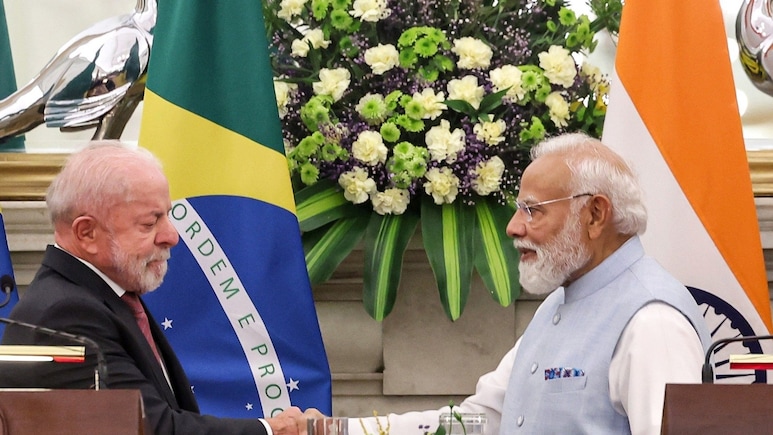
India and Brazil on Saturday unveiled a far-reaching vision to deepen their strategic partnership, placing digital transformation, economic integration, climate leadership and Global South cooperation at the heart of bilateral ties, following extensive talks between Prime Minister Narendra Modi and Brazilian President Luiz Inacio Lula da Silva in New Delhi.
The joint statement issued after President Lula's state visit to India reflects a decisive shift toward long-term, structured cooperation across strategic sectors, building on the momentum generated by Prime Minister Modi's state visit to Brazil in July 2025. The two leaders reaffirmed the Brazil-India Strategic Partnership established in 2006, describing it as a partnership "between two great nations with higher purposes" anchored in democratic values, economic inclusion, and shared leadership of the Global South.
Digital Partnership and Artificial Intelligence at the Core
A defining feature of the visit was the launch of the Joint Declaration on the Digital Partnership for the Future, positioning India and Brazil as leading voices for inclusive, people-centric digital transformation among developing nations. The leaders underlined the importance of Digital Public Infrastructure (DPI) as a foundational enabler of universal access to services, financial inclusion and innovation at population scale.
Artificial intelligence emerged as a central pillar of cooperation, particularly following President Lula's participation in the 2nd AI Impact Summit in New Delhi. Both sides committed to collaboration on AI strategies, large language models, data protection frameworks and ethical governance, aligning their efforts with existing UN and BRICS frameworks. The leaders stressed that AI must serve development goals, democratise innovation and avoid deepening global inequalities.
The two countries also expressed strong interest in integrating digital and climate transitions through initiatives such as the Open Planetary Intelligence Network (OPIN), linking technology with sustainability and climate action across the developing world.
Expanding Trade, Investment and MERCOSUR Engagement
Economically, the leaders welcomed a robust 25.5% increase in bilateral trade in 2025 and reaffirmed their shared objective of reaching USD 30 billion in trade by 2030. They directed officials to address non-tariff barriers, anti-dumping issues and regulatory challenges to boost business confidence.
A major strategic focus was the expansion of the India-MERCOSUR Preferential Trade Agreement, which both sides acknowledged no longer reflects the full potential of economic complementarities. The leaders welcomed the decision to deepen and expand the agreement, with expectations that it will significantly improve market access for agricultural, agro-industrial and industrial goods while stimulating investment flows.
The signing of a Memorandum of Understanding on the Mutual Recognition of Electronic Certificates of Origin was highlighted as a breakthrough in trade facilitation, enhancing transparency, predictability and efficiency for exporters and importers.
Health, Pharmaceuticals and Global Equity
Health cooperation featured prominently, with both leaders emphasising joint efforts to strengthen local and regional production of medicines, vaccines and strategic health inputs. The partnership aims to improve equitable access to affordable, quality healthcare across the Global South.
The signing of an MoU between Brazil's ANVISA and India's CDSCO is expected to accelerate regulatory approvals and foster deeper pharmaceutical collaboration, including co-development and technology transfer for treatments targeting rare, oncological and socially determined diseases.
India and Brazil reiterated their strong support for the World Health Organization and universal health coverage, underscoring the importance of sustainable financing and multilateral coordination in global health governance.
Defence, Security and Counter-Terrorism Cooperation
Defence and security were reaffirmed as integral pillars of the strategic partnership. The leaders welcomed growing defence-industrial cooperation, including co-design and co-production initiatives linking India's Atmanirbhar Bharat programme with Brazil's defence industrial base.
Both sides strongly condemned terrorism in all its forms and reaffirmed their commitment to combating cross-border terrorism, terror financing and online radicalisation. Brazil unequivocally condemned the terrorist attacks in Pahalgam and New Delhi in 2025, signalling strong solidarity with India.
Cybersecurity, maritime cooperation, space collaboration and peacekeeping operations were identified as priority areas for enhanced strategic engagement.
Climate Leadership, Energy Transition and Critical Minerals
Climate action and energy transition formed another cornerstone of the Joint Statement. Prime Minister Modi commended President Lula's leadership in hosting COP30 in Belem and welcomed Brazil's launch of the Tropical Forests Forever Facility, aimed at mobilising long-term financing for forest conservation.
Both leaders committed to accelerating the deployment of sustainable fuels, renewable energy, green hydrogen and clean technologies. The signing of an MoU on cooperation in rare earth elements and critical minerals was described as strategically significant, given their importance for clean energy technologies and resilient supply chains.
India and Brazil also agreed to intensify collaboration in steel, oil and gas, and carbon capture technologies, while promoting sustainable and responsible industrial practices.
Strengthening the Global South and Multilateral Reform
On global governance, the leaders reiterated the urgent need for comprehensive reform of the United Nations, particularly the Security Council, and reaffirmed mutual support for each other's permanent membership in an expanded UNSC. They emphasised revitalised multilateralism, diplomacy and peaceful dispute resolution as essential to addressing 21st-century challenges.
India welcomed Brazil's support for its candidature for a non-permanent UNSC seat for 2028-29, while both sides pledged to coordinate closely within BRICS, IBSA, the G20 and other multilateral forums.
Deepening People-to-People Ties
Cultural, educational and people-to-people exchanges were identified as vital drivers of long-term partnership. The leaders welcomed measures to enhance mobility, including the extension of multiple-entry tourist and business visas from five to ten years.
Cooperation in education, sports, cinema, tourism, yoga and traditional medicine is expected to further deepen societal ties, while agreements on archival cooperation and intellectual property protection underscore a shared commitment to preserving cultural heritage.
A Strategic Partnership for the Next Decade
The joint statement reflects a comprehensive and future-oriented partnership that goes beyond bilateral interests to address global challenges. By aligning digital innovation with sustainability, economic growth with social inclusion, and national priorities with Global South leadership, India and Brazil have positioned their relationship as a model for South-South cooperation in an increasingly fragmented world.
As President Lula concluded his fifth visit to India, both leaders expressed confidence that the strategic roadmap agreed upon will guide the partnership over the next decade, reinforcing their shared vision of a more inclusive, resilient and equitable global order.
Track Latest News Live on NDTV.com and get news updates from India and around the world

