





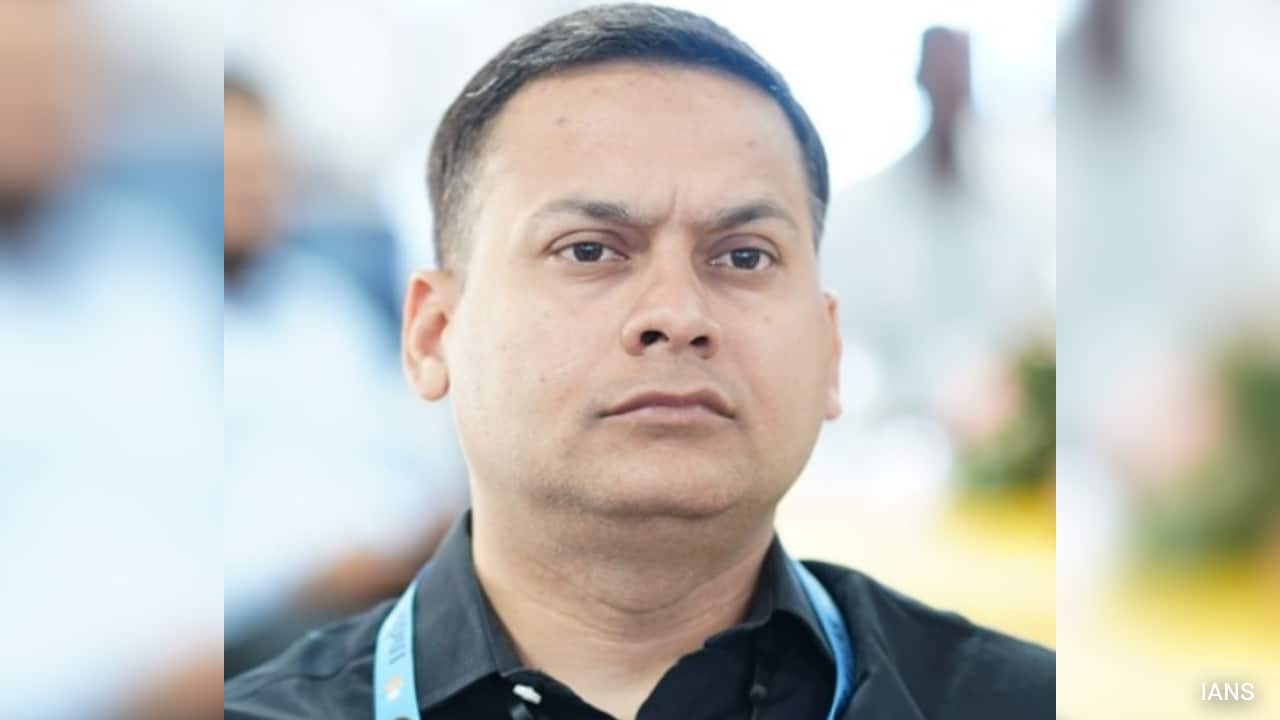
Amit Malviya, the head of the BJP IT and social media department since 2015, finds himself out of the spotlight. As party chief Nitin Nabin unveiled his national organisational team on Monday, Amit Malviya was replaced by Deepak Mhaskey from Chhattisgarh.
There is much speculation regarding the reasons behind his removal.
This move is also being linked to the 'Gen Z' movement and the stiff competition the BJP is facing from the Congress and other opposition parties on social media platforms.
However, BJP sources have denied these claims.
The sources said attributing this change solely to events of the last few months amounts to a superficial analysis that is incorrect.
He has not only been in charge of social media and the IT cell for 11 years, but has also served as the co-in-charge for West Bengal, the party said.
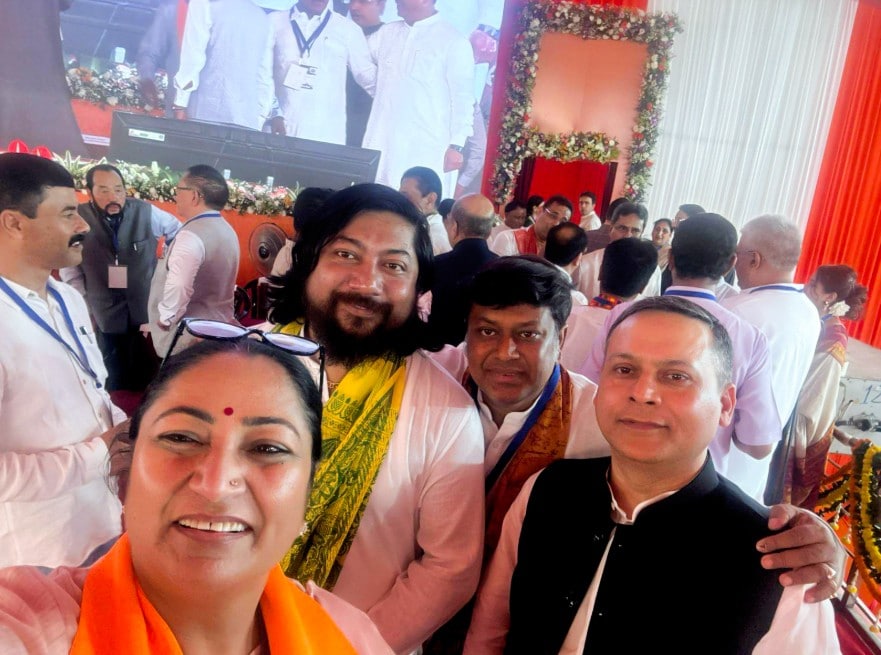
Delhi Chief Minister Rekha Gupta takes a group selfie with West Bengal Minister Nisith Pramanik, Union MoS Sukanta Majumdar and BJP member Amit Malviya during the swearing-in ceremony of the new West Bengal government
Photo Credit: ANI
According to sources, Amit Malviya had himself expressed a desire on several occasions to be relieved of this responsibility. He had discussed the matter with the top leadership following the 2019 and 2024 Lok Sabha election results.
Even after Nitin Nabin became the president, Malviya had discussed his future role. Sources said he even held extensive discussions with the party leadership regarding potential successors. Sources state that several of the names considered for the role were suggested by Malviya himself.
There are various political reasons why Amit Malviya could not be accommodated in another role within Nitin Nabin's team.
Caste and regional equations also played a part.
Malviya comes from Uttar Pradesh, a key Hindi heartland state which will go to polls next year. Smriti Irani and Harish Dwivedi were appointed as General Secretaries in the organisational revamp, while Rekha Verma and Tariq Mansoor were named Vice Presidents. Amarpal Maurya heads the Backward Classes Morcha, and Kunwar Basit Ali leads the Minority Morcha. Shivprakash, the Joint General Secretary (Organization), also hails from Uttar Pradesh. The BJP appointed Harish Dwivedi, who had previously worked with Nitin Nabin in the Yuva Morcha, as General Secretary to ensure representation for the Brahmin community.
Sources say it was not feasible to accommodate Amit Malviya, who is also a Brahmin, in the role of General Secretary. He is not senior enough in age to be appointed as a national vice-president or entrusted with the responsibilities of a secretary, they added.
However, according to sources, his future role has not yet been decided.
Within the party, his performance as the co-in-charge of West Bengal over the past six years is considered highly commendable. The BJP came to power in the state for the first time this year, beating Mamata Banerjee's Trinamool Congress. Sources say, Malviya worked effectively right down to the grassroots level.
According to BJP leaders, the last decade - during which Amit Malviya has headed the IT and social media cell - has seen many ups and downs. Opponents accuse him of orchestrating systematic social media attacks against leaders of rival parties. Conversely, BJP leaders maintain that as the IT cell chief, it was Malviya's responsibility not only to prominently project the party and government's narrative but also to blunt attacks from the opposition - a task he performed admirably, they say.
The data bears this out.
Narendra Modi was the first to establish a strong social media presence while serving as the Chief Minister of Gujarat. In the 2009 Lok Sabha elections, the BJP's prime ministerial candidate, LK Advani, also launched a campaign on social media. In this regard, the BJP enjoyed a 'first-mover advantage' in the social media space.
The BJP gained an early lead during the nascent digital era of 2013.
At that time, the party had between 200,000 and 300,000 followers on X (formerly Twitter); today, that figure has reached 23 million. In contrast, the Congress was a late entrant to social media. In 2013, it had between 50,000 and 100,000 followers - a number that stands at 11 million today, roughly half of the BJP's count.
Similarly, on Facebook, the BJP had between 1.5 million and 2 million followers in 2013, a figure that has now risen to approximately 16 million. Meanwhile, the Congress had between 300,000 and 500,000 followers on Facebook in 2013, compared to about 6.7 million today. In 2013, the BJP's official YouTube channel had only 20,000 to 30,000 subscribers; today, that figure has risen to approximately 6.3 million, whereas the Congress channel has 4.8 million.
Prime Minister Narendra Modi currently has over 100 million followers, while Rahul Gandhi has around 27 million. It is important to note here that digital platform tracking was not very effective in 2013, so the figures provided are estimates.
The BJP has also begun strengthening its presence on Instagram.
The party's new social media team now faces the challenge of winning over Gen Z and finding better ways to engage with them.
Track Latest News Live on NDTV.com and get news updates from India and around the world

