





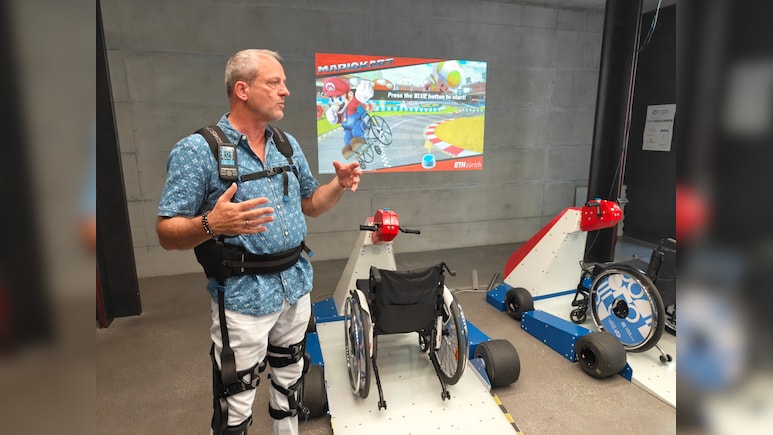
At the Federal Institute of Technology (ETH) in Zurich, Switzerland, a quiet revolution is in progress. It is not about replacing humans with machines, but about helping people regain their dignity, mobility, and independence. At the heart of this effort is Professor Robert Riener, a leading expert in rehabilitation robotics, who is using Artificial Intelligence and machine learning to assist people with injuries and disabilities. ETH is also the place where Albert Einstein did his early education.
What NDTV witnessed in Zurich was not science fiction. It was science in action, quietly transforming lives.
In a laboratory at ETH, Professor Riener demonstrated what he called the Mayo suit. At first glance, it looks like a futuristic outfit, almost like protective gear. But its purpose is far more profound. It is designed to help people with muscle weakness or paralysis stand, walk, and even climb stairs.
The way the suit works is deceptively simple in concept, but complex in design. It uses motors and tendon like elastic cables placed strategically along the body, especially around the hips and knees.
These act like artificial muscles, providing support to movements that the human body struggles to perform.
"From each motor there are tendons going behind the hip and in front of the knee joint. When switched on, it becomes quite strong, helps one stand and walk," Professor Riener explained.
The impact of this technology becomes evident when the challenges faced by people with severe muscle weakness is considered.
A person who might otherwise walk only 100 to 200 meters before becoming exhausted can suddenly go much further. Professor Riener said, "With this device, the person can walk some kilometres and take a walk or hike".
Even more striking is the possibility of taking these assisted movements into real world settings. Not just flat roads, but challenging terrain. "A hike with this suit? Even in the Swiss mountains," he said, almost as a matter of fact.
But what truly makes this technology powerful is not just the mechanical support. It is the intelligence behind it. Artificial Intelligence and machine learning play a crucial role in making these devices responsive and adaptive.
"We use a lot of machine learning," Professor Riener said. "Our codes are able to distinguish if the leg is now touching the ground or swinging. Depending on that, the device supports accordingly."
This ability to understand the phases of walking is critical. Human movement is dynamic, constantly adjusting to balance, terrain, and intent. Machine learning allows the exo-suit to sense these changes and respond in real time, making the assisted movement feel more natural.
The technology is evolving further with the integration of deep learning and even brain computer interfaces. "These technologies are now getting better and better thanks to better machine learning algorithms," he said.
This opens up the possibility that in the future, devices may not just respond to physical movement, but also to signals from the brain, allowing even more intuitive control.
Yet, despite all this technological sophistication, Professor Riener is clear that the goal is not to create cyborgs or replace human identity.
Asked if he had become a computer assisted human being as he was wearing the special suit, he smiled. "Yes. But the emphasis lies still on the human being. I am not a cyborg or a robot. It is technology which is supporting the human to be even more being a human."
In his book "AI to Eye" Professor Riener argues that Artificial Intelligence has the potential to make the world more inclusive, but only if it is designed with people at its center.
To reinforce some of these ideas of openness and transparency in AI, a field which today is dominated by private companies, Switzerland is gearing up to organise the "Geneva AI Summit' in 2027, where "AI for good" will be the focus, asserts Ms Nina Frey, Senior Advisor AI, Federal Department of Foreign Affairs, Switzerland. It will be a follow up of the highly successful "India AI Impact Summit 2026" held in New Delhi earlier this year.
AI is already helping improve everyday life. Tools like speech recognition can make content accessible to those who are deaf. Text systems can simplify complex information, so that more people can understand it. In medicine and rehabilitation, AI can monitor health conditions and detect problems early, improving outcomes for patients.
Combined with robotics and exoskeletons, AI can enhance mobility and independence for people with disabilities. It can allow them to move more freely, interact with others on equal terms, and participate more fully in society.
But AI is not without risk. Professor Riener cautioned that the technology reflects the data it is trained on. If that data is biased, the outcomes can be biased as well. Many systems today are built on data that does not adequately represent people with disabilities, leading to errors and even discrimination.
He also warned that AI systems can reinforce stereotypes, especially when generating images or describing people with disabilities. These representations can influence how society views disability, often reducing it to a limitation rather than recognizing it as part of human diversity.
So what is the solution? "It is obvious, but challenging," he said, "AI must be developed in an inclusive way."
That means involving people with disabilities not just as users, but as developers, designers, and decision makers. It also means ensuring that data is diverse, that algorithms are transparent, and that fairness is a guiding principle.
The work at ETH Zurich reflects this approach. The exoskeletons are not designed in isolation. They are tested, refined, and improved with the involvement of those who use them. Events like the global competition organised by Professor Riener bring together engineers and people with disabilities to showcase and improve these technologies.
The aim is simple. To move from the laboratory to real life. To create devices that are not just impressive, but practical, affordable, and widely usable.
Moreover, as these devices become more advanced, they may not only help those with disabilities, but also enhance the abilities of healthy individuals. Endurance could improve. Physical effort could be reduced. New possibilities of human performance could emerge.
But through all of this, one principle remains clear in Professor Riener's work. Technology should serve humanity. It should not define it. Artificial intelligence can help humans overcome limitations. But they do not replace the essence of being human. "It is technology which is supporting the human to be even more being a human," Professor Riener said. And that is where the true promise of AI lies. Not in creating machines that replace us, but in building tools that help us live fuller, freer, and more inclusive lives.
(NDTV was invited to visit ETH by Presence Switzerland, Federal Department of Foreign Affairs, Switzerland)
Track Latest News Live on NDTV.com and get news updates from India and around the world

