





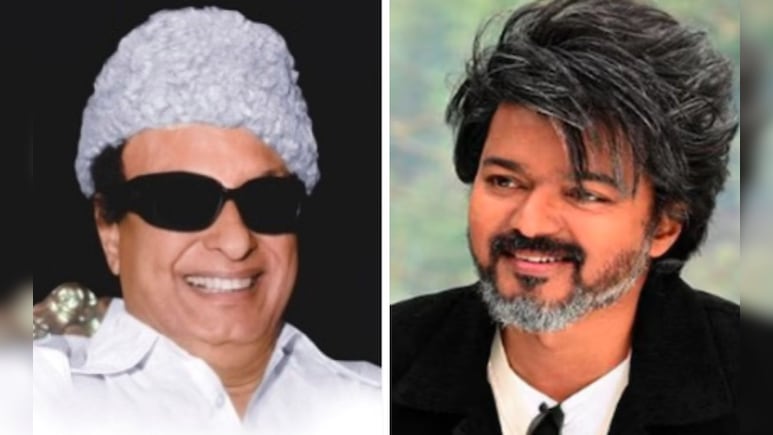
As Tamil Nadu gears up for the 2026 assembly elections, the highly charged atmosphere in the state is marked more by quiet mobilisation and narrative positioning than by loud campaign rhetoric - for now.
With movie star Vijay and his Tamilaga Vetri Kazhagam adding a new layer to the political conversation, the electoral arithmetic is more about the long-term disruption he could cause in the Dravidian-dominated landscape. Tamil Nadu is perhaps the only state in India where the journey from the silver screen to the Secretariat has been so seamless, so frequent, and so politically decisive. Here, cinema has never been a mere source of entertainment; it has functioned as a powerful instrument of political communication, mass mobilisation, and leadership-building.
Looking back at the long legacy of films and film stars in Tamil politics, the state's political history reflects a deep and enduring influence of cinema. For nearly a century, films and film stars have shaped political thought, public opinion, and electoral outcomes in the state. Unlike elsewhere, cinema in Tamil Nadu has not merely mirrored society; it has actively participated in the making of strong political leaders and movements.
Tamil Nadu and the Dravidian Movement
The roots of this cinema-politics relationship go back to the early decades of the 20th Century, when the Dravidian movement began challenging caste hierarchies, social inequality, and the north Indian cultural dominance.
Movement leaders realised that reaching the masses required more than political speeches or pamphlets and that popular culture was key. While this movement began with theatre, it was cinema that became the most effective medium to propagate political ideas.
One of the first leaders to recognise cinema's potential was CN Annadurai, founder of the Dravida Munnetra Kazhagam or DMK. A powerful orator and writer, Annadurai used Tamil films, by writing screenplays and dialogues with a strong political messaging, to communicate Dravidian ideals such as rationalism, self-respect, and social justice.
It was, however, M Karunanidhi who effectively combined politics, literature, and cinema with rare skill and created a cultural movement with his ideological films. Case in point - Parasakthi (1952) which speaks about the Dravidian ideology and equality, oppression, and power.
The rise of MGR and Jayalalithaa
It was with cinema icon MG Ramachandran, or MGR, that the link between film stars and politics was firmly established. He was a matinee idol whose on-screen image directly translated into political authority. The characters he played were often portrayed as honest, compassionate, and fearless defenders of the poor. Slowly, Tamil audiences started to believe that the hero they admired on screen would act the same way in real life.
MGR didn't jump directly from cinema into politics - he was a member of the Indian National Congress till 1953 before he joined the DMK. In 1962, he became a member of the Madras State Legislative Council and the rest is history.
He founded the All India Anna Dravida Munnetra Kazhagam (AIADMK) and went on to become the Chief Minister of Tamil Nadu -- thanks to the foundation cinema had laid for him.
His popularity cut across class and region, and his films had created a deep emotional bond with voters. It was his success which permanently changed Tamil Nadu politics, proving that cinematic appeal could be converted into electoral power.
Following MGR, J Jayalalithaa emerged as another towering figure who moved from cinema to politics. Having acted alongside MGR in numerous films, Jayalalithaa entered public life with strong visibility and recognition. From the beginning, she stood out as an actress of authority, intelligence, and emotional restraint. In most of her films, Jayalalithaa played strong-willed, educated, and self-respecting women, and over time, she built a powerful political identity of her own, marked by authority, symbolism, and a commanding public presence. Despite facing significant challenges, including gender bias, she went on to become one of the most influential Chief Ministers in the state's history.
The era of success and failure
The political landscape began to evolve after the Jayalalithaa era. There were numerous other Tamil actors like Sivaji Ganesan, Vijayakanth, R Sarath Kumar, Kamal Haasan, Napolean, Khushbu and Gauthami, who also forayed into politics. Acting legend Sivaji Ganesan was always politically inclined but he never never cultivated a political screen persona aligned with social reform or populism like MGR.
In a surprising move, in 1988 he launched his own party, the Tamilaga Munnetra Munnani (TMM) at a time when Tamil Nadu politics was polarised between the DMK and the AIADMK. Sadly, his political foray was short-lived as in the 1989 Assembly elections, TMM failed to win a single seat and the actor withdrew from politics.
Vijayakanth, who founded the Desiya Murpokku Dravida Kazhagam (DMDK) in 2005, is perhaps the only actor since Jayalalithaa who achieved notable electoral success and served as Leader of the Opposition in the Tamil Nadu Assembly. The DMDK emerged as a serious third force in a political landscape and after Vijayakanth's death, the party is led by Premalatha Vijayakanth and continues to be an alliance player.
In contrast, R Sarathkumar who founded the All India Samathuva Makkal Katchi (AISMK) in 2007 and served as an MLA and MP and aligned with major Dravidian parties, chose to merge with the BJP in 2024. The party failed to build a strong cadre base or secure consistent electoral wins over the years and its continuous struggle to survive in the Tamil Nadu political landscape, proved that celebrity alone is not enough for a party's success.
Cut to Rajinikanth whose political entry was one of the most anticipated - and ultimately unfulfilled - chapter in Tamil Nadu politics.
In December 2017, Rajinikanth formally announced his decision to enter politics and in 2020, he announced the launch of his political party, the Rajini Makkal Mandram. But in December 2020, ahead of the 2021 TN Assembly elections, the Superstar announced that he had reversed his decision, citing health concerns.
But his brief political ambition, unsettled political calculations, raised expectations of a new alternative, and demonstrated the limits of star power in contemporary politics in the state. It showed that in modern Tamil Nadu, charisma without organisation and ideology is no longer enough to translate stardom into state power.
In 2018, the other big star of Tamil cinema - Kamal Haasan - also announced his political debut and launched his party, Makkal Needhi Maiam (MNM). MNM contested the 2019 Lok Sabha elections and the 2021 TN Assembly elections but failed to win a single seat. He subsequently aligned with the DMK for better political prospects for himself and his party. But the Ulaganayagan's political journey didn't take the traditional actor-politician model - he didn't try to convert cinematic heroism into political saviourhood. Instead, he tried to create a party centred on governance rather than charisma and he didn't achieve much success. His political journey clearly shows that cinema alone no longer guarantees power in Tamil Nadu.
Going back to the DMK and Kalaignar Karunanidhi, while it is well-known that he wrote screenplays for films, very few know that his son, MK Stalin, dabbled in acting with films like Makkal Aanai Ittal and Ore Ratham. However, MK Stalin's focus remained on politics and he became the heir to DMK's political throne as we know today.
But MK Stalin's son, Udhayanidhi, chose a slightly different route to enter politics. His cinema journey began as a producer under Red Giant Movies, till he made his acting debut with Oru Kal Oru Kannadi in 2012. He tried to establish himself and increase his popularity among the public through cinema and his movie career became a stepping stone to his political debut in 2019.
Meanwhile, several actresses like Khushbu Sundar and Gauthami also became members of political parties holding party positions and actively campaigning. But Jayalalithaa continues to remain the sole example of an actress who not only entered TN politics but reshaped the state's political history.
Thalapathy Vijay's Political Debut
Today, all eyes are on Thalapathy Vijay, his party TVK and the 2026 Tamil Nadu Assembly elections. His last film, Jana Nayagan (People's Leader), is all set to release this week and the Tamil audience as well as his political opponents are waiting to catch the political messaging on screen.
Vijay's films increasingly reflect concerns around governance, corruption, education, and social responsibility.
The actor has a massive following and his transition into politics has been marked by careful messaging and strong engagement with younger audiences, showing how cinema continues to shape political imagination.
His stardom and large fan following have the potential to disrupt Tamil Nadu's entrenched DMK-AIADMK binary by mobilis ing young and first-time voters, most of whom are his fans. But the big question is - like in the case of MGR and Jayalalithaa, can Vijay's mass cinematic appeal be converted into durable political power and ring in a new era in the politics of Tamil Nadu? We'll have to wait and watch.
Track Latest News Live on NDTV.com and get news updates from India and around the world

