





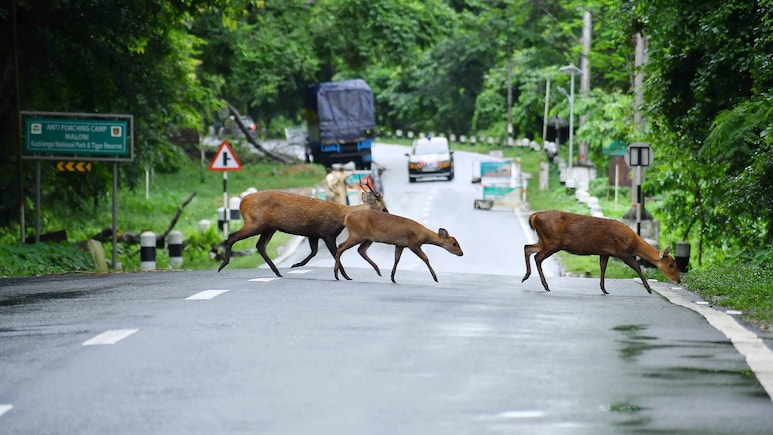
The debate over the Eco-Sensitive Zone (ESZ) around Kaziranga National Park has reached the villages outside the park, with some residents backing the Assam government's proposal for a site-specific zone instead of a blanket 10-km boundary.
People living in villages around Kaziranga told NDTV that a uniform 10-km restriction could affect construction, land use, small businesses and other activities that are part of everyday life in the area.
The government's proposal is to decide the extent of the ESZ according to the situation in different parts of the Kaziranga landscape.
Madhur Mohanta, a resident of Uthori village, said local people want development in their villages without compromising the protection of the national park.
"We welcome the government's decision to reduce the Eco-Sensitive Zone around Kaziranga from 10 kilometres to 1 kilometre. This will help in the development of our villages and also create opportunities for tourists visiting Kaziranga to explore nearby villages, which can benefit local people and generate employment," Mohanta said.
Mohanta also questioned the Congress demand for a wider zone.
"Those who are demanding that the Eco-Sensitive Zone be increased back to 10 kilometres - where were they earlier? Congress leaders are protesting today and demanding a 10-kilometre Eco-Sensitive Zone, but what did they do when they were in government?" he said.
According to Mohanta, a 10-km zone could affect more than 20 lakh people across four constituencies. He said restrictions on houses, land and livelihood activities would be felt directly by people living around the park.
Another indigenous resident from the area also supported the site-specific approach. The resident said the situation is not the same everywhere, with populated areas requiring different treatment from forested stretches.
"We cannot be asked to choose between development and Kaziranga. Both wildlife and human beings need space to survive," the resident said.
The resident, however, said the protection of Kaziranga and its wildlife must not be weakened and urged the authorities and the Supreme Court to consider the concerns of communities living around the park.
The issue has become a political flashpoint in recent days, with Assam Pradesh Congress Committee president and Jorhat MP Gaurav Gogoi opposing the government's proposal.
Gogoi joined a protest at Kaziranga and alleged that commercial interests were being given greater importance than conservation.
"Those who speak about Kaziranga are being sent to jail, while protection is being provided to Adani. The entire issue is being used politically in Assam," Gogoi said.
He also questioned the money being spent on the proposed elevated corridor through the Kaziranga landscape, comparing it with the amount available for flood relief and rehabilitation.
"Today, what is the cost of the elevated corridor? It is around Rs 7,000 crore. But how much has been allocated for flood relief and rehabilitation? Has Rs 7,000 crore been allocated? People have not even received Rs 400 crore," he said.
Gogoi further alleged that changes to the ESZ could open the way for mining and other commercial activity in the wider Kaziranga landscape, including the Karbi Anglong hills.
"The entire issue is about protecting illegal coal and stone quarrying activities in Karbi Anglong and within the Kaziranga landscape by giving them legal protection so that outside companies, including other big industrialists and mining companies, can carry out large-scale mining activities in the Karbi Anglong hills," he alleged.
The Congress leader also pointed to the movement of animals during floods. Kaziranga is regularly affected by flooding, and animals move towards higher ground and adjoining areas when water levels rise.
"If the Eco-Sensitive Zone is reduced to one or two kilometres, wildlife will not receive the protection it requires," Gogoi said.
The Assam government has rejected the allegation that the proposed site-specific ESZ would dilute protection for Kaziranga.
Chief Minister Himanta Biswa Sarma has said the government has to consider both conservation and the concerns of communities that have lived around the park for generations.
Sarma has also maintained that the 10-km protection currently in place is an interim arrangement and that the final ESZ has to be settled through the prescribed legal process and in line with directions of the Supreme Court.
"Several cases concerning the local communities have already been filed in the Supreme Court. There is also a case concerning the local communities of Kaziranga before the Supreme Court," Sarma said.
The Chief Minister has questioned what would happen to residents if a blanket 10-km zone were imposed around the park.
"The question is, if political pressure is created and the people living around Kaziranga are eventually displaced from the area, then who will take responsibility for the people of Kaziranga? That is the real issue," he said.
Sarma has also said that the actual impact of a wider ESZ needs to be assessed rather than looking only at the distance from the park boundary.
"You have to look at the facts and calculate the actual impact. If you consider a 10-kilometre Eco-Sensitive Zone from Kaziranga, how many people will actually be affected? How many businesses and activities will come within that area? These things need to be properly assessed," he said.
On Tuesday, Sarma again criticised the Congress campaign and said the opposition had misunderstood the government's position. He reiterated that protecting Kaziranga remained a priority but said the interests of people living around the park could not be ignored.
The legal position is also an important part of the dispute. Under Supreme Court directions, protected areas are required to have an ESZ of at least one kilometre where a wider zone has not already been legally prescribed. Where a wider zone has been proposed or prescribed, the existing protection can continue until a final decision is taken.
A March 2026 order of the Gauhati High Court had noted that the 10-km protection around Kaziranga remained operative at that stage in the absence of a final notified ESZ.
For people living outside the park, the argument is not simply about whether the boundary should be one kilometre or 10 kilometres. They are concerned about what restrictions would mean for homes, roads, businesses, tourism and other activities in areas where people have lived for years.
For the Congress and conservation groups, the wider concern is the protection of wildlife corridors and areas used by animals when they leave Kaziranga, particularly during floods.
The Karbi Anglong hills are important in this context as animals from Kaziranga move towards higher ground and adjoining areas during the flood season.
The final extent of the ESZ will now have to go through the applicable environmental and legal process. Until a decision is taken, the dispute is likely to remain a point of contention between the government, local communities and the opposition.
Track Latest News Live on NDTV.com and get news updates from India and around the world

