





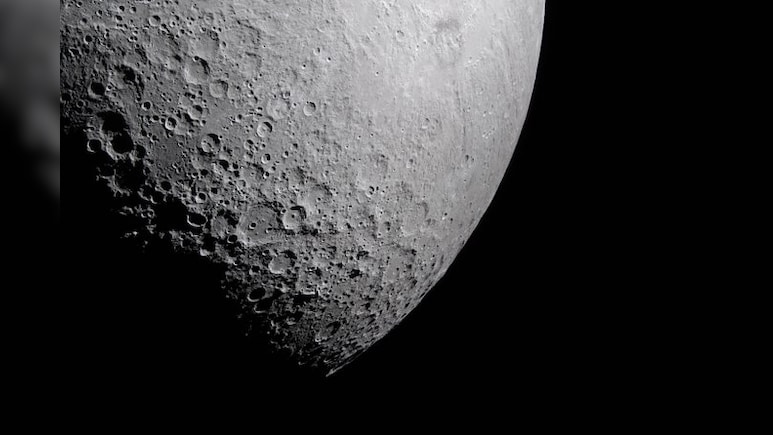
The Chandrayaan-2 orbiter of the Indian Space Research Organisation (ISRO) has provided new scientific evidence that points to the possible presence of ice beneath the Moon's surface in its south polar region.
The findings come from the Dual Frequency Synthetic Aperture Radar (DFSAR) onboard Chandrayaan-2, a microwave imaging instrument operating in L- and S-band frequencies. It is the first fully polarimetric radar system used to study the lunar surface.
According to the press release by ISRO, the study focused on “doubly shadowed craters” which are located within permanently shadowed regions (PSRs) at the lunar poles. These areas never receive sunlight and remain extremely cold with temperatures dropping to around 25 Kelvin (around -248°C). This makes them potential traps where water ice could have been preserved for billions of years.
Scientists used advanced radar polarimetric methods to study the craters and found “possible presence of subsurface ice beneath the floors of four doubly shadowed craters in the lunar South Polar Region.”
They developed a method to detect possible subsurface ice on the Moon using radar data. The approach uses Circular Polarization Ratio (CPR) and Degree of Polarization (DOP) values.
DOP measures how much of the reflected radar signal retains its original polarization after interacting with lunar surface or subsurface material.
The study found that CPR values greater than 1, along with DOP values below 0.13, could indicate scattering patterns linked to buried ice deposits beneath the lunar surface.
“This approach helps separate genuine ice signatures from radar responses produced by surface roughness,” the spacy agency noted.
Among the craters studied, one 1.1 km-wide crater inside the Faustini crater showed particularly strong indications of subsurface ice. The evidence is supported not only by radar data but also by its distinctive “lobate-rim morphological characteristics.”
A lobate-rim morphology refers to a flow-like or lobed appearance that can form when an impact disturbs ice-rich material beneath the surface.
“These findings provide important new insights into the distribution of lunar polar volatiles and have significant implications for future lunar exploration missions, including identification of potential ice-bearing regions for future landing and in-situ resource utilization (ISRU) activities,” ISRO said.
Chandrayaan-2, India's second mission to the Moon, was launched on July 22, 2019, by ISRO. While the lander did not achieve a successful soft landing, the orbiter continues to function and has been delivering valuable scientific data from lunar orbit.
In 2023, ISRO again attempted a soft landing on the Moon with Chandrayaan-3 and successfully touched down near the lunar south pole on August 23. The achievement made India the first country to reach the Moon's south polar region.
Track Latest News Live on NDTV.com and get news updates from India and around the world

