





The Indian Navy's INSV Kaundinya will embark on a journey on Monday from Porbandar in Gujarat to Muscat in Oman to test India's ancient seafaring traditions.
Unlike modern naval ships, INSV Kaundinya has no engine, no metal nails, and no modern propulsion. It depends entirely on wind, sails, and a shipbuilding method that is over 1,500 years old.
What Is INSV Kaundinya?
INSV Kaundinya is a stitched sail ship built using techniques believed to have been used in India during the 5th century CE. The design is based mainly on ships shown in the Ajanta cave paintings, along with descriptions from ancient texts and foreign travellers' accounts.
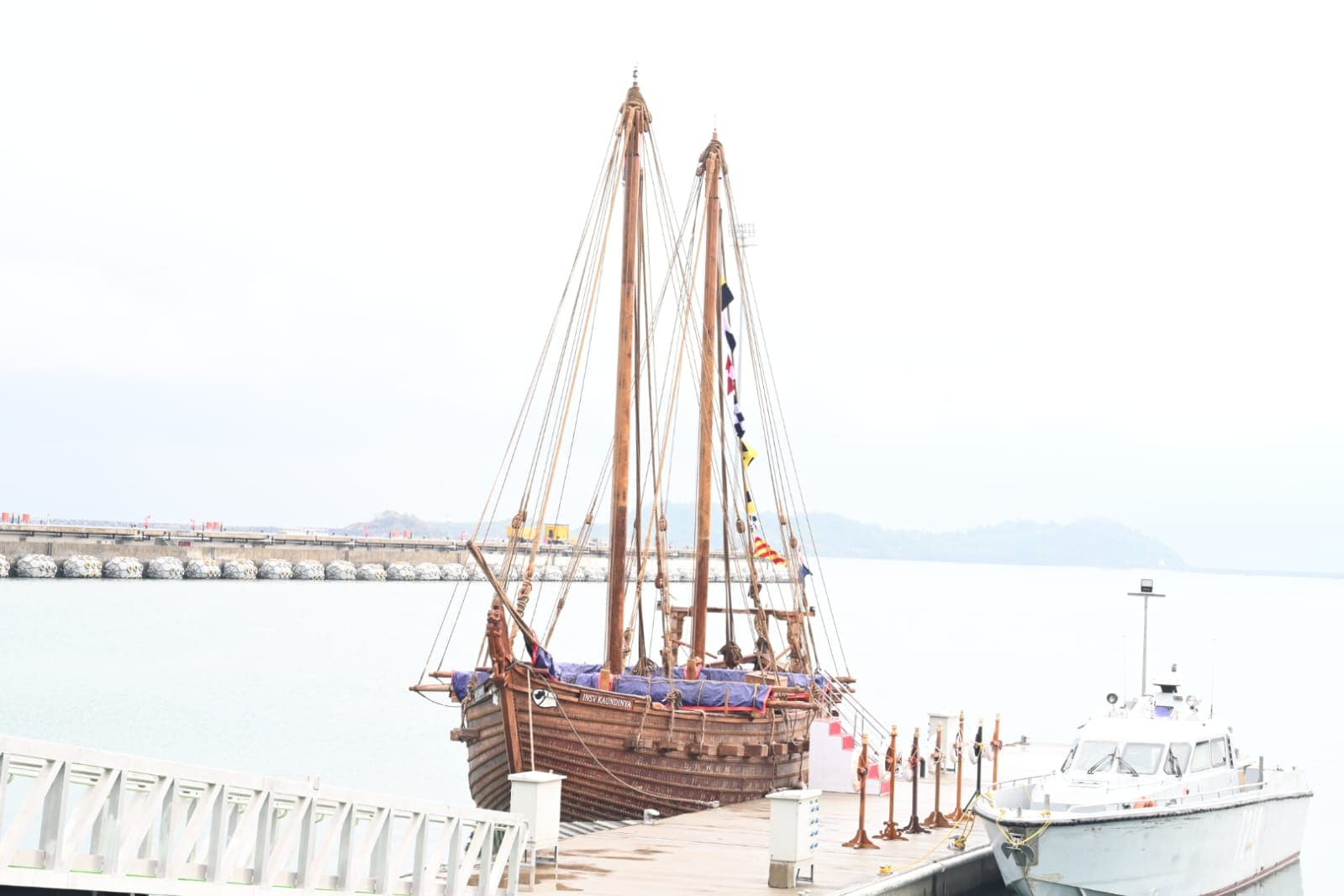
The ship is called a “stitched ship” because its wooden planks are sewn together using coir (coconut fibre) ropes, instead of being fixed with iron nails. Natural resin, cotton, and oils are used to seal the hull and make it seaworthy.
Although it belongs to the Indian Navy, INSV Kaundinya is not a combat vessel.
How Is INSV Kaundinya Built?
INSV Kaundinya is about 19.6 metres long, 6.5 metres wide, and has a draft of around 3.33 metres. It is powered completely by sails and carries a crew of about 15 sailors.
The ship follows the Tankai method, a traditional Indian shipbuilding technique that avoids metal entirely. The hull is stitched first, and ribs are added later, making the structure more flexible. This flexibility helps the ship absorb strong waves instead of breaking under pressure.
Materials used include:
- Wooden planks.
- Coir rope made from coconut fibre.
- Natural resins and oils for waterproofing.
Who Built INSV Kaundinya?
The project began in July 2023 through a joint agreement between the Ministry of Culture, the Indian Navy, and Hodi Innovations, with funding from the Ministry of Culture.
A team of traditional craftsmen from Kerala, led by master shipwright Babu Sankaran, stitched the ship by hand. With no surviving blueprints, the Indian Navy helped recreate the design using visual sources and conducted scientific tests, including hydrodynamic studies at IIT Madras, to ensure safety and stability.
The ship was launched in February 2025 and formally inducted into the Navy in May at Karwar, Karnataka.
What The Symbols On INSV Kaundinya Mean
INSV Kaundinya carries several cultural symbols linked to India's maritime past:
- Gandabherunda, the two-headed eagle of the Kadamba dynasty
- Sun motifs on the sails
- Simha Yali, a mythical lion figure on the bow
- A Harappan-style stone anchor on the deck
Who Was Kaundinya?
The ship is named after Kaundinya, a 1st-century Indian mariner. According to Southeast Asian and Chinese records, he sailed to the Mekong Delta, married Queen Soma, and helped establish the Kingdom of Funan in present-day Cambodia.
This kingdom became one of the earliest Indian-influenced states in Southeast Asia. The Khmer and Cham dynasties are believed to trace their origins to this union. Although Indian records do not mention him, Kaundinya is considered the earliest named Indian sailor with global historical impact.
Why This Voyage Is Important
The route from India to Oman and onward to Southeast Asia was once a major trade corridor. Indian merchants and sailors used these sea lanes to trade spices, textiles, and ideas with West Asia, Africa, and Southeast Asia. By sailing this route again, INSV Kaundinya is retracing India's ancient maritime highways.
Track Latest News Live on NDTV.com and get news updates from India and around the world

