





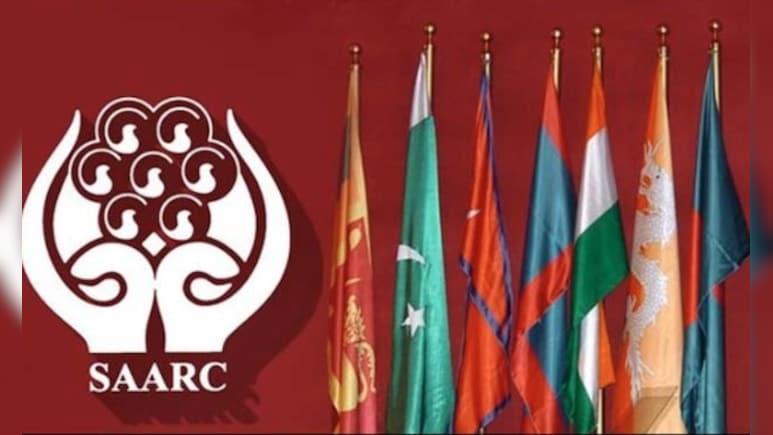
- SAARC revival calls persist but hinge on India-Pakistan relations and consensus rules
- India dominates SAARC with 75% population and controls bloc’s functioning via consensus
- India promotes BIMSTEC and bilateral ties as alternatives excluding Pakistan from SAARC
It's become a ritual. Every few years, a leader stands at a podium (an Independence Day, a UN sideline, a bilateral summit) and says the same thing: SAARC needs to be revived. Maldivian President Mohamed Muizzu has just done it. Bangladesh's new government has also been insisting. And every time, the conversation comes back to the same two countries in the room, and the unspoken question: will India go along, and will Pakistan let it?
Why India Is The Centre Of This Story
SAARC was never built as a group of equals, whatever the founding charter says. India accounts for roughly three-quarters of South Asia's population, economy, and landmass. Every other member's trade, security calculus, and even domestic politics bend around their relationship with Delhi more than around each other. So, when the bloc goes quiet, the question isn't really "why is SAARC dysfunctional," it's "what's the state of India's relationship with its most difficult neighbour," because that relationship is functionally the bloc's on/off switch.
The mechanism is simple. SAARC works on consensus, and the summits rotate between member states in alphabetical order. The 2016 Islamabad summit was Pakistan's turn to host, but it fell apart after India withdrew following the Uri terror attack. Bangladesh, Bhutan and Afghanistan also pulled out. No summit has happened since. That's not a bureaucratic stalemate; it's India using the one lever consensus-based diplomacy gives it, and Pakistan being unable or unwilling to remove the reason India pulled it.
Reading Delhi's Statement Carefully
The MEA's Tuesday statement, "everyone in South Asia is aware of which country... is responsible for stymying SAARC," is India's now-standard formulation, and it's worth noticing what it does rhetorically. It doesn't name Pakistan, because it doesn't need to: every regional audience fills in the blank. It also reframes the entire conversation. Instead of "SAARC is dysfunctional and needs fixing," it becomes "SAARC's dysfunction has a single, already-identified author, and the fix is on them." That's a genuinely different diplomatic posture than Muizzu's or Bangladesh's framing, which is closer to "let's all just get back to the table regardless of history."
This is where India's actual strategy becomes visible, and it's been consistent for close to a decade: Delhi has not abandoned regional cooperation; it has rerouted it. BBIN (Bangladesh-Bhutan-India-Nepal), BIMSTEC, and a thickening web of bilateral ties are India's answer to a SAARC it sees as hostage to one member. BIMSTEC in particular has been quietly promoted by Delhi as the more useful vehicle, precisely because it excludes Pakistan and includes Southeast Asian-facing members like Myanmar and Thailand. So when smaller SAARC states call for "revival," India's establishment doesn't hear a call to action so much as a request to return to a format it has already partly walked away from.
Why The Smaller Members Keep Asking Anyway
Muizzu's and Bangladesh's pitch are worth reading as coming from real, if different, self-interest rather than just diplomatic nostalgia.
For the Maldives, a small state with an outsized dependence on tourism and now facing serious domestic political turbulence, a functioning SAARC would be a genuine hedge: a forum where it has more voice than it does in purely bilateral dealings with Delhi or Beijing. Muizzu offering the Maldives as "mediator" also fits his broader post-2023 foreign policy arc. Having leaned toward China early in his presidency and strained ties with India, positioning himself as a regional bridge-builder is useful rehabilitation, both regionally and with his own domestic audience.
Bangladesh's push is sharper and more strategically loaded. Tarique Rahman's government, which took office in February after the BNP's landslide return following Sheikh Hasina's 2024 ouster, has been visibly diversifying Dhaka's foreign policy away from the near-total alignment with Delhi that characterized the Hasina years: resumed high-level contact with Pakistan, a first direct Dhaka-Islamabad flight in fourteen years, talk of Pakistani fighter jet sales. Rahman's personal insistence that SAARC descends from his father Ziaur Rahman's original vision adds a dynastic legitimacy angle to what is also, transparently, a way of building an independent regional identity that isn't just "India's neighbourhood." Reviving SAARC serves that project whether or not it actually revives.
The Fairer Counter-Read
It would be one-sided to leave India's framing unchallenged. Pakistan's position, which it makes forcefully even if it wasn't quoted, is that India has weaponised a consensus mechanism for political ends and that "terrorism" is deployed selectively as a veto, pointing to unresolved Kashmir as a two-sided dispute India also won't multilateralise. Independent regional analysts also note that India's bilateral-and-minilateral pivot allows Delhi to conveniently cooperate on its own terms with partners it likes, while a genuinely revived SAARC would force it back into a room where Pakistan has equal procedural standing. Both things can be true at the same time. Pakistan's terror-linked conduct has been the proximate trigger since 2016, and the resulting freeze has been strategically convenient for India.
Where This Actually Leaves SAARC
Realistically, nothing in the current signals, Muizzu's speech, Bangladesh's advocacy, even the sympathetic noises from smaller members, changes the fundamental math. SAARC requires unanimous consensus to convene a summit; India isn't going to back that while India-Pakistan relations remain where they are, and Pakistan has shown no sign of the kind of policy shift Delhi is implicitly demanding. The bloc's revival talk has become almost a genre unto itself: periodic, sincere among the smaller members, and largely inert as long as its two largest members treat it as a proxy battlefield for a dispute that predates the organisation itself.

