





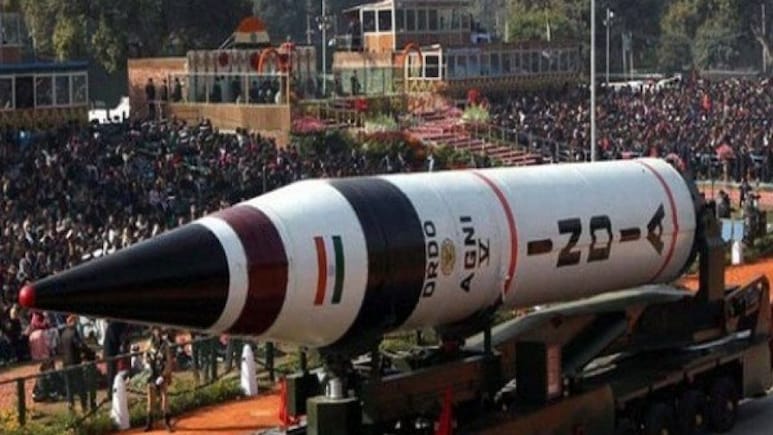
A new study by four leading nuclear weapons researchers estimates that India may now possess up to 190 nuclear warheads, providing the most detailed public assessment yet of the country's atomic arsenal in 2026. But the true figure remains known only to a tiny circle within the Indian establishment because New Delhi has never officially disclosed the size of its nuclear weapons stockpile.
The report, titled 'Indian Nuclear Weapons, 2026', was authored by Hans M. Kristensen, Matt Korda, Eliana Johns and Mackenzie Knight-Boyle of the Federation of American Scientists and published in the regarded 'Bulletin of the Atomic Scientists' (BAS).
The authors estimate that India has produced enough weapons-grade plutonium for between 140 and 225 nuclear warheads and may have assembled as many as 190 warheads. They further estimate that more than 160 warheads are available for operational nuclear forces, with additional warheads being produced for missiles entering service.
Importantly, the report repeatedly notes the opacity surrounding India's strategic arsenal. The authors state that the Indian government does not publish numbers about the size of its nuclear weapon stockpile and that India has never disclosed the size of its arsenal.
The Strategic Forces Command has also been exempted from India's Right to Information Act, making independent verification extremely difficult. It is rightfully one of the best-kept secrets.
For decades, India has maintained a policy of deliberate ambiguity. Unlike some nuclear powers that periodically release broad data about their arsenals, New Delhi prefers silence. This has led outside researchers to rely on satellite imagery, government statements, missile test data, budgetary information and open-source intelligence to estimate India's stockpile. The BAS study represents one such effort.
Even if India's estimated inventory of 190 warheads is accepted, it remains far smaller than those of the world's two largest nuclear powers, the United States and Russia. Publicly available global nuclear estimates place the United States' inventory in the thousands of warheads, while China's arsenal has expanded rapidly and is generally assessed to exceed 600 warheads. Pakistan is estimated to possess roughly a similar order of magnitude to India, with most international assessments placing Islamabad in the high hundreds. India therefore remains a significant nuclear power but not one on the scale of the Cold War superpowers.
For India, however, nuclear weapons have never been merely about numbers. Following the Pokhran II nuclear tests in May 1998, former Indian President and renowned scientist Dr A.P.J. Abdul Kalam famously described nuclear weapons as "weapons of peace." His argument was that a credible nuclear deterrent would prevent coercion and war rather than encourage it. More than a quarter century later, that phrase continues to shape India's strategic thinking and public perception of its atomic arsenal.
Also read: 'Safe And Sound': World Nuclear Body Chief On India's Fast Breeder Reactor
Five decades before Kalam called nuclear bombs 'weapons of peace', India's Father of the Nation, Mahatma Gandhi, famously, in a way, had echoed what Kalam emphasised much later in 1998 after the Shakti series of atomic tests. In 1946, Shri Mohandas Karamchand Gandhi said: "non-violence... is the only thing that the atom bomb cannot destroy."
He wrote this famous nuclear disarmament statement in the February 10, 1946 issue of the Harijan magazine. It still holds that the only country to use atomic bombs in war was the United States of America in 1945 at Hiroshima and Nagasaki in Japan. Gandhiji is considered the 'apostle of peace' as we celebrate his 157 th birth anniversary.
The broader significance of nuclear weapons extends beyond military deterrence. Since the end of the Second World War, atomic weapons have often been regarded as the ultimate symbol of national power.
The permanent five members of the United Nations Security Council, the United States, Russia, China, Britain and France, are all nuclear weapon states. Their possession of atomic weapons has long been viewed by strategic analysts as one of the foundations of their exceptional status in the international system. In that sense, nuclear weapons have frequently been described as the 'currency of power' in global geopolitics.
The BAS report argues that India continues to modernise every leg of its nuclear triad. The study identifies nuclear-capable aircraft, land-based ballistic missiles and sea-based systems, indicating a steady strengthening of India's deterrent posture. The authors estimate that India currently operates multiple nuclear-capable missile systems while several more are under development.
Also read: Axiom Mission 4 Is India's Cosmic Leap Into Private Spaceflight: ISRO Chief
The regional context is equally important. The report notes that tensions with Pakistan remain one of the world's most significant nuclear flashpoints and specifically references India's Operation Sindoor in 2025. According to the study, the operation followed a terrorist attack in Jammu and Kashmir and involved Indian strikes against targets in Pakistan. The confrontation once again raised international concerns about escalation between two nuclear-armed neighbours. India's strategic restraint resulted in Operation Sindoor lasting a mere 88 hours, as other wars of the world continue to linger for years, like the Ukraine and Iran conflicts. Indian military needs to be applauded for this huge restraint.
Many Indian strategic thinkers argue that Operation Sindoor demonstrated that Pakistan's repeated references to its nuclear capability did not prevent India from carrying out calibrated military action. In their view, the operation exposed what they describe as Pakistan's nuclear bluff by showing that New Delhi was prepared to respond to terrorism while remaining below the nuclear threshold.
Yet the central question remains unanswered. Exactly how many nuclear weapons does India possess? The new BAS estimate of up to 190 warheads is the latest attempt by outside experts to fill that knowledge gap. Whether the number is lower, higher or precisely correct is something known only to India's nuclear decision-makers.
What is certain is that nearly three decades after Pokhran, India's "weapons of peace" remain at the core of its national security strategy and an enduring symbol of its rise as a major global power.
Track Latest News Live on NDTV.com and get news updates from India and around the world

