





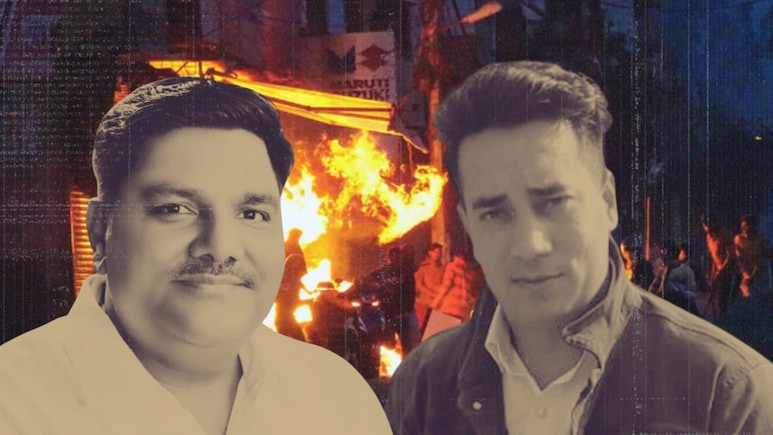
- Delhi court convicts ex-AAP councillor Tahir Hussain in 2020 IB staffer Ankit Sharma murder case
- Verdict based on 91 witnesses, forensic, medical, electronic, and documentary evidence
- Murder involved brutal assault; victim's body found in drain with 51 injuries
A Delhi court on Tuesday convicted former AAP councillor Tahir Hussain and several co-accused in the murder of Intelligence Bureau staffer Ankit Sharma during the 2020 Northeast Delhi riots, holding that the prosecution had proved its case beyond reasonable doubt after examining 91 prosecution witnesses and a large body of documentary, medical, forensic and electronic evidence.
Javed, Anas, Nazim and Kasim were the other co-accused in the case.
Additional Session Judge Parveen Singh of the Karkardooma Court delivered the verdict in the FIR registered at Dayalpur Police Station, rejecting the defence's allegations that Hussain had been falsely implicated through a fabricated investigation.
The judgment comes more than six years after the February 2020 Northeast Delhi riots, which claimed over 50 lives and left hundreds injured.
During the trial, the prosecution examined 91 witnesses, including family members of the deceased, police officials, forensic experts, doctors and witnesses.
The case pertains to the killing of 26-year-old IB staffer Ankit Sharma, who went missing on February 25, 2020, during the communal violence in Northeast Delhi. His body, bearing multiple stab injuries, was recovered from a drain near Chand Bagh Pulia the following day.
According to the prosecution, Sharma was intercepted by a violent mob, brutally assaulted and murdered before his body was thrown into the drain.
Police, divers, and local residents helped pull out the body. Preliminary investigations revealed that this was not a case of natural death, but a murder. It was at this point that the Delhi Police's Special Investigation Team launched a detailed investigation into the murder.
According to the police, at the time of the incident, several cameras had been turned downwards or their lenses covered to prevent the events from being recorded. This clearly indicated a premeditated attempt to avoid having their activities captured on camera, police said. Despite this, the investigating agency collected the available footage and conducted a frame-by-frame analysis.
During the investigation, the police obtained a crucial video. This was not from a CCTV camera; instead, it had been recorded by a witness on his mobile phone.
The video showed three individuals dumping the officer's body into the Khajuri drain near the Chandbagh culvert. The police seized the video and presented in court as electronic evidence.
According to the court, with the help of this video, the investigating agency succeeded in presenting the sequence of events regarding the disposal of the body after the murder. This video, the court said, corroborated the statements of witnesses.
Investigating officers conducted a detailed analysis of the accused's mobile phones, Call Detail Records (CDRs), mobile tower locations, and other electronic records. Through this technical evidence, it was determined which area the accused were present in at the time of the incident and what their activities were. The court stated that all electronic records had been collected in accordance with the law; therefore, their authenticity could not be questioned.
In its verdict, the court specifically noted that the investigation did not hinge on a single witness.
To establish the identities and roles of the accused, the investigating agency relied on multiple independent witnesses, digital records, medical reports, forensic reports, and other documentary evidence.
This enabled the prosecution to successfully establish the sequence of events before the court.
Photo identification also formed part of the investigation
During the investigation, the accused were identified by showing their photographs to several witnesses.
The defense questioned this procedure, but the court clarified that photo identification and the Test Identification Parade (TIP) are merely tools to aid the investigation.
The most crucial evidence is the identification made by a witness in court. In this case, several witnesses identified the accused in court, a fact the trial court considered significant.
Post-mortem report reveals a gruesome picture of the murder.
A post-mortem examination of Ankit Sharma's body revealed 51 severe injuries, including those inflicted by sharp-edged weapons and heavy objects.
The post-mortem report clearly indicated that Ankit Sharma had been attacked in an extremely brutal manner. The investigating agency informed the court that this was not a case of ordinary assault, but rather a premeditated and cold-blooded murder.
The investigation also revealed that attempts had been made to burn parts of the body. According to the police, this was done with the aim of concealing the victim's identity and misleading the investigation. The court also considered this fact a crucial link in the investigation.
During the investigation, blood samples were collected from the drain wall, soil samples were gathered, and other biological and physical evidence was sealed and sent to the Forensic Science Laboratory (FSL).
All these samples underwent scientific examination, and the reports were submitted to the court. The court held that the medical and forensic evidence corroborated the testimonies and strengthened the prosecution's case.
The police also recovered the weapons used in the murder. These weapons were sent to the FSL. Subsequently, the forensic department stated that the injuries found on Ankit Sharma's body during the post-mortem could have been inflicted by the recovered weapons. The court considered this scientific opinion significant, noting that it established a link between the recovered weapons and the murder.
However, the court also clarified that the conviction was not based solely on the recovery of weapons, but was part of a chain of multiple pieces of evidence.
What was found at Tahir Hussain's house?
During the investigation, the police searched the house of the then-councillor Tahir Hussain. According to the investigating agency, a large quantity of materials used in the riots was recovered from the roof of the house.
These included a large number of stones, bricks, glass bottles filled with petrol, catapults, and other riot-related items. All these objects were sent to the FSL, where they underwent scientific examination.
The prosecution informed the court that the witnesses' statements, the site plan of the scene of the incident, and the recovered materials corroborated each other. The court also acknowledged that Tahir Hussain's house had become a major hub for violent activities.
In this case, the testimonies of a total of 91 witnesses were recorded. These included witnesses, local residents, police officers, investigating officers, doctors, post-mortem experts, FSL scientists, and technical experts.
In its verdict, the court stated that the testimonies of these witnesses corroborate each other and contain no contradictions that would cast doubt on the entire sequence of events.
Given the sensitivity of the case, the safety of key witnesses and the complainant was also ensured so that they could present their testimony in court without any pressure.
Court inspects the scene of the incident itself
A notable aspect of this case was that, on May 11, 2026, the trial court itself inspected the Chandbagh culvert and the surrounding scene of the incident.
During the inspection, the court compared the site plan prepared by the police with the actual scene of the incident. The court found that the site plan prepared by the investigating agency was accurate and reflected the actual conditions at the scene.
This inspection further reinforced the credibility of the investigation before the court.
The police submitted all crucial documents to the court: these included the site plan, seizure memos, arrest memos, disclosure statements, records related to the crime scene, forensic reports, and electronic records.
Why did the defense's arguments fail to hold water?
During the hearing, the accused raised several legal and factual objections. Questions were raised regarding the alleged delay in registering the FIR, the investigation process, the credibility of witnesses, and the electronic evidence.
However, the prosecution countered every objection with documentary, medical, forensic, and electronic evidence. The court observed that the witness testimonies, post-mortem report, FSL report, CCTV footage, mobile records, and evidence recovered from the crime scene corroborated one another.
What did the court conclude regarding Tahir Hussain?
The trial court said that many independent witnesses had stated that Tahir Hussain was playing an active role in the violent mob present in and around Chandbagh Pulia on 25 February 2020.
According to witnesses, he was whipping up the frenzy among the crowd with provocative statements. The prosecution also said that his house was filled with stones, bricks and petrol bomb-like materials.
What evidence was found against Nazim and Qasim?
The court stated that several witnesses identified Nazim and Qasim as members of the violent mob. Some witnesses reported seeing the two grabbing Ankit Sharma and dragging him away.
The knife recovered during the investigation and the opinion of the forensic department also supported the prosecution's case. The court convicted both of them of serious offenses related to murder and rioting.
However, Nazim was acquitted of charges under the Arms Act, and both were cleared of the charge of criminal conspiracy under Section 120B.
How the roles of Javed and Anas were established?
Several witnesses came forward against Javed and Anas as well. Witnesses informed the court that both men were part of a violent mob and were present at the scene during the violence and the murder that took place near the Chandbagh Puliya.
Photo identification, in-court identification, and the testimony of other witnesses confirmed their roles. The court held that the prosecution had succeeded in proving the charges against them.
The court observed that the violent mob present at the Chand Bagh Puliya on the evening of February 25, 2020, shared a common objective of inciting violence. Ankit Sharma was killed in furtherance of this common objective, it said. Therefore, Section 149 applies to the accused who were part of the mob and played an active role in it, the court said.
Hussain, who was expelled from the AAP, joined the AIMIM in 2024.
Track Latest News Live on NDTV.com and get news updates from India and around the world

