





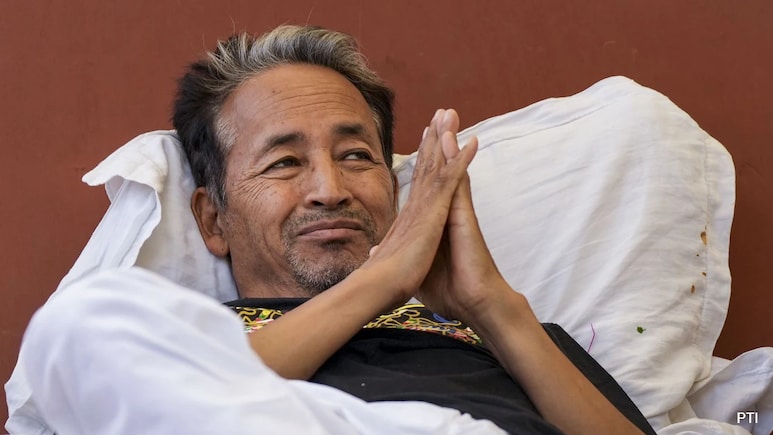
The Delhi High Court's refusal to shift climate activist Sonam Wangchuk to a private hospital while upholding the Delhi Police's decision to hospitalise him during his hunger strike has brought the constitutional tension between the right to protest and the right to life back into focus.
While the single judge bench on Sunday held that the State's actions did not violate Wangchuk's bodily autonomy, the appeal filed by Gitanjali Angmo against it argues that a competent adult has the right under Article 21 to refuse medical treatment and choose where to receive it.
As the matter comes up before a two-judge bench of Delhi High Court, the case revives a longstanding legal debate over the limits of State intervention in hunger strikes and how courts have balanced personal autonomy with the duty to preserve life.
Past Cases And How They Were Dealt With By Courts
Irom Sharmila's 16-year hunger strike (2000-2016) against the Armed Forces (Special Powers) Act (AFSPA) became the defining Indian case on the tension between individual autonomy and State intervention. During her protest, she was repeatedly arrested under Section 309 of the erstwhile Indian Penal Code, which then criminalised attempted suicide, and was subjected to nasogastric force-feeding while in custody.
In 2016, the Manipur Sessions Court acquitted her, holding that a hunger strike constituted a legitimate form of political dissent rather than an attempt to die by suicide. Although this decision predated the effective decriminalisation of Section 309 through the Mental Healthcare Act, 2017 (in force from 29 May 2018), it marked an important shift in recognising prolonged hunger strikes as political expression, with such protests now generally addressed through medical monitoring rather than criminal prosecution.
Supreme Court's Active Role In 2025 Farmer's Protest
The 2025 hunger strike by Punjab farmer leader Jagjit Singh Dallewal during the farmers' protests reaffirmed the balance between the right to protest and the State's duty to protect life. The Supreme Court became an active mediator between the government and the protesting farmers. The bench headed by Justice Surya Kant -- the current Chief Justice of India -- directed the State of Punjab, the Central government, and other authorities to provide immediate and adequate medical care to Dallewal without compelling him to end his fast unless such intervention became imperative to save his life, thereby recognising both his autonomy and the State's obligation to preserve life.
This approach was consistent with the court's broader jurisprudence, including Mazdoor Kisan Shakti Sangathan vs Union of India (2018), which affirmed that peaceful protest is a fundamental right protected under Articles 19(1)(a) and 19(1)(b) of the Constitution and forms an essential feature of democratic dissent.
Supreme Court On Ramdev's Hunger Strike
In the aftermath of yoga guru Ramdev's 2011 hunger strike in support of the anti-corruption movement, the Supreme Court passed a judgment holding that hunger strike has been historically seen as valid constitutional means of peaceful protest.
Taking a dim view of the Delhi Police's midnight crackdown at Ramlila Maidan, the Supreme Court held that Ramdev's hunger strike did not pose an exceptional threat to public order and cautioned against the routine use of Section 144 of the erstwhile Code of Criminal Procedure to curtail fundamental rights.
Significantly, the court recognised hunger strikes as a legitimate form of democratic dissent, observing that they are neither unconstitutional nor prohibited by law. It affirmed that hunger strikes have long been accepted, both historically and within India's constitutional jurisprudence, as a lawful means of peaceful protest.
"The threat of going on a hunger strike extended by Baba Ramdev to personify his stand on the issues raised, cannot be termed as unconstitutional or barred under any law. It is a form of protest which has been accepted, both historically and legally in our constitutional jurisprudence," the top court said.
Takeaway From Past Orders
These past precedents in above cases show that hunger strikes are not illegal, but when prolonged to the point of risk to one's life, the courts try to balance the fundamental right to protest under Article 19(1)(a) and (b), with fundamental right to life under Article 21 of the Constitution.
The Bhartiya Nyaya Samhita (BNS) on the face of the record has decriminalised attempted suicide in Section 309 of the erstwhile Indian Penal Code but has introduced a separate provision under Section 226 of BNS i.e., 'attempt to commit suicide to compel or restrain any public servant from discharging his official duty'. But, it is important to note that there is no First Information Report (FIR) against Wangchuk as far as charge of Section 226 is concerned.
Legal Debate Sparked By High Court Order On Sonam Wangchuk
Senior Advocate Vivek Tankha who challenged the Sunday Special bench's order before a larger bench of high court said that order refusing to shift Wangchuk to private hospital is divorced from law. He said that no one can be stopped from choosing the doctor and hospital for treatment.
The single judge had, however, noted that Wangchuk's sugar and sodium levels were below the normal range and that his potassium level was stated to be dangerously low.
While refusing interim relief, justice Mini Pushkarna had said that the medical team would take the ultimate decision regarding the assessment of Wangchuk's condition in accordance with strict medical protocols.
Advocate Bharat Chugh who was also a former judge with district judiciary told NDTV that what's striking about the Delhi High Court's order is not what it says, but what it avoids saying.
"The Bench tells us that 'life of every citizen is precious' and directs daily medical monitoring. But it stops short of the question that actually matters: what happens when a mentally competent adult, protesting through his own body, refuses the treatment the state must now offer him? That is where Article 21 stops being one right and becomes two rights in tension. On one side is the individual's autonomy over his own body, protected under the privacy jurisprudence this Court itself built since Puttaswamy. On the other is the state's duty to preserve life."
Chugh argues that the single judge order simply doesn't engage that collision.
"It resolves the easy part, surveillance and readiness, and leaves the hard part for later, presumably to be litigated only if Wangchuk's condition worsens into a crisis," Chugh added.
Chugh further called the order "quietly troubling" for resting a welfare order on a rhetorical line rather than a legal standard.
"Life is precious is true, but it isn't a threshold. It doesn't tell government doctors when monitoring should turn into intervention. It doesn't say whether an informed, competent refusal of treatment carries any constitutional weight at all, a question Indian courts have never squarely answered, unlike common law jurisdictions that have long recognised a competent patient's right to refuse even life-saving treatment. This order had a chance to at least point toward that doctrine. It didn't," Chugh explained.
Senior advocate Sidhart Luthra in a post on X said that the law may eventually determine how far the State must go to preserve life during an indefinite fast.
However, the larger question is whether those who rule us in a democracy consider why the need for an indefinite fast?
"Peaceful language of dissent should not be ignored at the peril to a citizen's health and validity of the concerns that drive a person to fast unto death is not to be dealt with as a medical situation, but the final language of someone who believes the cause that they espouse peacefullly is no longer being heard. A nation which holds freedom of expression as a fundamental right, can only be strengthened by its willingness to engage with peaceful dissent," Luthra's post read.
Advocate Chugh raises a harder question: is this order really adjudicating a right, or somehow giving into state optics?
He argued that "daily monitoring lets the state show diligence without the Court ever ruling on whether a hunger strike is protected protest, or on the legality of the state's response to it."
Track Latest News Live on NDTV.com and get news updates from India and around the world

