





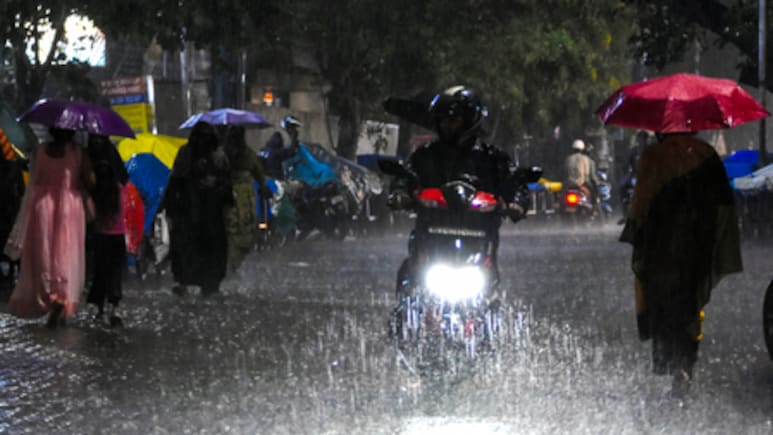
As relentless monsoon rains wreaked havoc across Maharashtra, triggering landslides, flooding highways, shutting the newly opened Mumbai-Pune Link and bringing life to a standstill in the two cities, the state government was preparing for another looming weather emergency in Nashik.
This time, authorities were not caught off guard.
Armed with Bharat Forecast System (BharatFS) -- India's next-generation high-resolution weather forecasting platform --Maharashtra's disaster management machinery received highly localised advance forecasts, indicating the possibility of cloudburst-like rainfall over Nashik district.
The early warning provided authorities with nearly 24 hours of lead time, allowing officials to activate emergency protocols before the heaviest rainfall arrived.
Officials say the Nashik episode has become one of the first major examples of how AI-assisted weather intelligence, advanced numerical weather prediction and high-performance supercomputing can transform disaster management from a reactive exercise into proactive preparedness.
What is BharatFS?
The Bharat Forecast System (BharatFS) is India's most advanced indigenous weather prediction system, developed by the Indian Institute of Tropical Meteorology (IITM), Pune, under the Ministry of Earth Sciences.
Unlike older forecasting models that generated weather predictions over grids of around 12 kilometres, BharatFS produces forecasts at an approximately 6-kilometre resolution, enabling meteorologists to detect highly localised extreme weather events including cloudbursts, flash floods, landslides, extremely heavy rainfall, high wind events.
The forecasting model is powered by India's high-performance supercomputers Arka (located at IITM Pune) and Arunika (at NCMRWF, Noida). The forecasts are generated significantly faster and updated frequently, officials said.
Although BharatFS is primarily an advanced numerical weather prediction model, it incorporates AI-assisted decision-support systems, advanced atmospheric modelling and supercomputing to deliver more accurate and localised forecasts.
How AI Helped Maharashtra Stay Ahead?
While Mumbai, Pune and Raigad were already battling a severe weather crisis, BharatFS identified the possibility of extremely heavy localised rainfall over Nashik nearly a day before the most intense weather was expected.
The forecast immediately triggered a series of precautionary measures across the district.
According to officials, the early warning enabled the administration to:
- Activate the State Disaster Management machinery
- Alert the Nashik district administration
- Position NDRF, SDRF and local rescue teams
- Monitor vulnerable rivers and dams
- Prepare evacuation plans
- Issue public advisories
- Restrict access to vulnerable locations
- Officials say this additional lead time proved crucial in strengthening preparedness despite multiple weather emergencies unfolding simultaneously across Maharashtra.
First State to Adopt BharatFS:
In May, Maharashtra became India's first state to integrate BharatFS into its disaster management system after the State Disaster Management Authority (SDMA) signed an agreement with IITM.
The forecasts are integrated with the State Emergency Operations Centre (SEOC) and the state's Geo-Spatial Decision Support System (GeoDSS), allowing district collectors and disaster response teams to receive highly localised weather intelligence almost in real time. Forecasts are updated every three hours and include rainfall, wind speed, temperature, cloud cover and atmospheric pressure.
Disaster Management Minister Stayed Overnight in Nashik:
Recognising the seriousness of the warning, Maharashtra Disaster Management Minister Girish Mahajan remained in Nashik throughout the night to personally monitor the evolving situation.
The minister coordinated directly with district officials, reviewed emergency preparedness, monitored weather updates and ensured that all disaster response agencies remained on standby.
Following the warning, authorities implemented several precautionary measures:
- Schools and colleges were ordered to remain closed
- Major temples suspended darshan
- Weekly markets were cancelled
- Tourist destinations and forts were barricaded.
- Rescue teams and emergency equipment were pre-positioned
Officials continuously monitored river levels and vulnerable villages
The government's decision to maintain overnight monitoring reflected the seriousness with which the cloudburst warning was treated.
What Makes BharatFS Different?
Cloudbursts are among the most difficult weather events to predict because they occur over extremely small geographical areas and develop rapidly.
Traditional forecasting systems often identify heavy rainfall across an entire district but struggle to pinpoint precisely where the most intense precipitation will occur.
With its 6-km high-resolution grid, BharatFS can model terrain far more accurately, especially across the complex topography of the Western Ghats.
This enables meteorologists to forecast localised weather events with much greater precision than previous systems.
From Reactive to Predictive Disaster Management:
Experts say BharatFS represents a major shift in India's disaster management strategy.
Instead of responding only after floods or landslides occur, authorities can now:
- Deploy rescue teams in advance.
- Position heavy equipment strategically.
- Alert district administrations early.
- Issue public warnings before conditions deteriorate.
- Prepare evacuation plans for vulnerable communities.
For a state like Maharashtra - which experiences frequent cloudbursts, flash floods, landslides and cyclones during the monsoon - the technology could significantly reduce disaster response times and improve public safety.
A New Benchmark for Weather Preparedness:
The Nashik cloudburst threat made it clear how cutting-edge forecasting technology can provide the governments with valuable time to prepare before extreme weather strikes.
Even as Maharashtra dealt with landslides, flooded highways, transport disruptions and urban flooding across Mumbai and Pune, the state's ability to simultaneously prepare for Nashik highlighted the growing role of AI-assisted forecasting and high-resolution weather modelling in disaster management.
Officials believe BharatFS marks the beginning of a new era in weather preparedness-where technology, supercomputing and artificial intelligence work together to help governments anticipate disasters, reduce risks and protect lives before the rain triggers a crisis.

