





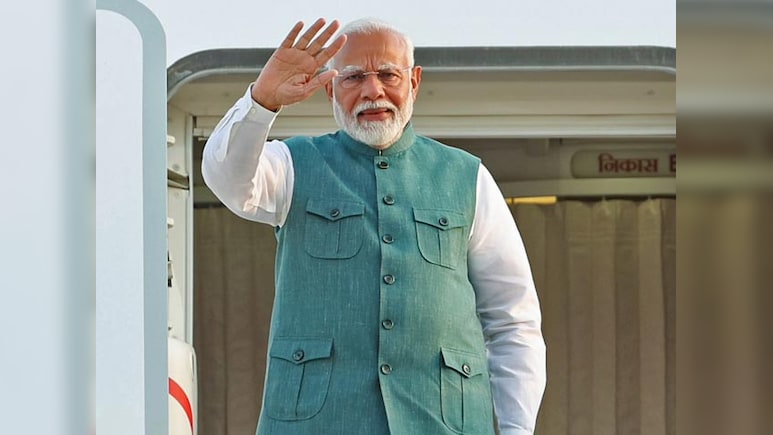
Highlighting India's growing global stature, Prime Minister Narendra Modi will participate in the upcoming G7 Summit to be held in Evian, France, on June 16-17, 2026. During this high-level summit, PM Modi will hold extensive discussions on several far-reaching and crucial global issues with the heads of state of G7 countries, invited partner countries, and representatives of major international organisations.
The agenda for this summit is highly comprehensive, focusing primarily on the following pillars:
- New Destination and International Solidarity: Building new partnerships and reinvigorating international solidarity against global challenges.
- Sustainable and Shared Growth: Promoting balanced, equitable, shared, and sustainable economic growth for all regions of the world.
- The Future of Artificial Intelligence (AI): Creating an ethical and technical framework to implement AI safely, rapidly, and efficiently on a global scale.
Apart from the main summit meetings, PM Modi will also hold significant bilateral meetings with several world leaders on the sidelines. There is a strong possibility within political circles that a special bilateral dialogue with US President Donald Trump may also take place during this time, which will give a new direction to India-US strategic relations.
France's Special Invitation and Strategic Background
The invitation for India to participate in this summit was extended during French President Emmanuel Macron's recent visit to India. During his official visit between February 17 and 19, 2026, President Macron met with Prime Minister Narendra Modi and personally invited him to attend the G7 Summit hosted by France.
The French President has urged India to actively participate not only in the main summit but also in the preparatory technical work and preceding discussions. France believes that India's role is indispensable in tackling global macro-economic imbalances and creating a new model for international partnership and solidarity.
Warmly welcoming this invitation, PM Modi reiterated India's long-standing strategic partnership with the G7. He strongly articulated India's commitment to constructively contribute to global discussions on crucial issues such as global economic imbalances, financing for development, international economic security, strong and resilient supply chains, climate action, and international security.
India's Indispensability: Why is India Invited to the G7?
In today's geopolitical and economic landscape, inviting India to the G7 summit has become a global necessity rather than just a diplomatic formality. The major reasons behind this are:
- India is currently the fastest-growing major economy globally. According to economic analysts and NITI Aayog estimates, India will very soon become the world's fourth-largest economy.
- Amidst geopolitical shifts, India has emerged as the central point of global supply chains. India is a reliable and strong partner for global economic security.
- In today's era, any global discussion on sensitive and strategic issues like global energy policies, the future of Artificial Intelligence (AI), and the security of critical minerals is considered incomplete and irrelevant in India's absence.
- India acts as a crucial link between the West and the Global South, becoming the voice of developing nations on major global platforms.
- India's vast domestic market and rapidly growing technology and manufacturing sectors make its role vital in discussions regarding global economic stability and supply chain security.
- Being one of the world's largest democracies, India naturally aligns with the core ideological principles of the G7 nations.
- The G7 recognises that complex, transnational issues such as climate change, pandemics, and international security cannot be successfully managed without including India.
- India's inclusion helps Western countries balance China's influence.
The G7 Group: Introduction, History, and Structure
The Group of Seven (G7) is an informal bloc of seven of the world's most advanced and developed economies. Its member countries are: the United States, the United Kingdom (UK), France, Germany, Italy, Japan, and Canada. Additionally, the European Union (EU) has been a permanent member of this group since 1981 and participates in all high-level meetings, although it does not hold the presidency.
The power of this group can be gauged from the fact that together these countries represent about 40 per cent of the global Gross Domestic Product (GDP) and 10% of the world's total population. The combined GDP of G7 countries is over $55,000 billion (approximately Rs 5,200 lakh crore). Comparatively, India's current GDP is around Rs 357 lakh crore.
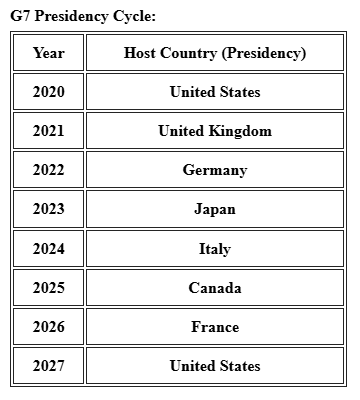
The main focus of the G7 is protecting human rights, promoting democratic values, strengthening global economic growth, and building consensus on issues related to international security. The presidency of the group rotates annually among the member countries, and that host country organises the summit for that year.
Historical Background
The G7 originated in 1975 as the 'World Economic Summit' through the efforts of former French President Valéry Giscard d'Estaing and then West German Chancellor Helmut Schmidt. Initially, it included six countries (Germany, France, Britain, Italy, Japan, and the USA), but with the addition of Canada in 1976, it became the G7. Between 1997 and 2013, Russia was included in the group, making it known as the 'G8'. However, following military action in Crimea in 2014, Russia was suspended, and the platform reverted to functioning as the G7.
India and G7: A Historical Journey Of Relations
It is important to note that India is not a full-time permanent member of the G7. India participates in this global forum as a 'Special Invitee'. Historically, countries like Russia and the US have strongly advocated for making India a permanent member of this group in the past.
Including the 2026 France Summit, India has been a part of the G7 (or formerly G8) meetings a total of 13 times. Notably, India has been consistently invited to this forum every year since 2019, reflecting India's strategic relevance in the eyes of the Western world.

Detailed History of Participation:
Atal Bihari Vajpayee (1998 - 2004):
- Prime Minister Vajpayee attended the G-8 Summit in Evian in June 2003.
Dr. Manmohan Singh's Tenure (2004 - 2013):
During the first five years of Manmohan Singh's tenure (2005-2009), India was regularly invited under the global economic dialogue framework. However, due to the rise of the G20 following the global financial crisis, India was not invited between 2010 and 2013.
- 2004: Not Invited (Host: USA)
- 2005: Successfully participated (Host: United Kingdom)
- 2006: Successfully participated (Host: Russia)
- 2007: Successfully participated (Host: Germany)
- 2008: Successfully participated (Host: Japan)
- 2009: Successfully participated (Host: Italy)
- 2010 to 2013: Not invited for 4 consecutive years (Hosts respectively: Canada, France, USA, UK)
Prime Minister Narendra Modi's Tenure (2014 - 2026)
India did not receive an invitation during the first five years of PM Modi's tenure (2014-2018). However, a major diplomatic and strategic shift occurred with the 2019 Biarritz Summit in France, after which India has been consistently invited, recognised as an indispensable partner.
- 2014 to 2018: Not invited for five years (Hosts respectively: Belgium, Germany, Japan, Italy, Canada)
- 2019: Successfully participated (Host: France - Biarritz Summit)
- 2020: Invited by the USA, but the summit was cancelled due to the COVID-19 pandemic.
- 2021: Successfully participated (Host: UK - via Virtual Medium)
- 2022: Successfully participated (Host: Germany)
- 2023: Successfully participated (Host: Japan)
- 2024: Successfully participated (Host: Italy)
- 2025: Successfully participated (Host: Canada)
- 2026: Officially invited and participation confirmed (Host: France - Evian Summit)
The upcoming G7 Summit 2026 in Evian is irrefutable proof that the strategic partnership between India and Western nations has entered a new golden era. For an emerging economic superpower like India and the establishment of secure global supply chains, the G7 platform is incomplete without India's presence. Whether it is correcting global economic imbalances or formulating a blueprint for the safe regulation of cutting-edge technologies like AI, India today sits as an indispensable power at the main table of global policy-making.
Track Latest News Live on NDTV.com and get news updates from India and around the world

