



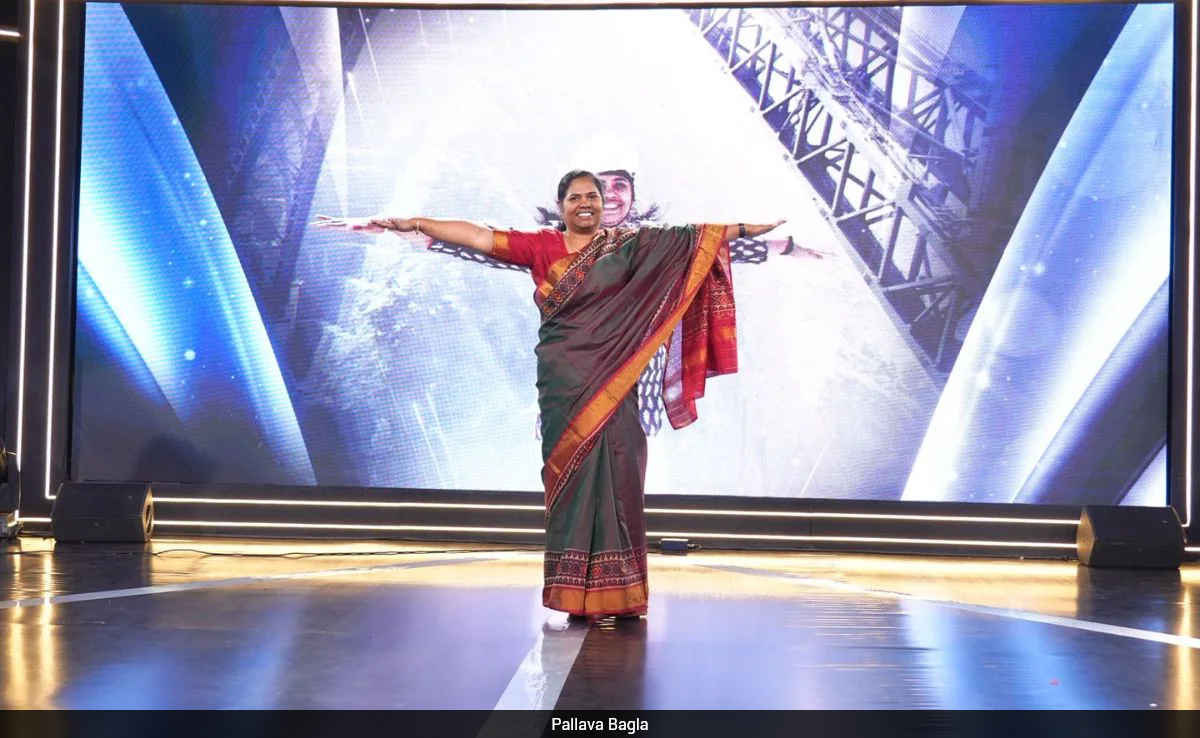
From a barefoot girl in a remote Andhra village who once sold old notebooks for 40 paise to buy kerosene to a celebrated scientist shaping India's engineering marvels - Professor Madhavi Latha's journey is nothing short of extraordinary. Yesterday, she was honoured as co-winner of the Indian Science Icon of the Year at the NDTV Indian Of The Year event, a recognition befitting her pioneering role in one of India's most ambitious infrastructure projects: the Chenab Railway Bridge. She dedicated the award to the Indian Railways and shared it with all the engineers who contributed to the bridge.
This bridge is not just another railway link. It is the world's highest railway bridge, soaring 359 metres above the Chenab River in Jammu and Kashmir - 35 metres taller than the Eiffel Tower. Part of the Udhampur-Srinagar-Baramulla Rail Link (USBRL), the bridge connects Kashmir to the rest of India by rail, fulfilling a century-old dream. When the Vande Bharat train rolls across this engineering marvel, it symbolises uniting Kashmir to Kanyakumari, stitching together the extremes of India.
The Big Bare Facts About Chenab Bridge
- Height: 359 metres above the riverbed (world's tallest railway bridge)
- Length: 1,315 metres
- Design: Arch bridge spanning two steep hills with no intermediate supports
- Seismic Safety: Built to withstand earthquakes of magnitude 8
- Wind Resistance: Can endure wind speeds up to 220 km/h
- Strategic Importance: Enables rail connectivity to Srinagar, reducing dependence on road transport vulnerable to landslides and snow
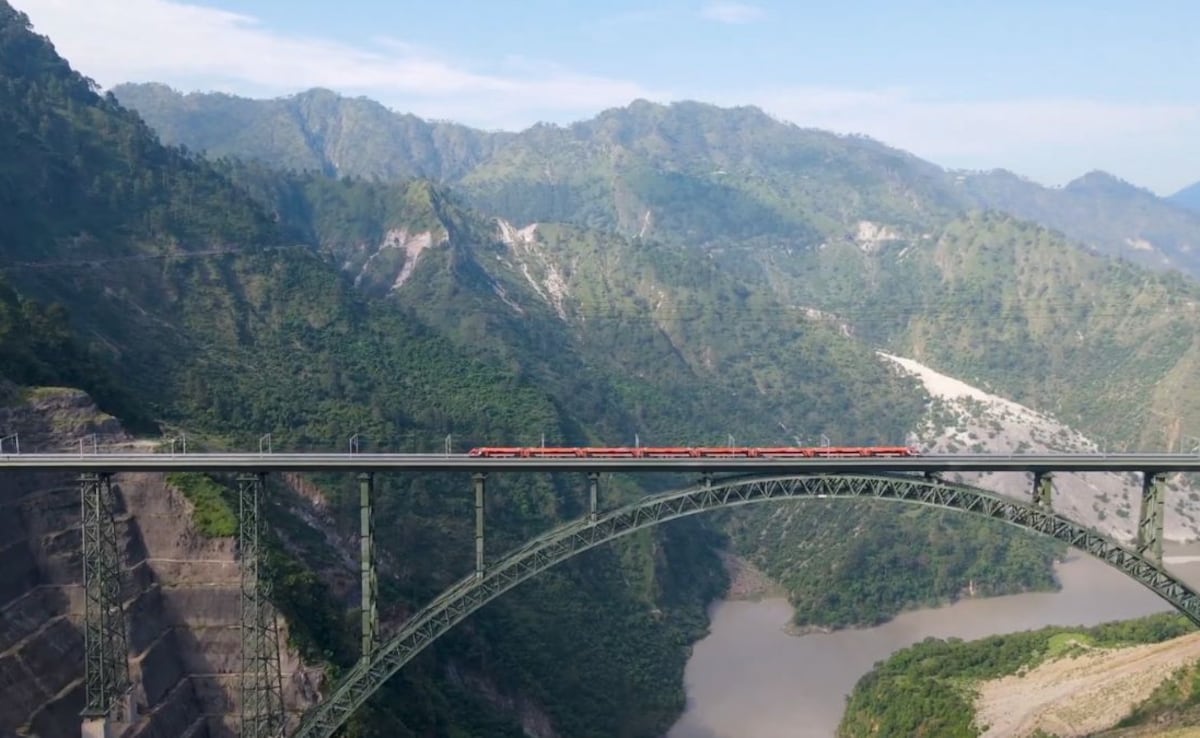
The bridge posed unprecedented challenges: unstable Himalayan rock slopes, high seismic vulnerability, and sheer inaccessibility. "When I first visited the site in 2005, there were no human footsteps on those slopes," recalls Madhavi Latha. "We had to take a boat across the Chenab and climb hills where landslides could sweep you into the valley any moment."
One Of The Women Behind the Slopes
As geotechnical consultant, Madhavi Latha's role was critical. She designed slope stabilisation strategies and foundation systems and monitored construction for 17 years. "The arch abuts on two hills without any support in between. "Stabilising those rock slopes was a nightmare," she says. "Every calculation had to factor in earthquakes, landslides, and extreme weather."
Her expertise in earthquake geotechnical engineering and rock mechanics made her indispensable to the project. "There were times when I worked three days without sleep, living in my office, because the bridge slope design was at its peak," she recalls. "This bridge became a part of my life."
From Edugunlupadu To IISc
What makes this achievement remarkable is the backdrop against which it unfolded. Born in Yedugundlapadu, a tiny village in Andhra Pradesh, Madhavi Latha grew up in extreme poverty. Her father, a farmer, lost his fortunes when she was ten. "I still remember my mother crying in front of the chulha because we had no kerosene," she says. "I sold my old notebooks for 40 paise to buy kerosene that day."
Her schooling was in the Telugu medium at a government school. At 16, she entered Jawaharlal Nehru Technological University Kakinada (JNTUK) for a B.Tech in civil engineering - the first engineer from her village. "I didn't even know what 'hi' meant," she laughs. "I ran away from college within two months because hostel life felt alien. I was ready to join a local B.Sc. college when my grandmother intervened. She told me, 'You are meant for big things.' She stayed with me for a month until I felt comfortable."
That turning point set her on a stellar academic path: M.Tech at NIT Warangal, PhD at IIT Madras, and eventually Assistant Professor at the Indian Institute of Science (IISc), Bengaluru, in 2003, becoming the first woman faculty in the 53-year-old Civil Engineering Department. Today, she heads the Centre for Sustainable Technologies at IISc and serves as editor-in-chief of the Indian Geotechnical Journal.
Struggles Behind The Success
Her story is not without sacrifices. After her PhD, she lived in a small house with her husband and a young daughter, surviving on a scholarship of Rs 3,200 a month. "We had two bicycles, one mat, and a lot of books," she recalls. Later, she moved to IIT Guwahati with her one-year-old child and 80-year-old grandmother, while her husband worked 3,000 km away in Bangalore. "There were times I left my kids at 4 am with the maid to catch a flight for a grant presentation and returned at midnight," she says.
Even cultural expectations weighed heavily. "If I travel for a seven-day conference, I cook and freeze food for the family for seven days," she admits.
Role Model For Young Women
Her advice to young girls is simple yet powerful: "Never hesitate to express yourself. Never be limited by inhibitions. Self-confidence is key." She regrets losing opportunities early in life because she stayed silent. "Your ideas will be respected because they have merit. Speak up."
She emphasises resilience: "Never give up. Focus and persistence can turn impossible tasks into achievements." And kindness: "It's more important to be considerate than just correct, especially when guiding young minds."
Science Icon And Beyond
Winning the Indian Science Icon of the Year award yesterday was a proud moment. "I feel content when I see my students succeed," she says. Many of her proteges are now faculty at IITs. "It's like multiplying your dreams," she smiles.
Her vision? To create something in geotechnical engineering that future generations will always cite. "I want people to say, 'This is Madhavi's contribution.' That's my dream."
Chenab Bridge: A Symbol Of Her Journey
The Chenab Bridge is more than steel and concrete- it mirrors her life. From the fragile slopes of the Himalayas to the fragile hopes of a young girl in Edugunlupadu, both needed stabilisation. Both demanded courage. And both now stand tall.
"When I look at the bridge, I feel proud," she says. "It's taller than the Eiffel Tower, but for me, the real height is the journey - from a barefoot child to being part of this global engineering marvel."
Her mantra for life: "Once you achieve one level, you aim for the next. Success is what drives me. And love for life keeps me going." Says Professor Madhavi Latha, who is simplicity personified and someone who credits her team more than herself for creating this engineering marvel.
Track Latest News Live on NDTV.com and get news updates from India and around the world

