





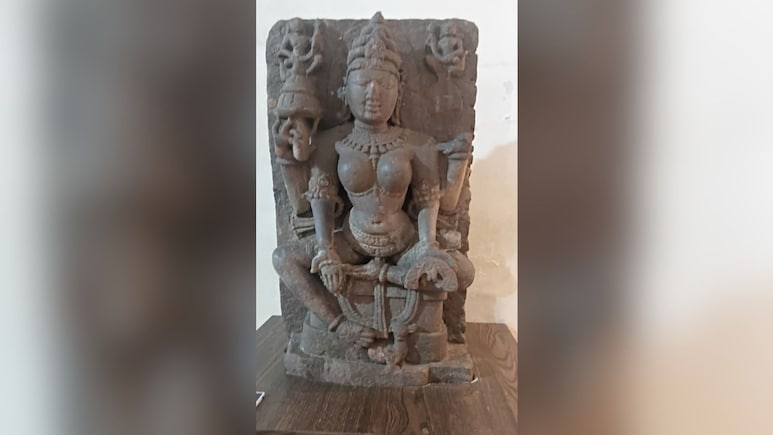
- The 12th-century sculpture at Bhopal Museum was misidentified as Goddess Saraswati for centuries
- Archaeologists have correctly identified the statue as Goddess Gayatri, linked to Vedic wisdom
- The sculpture lacks a veena and instead holds a lotus, rosary, and Vedas, confirming Gayatri's identity
A missing veena, a broken hand, an unexpected question from museum authorities and a digital examination have revealed that a striking 12th-century sculpture preserved at the State Museum in Bhopal, believed to be goddess Saraswati for nearly nine centuries, is not her at all.
Archaeologists have identified the idol as that of Goddess Gayatri, the divine personification of the Gayatri Mantra, the Vedas, sacred wisdom and spiritual illumination.
The discovery has transformed a familiar museum object into one of the rarest known sculptural representations of Gayatri in India. It has also corrected what experts describe as a historical misidentification that survived for centuries. In the official register, the red sandstone sculpture had been recorded as Goddess Saraswati.
Archaeologist Ramesh Yadav, associated with the Directorate of Archaeology, Archives and Museums, told NDTV that the sculpture had initially been entered in the museum records as Saraswati, but a closer examination revealed significant differences. "This is a second statue. It dates back to the 12th century, whereas the previous one was from the 11th century. This statue was originally in the Dhar Museum but was brought to Bhopal when the State Museum was being upgraded. Although it was initially recorded in the register as Goddess Saraswati, the Commissioner of Museums recently questioned its identity," Yadav said.
According to Yadav, the most important discrepancy was the absence of the veena, the stringed musical instrument that is one of the most defining attributes of Goddess Saraswati. "Its features differed from those of Saraswati, specifically the absence of the veena, which is essential for Saraswati's iconography. Instead, the features aligned with Goddess Gayatri, leading to its identification," he said.
One of the upper hands of the sculpture had broken centuries ago. This damage appears to have contributed to the earlier confusion. It had been assumed that the broken hand must once have held a veena.
However, high-resolution digital documentation and 3D mapping enabled archaeologists to closely examine the surviving contours, the position of the hand and traces of the original object.
"There are common iconographic markers. A swan is depicted at the base. One hand is broken, leading the initial identifier to assume it once held a veena. However, subsequent examination revealed that it held a lotus, or padma, rather than a veena. The visual distinction is subtle, but while Saraswati holds a veena, this figure held a lotus," Yadav told NDTV.
That distinction became the key to solving the mystery. Archaeologists then examined the other attributes carried by the deity and compared them with descriptions of Gayatri found in the Puranas and classical texts on temple art and sculpture.
The four-armed goddess is seated in lalitasana. Her lower right hand holds an akshamala, or rosary, while her upper right hand carries a lotus. Her lower left hand holds a book identified with the Vedas. The upper left hand is broken but is believed to have originally held another lotus or sacred object.
A finely carved swan appears near her right leg. In Indian tradition, the swan symbolises wisdom, spiritual discrimination and the ability to distinguish truth from illusion. Flying celestial garland bearers are carved on both sides of the stone panel, affirming the goddess's divine status.
"The image matches classical descriptions of Gayatri in the Silpasastras," Yadav said. "The four-armed goddess sits in lalitasana, holding a rosary, lotus and the Vedas. A finely carved hamsa beside her symbolises sacred wisdom, while celestial garland bearers affirm her divinity. Together, these attributes identify the deity as Gayatri rather than Saraswati."
Although Gayatri became closely associated with Saraswati in later Hindu traditions, ancient texts describe her as an independent Vedic goddess with her own theological and iconographic identity. The earliest foundation of the Gayatri tradition is found in the Rigveda through the celebrated mantra invoking Savitr, the divine solar power, and seeking the illumination of human intellect.
The identification has also challenged assumptions about the sculpture's artistic origin. Since it was found at Dhar, the historic capital of the Paramara dynasty, it had naturally been viewed through the lens of Paramara art.
However, archaeologists now say the sculpture differs significantly from the traditional Paramara style and exhibits a strong Western Chalukyan influence.
"Stylistically, it deviates from the Paramara style. Since the Chalukyas from Gujarat ruled Dhar during the 12th century, the statue exhibits the influence of the Chalukya art style, which is a distinctive characteristic," Yadav said.
The modelling of the body, elaborate ornamentation, refined execution and treatment of the garments are seen as characteristic of the Western Chalukyan sculptural tradition.
"Temples constructed in the Dhar and Jhabua regions during the 12th century differed from the Paramara style, and this stylistic influence was evident in the sculptures as well," he said.
The breakthrough emerged from Madhya Pradesh's growing use of 3D technology for the digital documentation of sculptures and archaeological objects. "We are employing 3D technology for documentation purposes," Yadav said.
Track Latest News Live on NDTV.com and get news updates from India and around the world

