





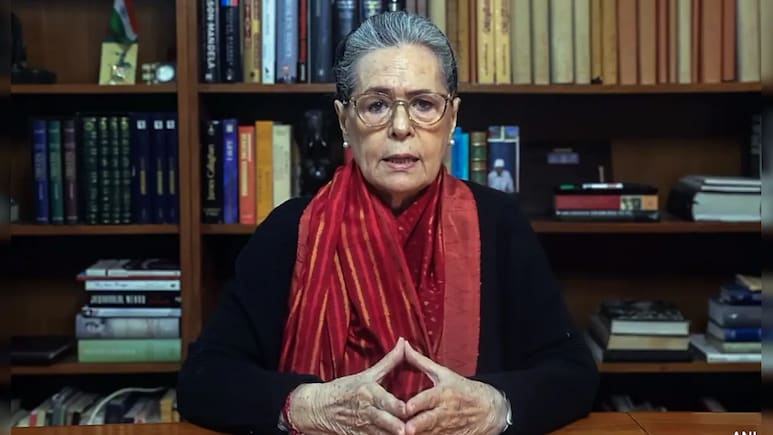
The BJP vs Congress spat over the G RAM G law – a rural employment guarantee scheme meant to replace the 20-year-old MGNREGA – rumbled on Monday with the former laughing off Sonia Gandhi's remarks as "flights of fancy" and "mischaracterisations… and outright falsehoods".
The Viksit Bharat Guarantee for Rozgar and Ajeevika Mission (Gramin), shortened to G RAM G, cleared Parliament last week despite vociferous protests from the Congress-led opposition that expressed concerns over a law that will "kill" the guarantee of employment. Chief among these were changed funding architecture that requires most states to foot 40 per cent of the bill.
On Saturday ex-Congress boss Sonia Gandhi released a video statement in which she accused the federal government of bulldozing the G RAM G bill through the House and said the "black law" passed to repeal it would be defied by the lakhs of Congress workers across the country.
She said the BJP had destroyed the MGNREGA scheme – enacted in 2005 by the Congress-led UPA government – and jeopardised the interests of crores of farmers and labourers pan-India.
The BJP responded on X. Amit Malviya said, "Sonia Gandhi's recent article (she also authored an op-ed in The Hindu, called 'the bulldozed demolition of MGNREGA'), reads less like a serious engagement with law or data and more like a flight of political fancy."
"It is evident she has not read the VB-G RAM G Act, because her arguments rest on mischaracterisations, selective memory, and outright falsehoods," he claimed.
He also alleged Sonia Gandhi had "romanticised" MGNREGA's origins.
"MGNREGA was conceived and driven by the National Advisory Council – an unelected executive body that functioned, in effect, as a super-cabinet. So dominant was its role that Prime Minister Manmohan Singh was frequently derided as a 'super cabinet secretary'…"
Dismissing the claim that dismantling of demand-based employment (to be replaced by a "normative allocation framework", as noted by the government in its press release), meant the guarantee of jobs had been revoked, Malviya said, "What has changed is the budgeting framework – from an open-ended, reactive model to a norm-based system…" and pointed to the increased number of minimum workdays – from 100 under MGNREGA to 125 under G RAM G.
He acknowledged MGNREGA "did play a role in alleviating distress" but insisted the scheme had not kept pace with today's rural realities. "… data show that 80 per cent of rural households report higher consumption, 42.2 per cent report higher incomes and 58.3 per cent now rely exclusively on formal credit. MGNREGA today functions as a fallback safety net… not as the defining feature of rural livelihoods," he said, dismissing claims the poorest will be abandoned.
"Rural poverty has fallen sharply from 25.7 per cent to 4.86 per cent. MSME credit has tripled since 2014, enabling self-employment and non-farm livelihoods. Public policy cannot be frozen in the conditions of 2005 when India has demonstrably moved forward," he said.
The BJP leader also dismissed as "false" the allegation that the government is shifting the financial burden to states, moving from a supposed 90:10 model to the 60:40 split.
"States already bore 25 per cent of material costs, major administrative expenses, and 100 per cent of unemployment allowance, often without predictability or transparency," he said.
The new model simply formalises and rationalises funding, making states "equal partners" rather than "passive implementers of top-down mandates", the BJP leader said.
On Gandhi objecting to the 60-day work restriction, Malviya said that, in reality, this period is "aggregated, flexible, and state-notified -- not a blanket ban". It protects agricultural operations during sowing and harvest, prevents labour shortages, allows workers to earn higher seasonal farm wages, and still expands the overall employment guarantee to 125 days, he said.
Malviya said Gandhi's concern that Panchayats and Gram Sabhas are being weakened is "similarly misplaced". "What is being dismantled is fragmentation and opacity, not decentralisation… the bottom line is clear. This is not demolition, it is overdue repair. The real choice is not between compassion and reform, but between paper guarantees that under-deliver and a modern framework that actually works," he said.
Malviya accused Gandhi of ignoring systemic failures that plagued MGNREGA for years.
"Rs 193.67 crore misappropriated in 2024-25 alone, with recovery of barely 5.32 per cent; fake works existing only on paper; machinery replacing labour; and digital attendance systems bypassed across 23 states. These were not 'minor lapses' but 'deep structural flaws', he said.
Despite these challenges, Malviya said, the Modi government delivered "measurable gains".
"Between FY 2013-14 and FY 2025-26, women's participation rose from 48 per cent to 56.74 per cent; Aadhaar-seeded active workers increased from 76 lakh to 12.11 crore; workers on APBS (Aadhaar Payment Bridge System) grew from zero to 11.93 crore; geo-tagged assets expanded from none to over 6.44 crore; and e-payments surged from 37 per cent to 99.99 per cent," he added.
Track Latest News Live on NDTV.com and get news updates from India and around the world

