





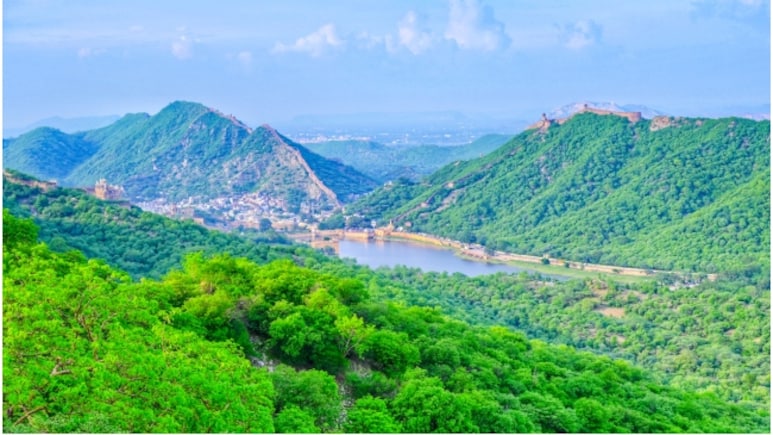
"If you were an alien or a space traveller some three billion years ago, the only discernible feature you would have seen which defined the northern margins of the landmass we call India would have been the Aravalli mountain range...But the Aravallis now struggle to survive the greed, pettiness and the extreme short-sightedness of politicians and corporations", wrote environmental campaigner Pranay Lal in his 2019 article "Aravallis: A mountain lost".
In 2025, the Aravalli range is back in the national debate. Hashtags like #SaveAravalli are flooding social media, and voices from activists to politicians decry it as a potential "death warrant" for India's oldest mountains.
But why?
A controversial Supreme Court ruling on November 20, which adopted a narrow new definition of the hills: only landforms rising 100 meters or more above local terrain now qualify as "Aravalli."
Environmentalists are warning that this could strip protections from up to 90 per cent of the range, unleashing a wave of mining, real estate grabs, and irreversible ecological havoc, accelerating desertification, crippling groundwater recharge, and dooming biodiversity in a region already gasping under pollution and water scarcity.
The question: Is this a pragmatic step toward regulated sustainability, or a devastating blow to one of nature's last defenses for northern India?
The Aravali range is the source of important rivers such as the Chambal, Sabarmati, and Luni. It acts as a shield against desertification and checks the spread of the Thar Desert towards eastern Rajasthan, into the Gangetic plain. It is richly endowed with sandstone, limestone, marble, granite, and also minerals such as lead, zinc, copper, gold, and tungsten.
Environmental activist Neelam Ahluwalia, who has been leading efforts through her organisation 'People for Aravallis' for the past 12 years, highlighted the urgency in a recent address. "The Aravalli mountain range spans 692 km across Gujarat, Rajasthan, Haryana, and Delhi, standing as a vital green barrier against the encroaching Thar Desert. It is 2 billion years old, and today it is fighting for its very existence," she said. Her words underscore the range's critical role as a natural barrier against desertification and a vital source of water and clean air for millions.
Why is the Aravalli in the spotlight now?
The immediate trigger is the Supreme Court's November 20 ruling in a long-running case aimed at addressing illegal mining and environmental protection in the Aravallis.
The court accepted a uniform definition proposed by a committee under the Union Ministry of Environment, Forest and Climate Change (MoEFCC): Only landforms rising 100 meters or more above the surrounding terrain qualify as "Aravalli hills," with clusters within 500 meters forming "ranges. This decision was intended to provide 'administrative clarity' for sustainable management, including a ban on new mining leases until a comprehensive plan is developed. However, environmentalists argue it effectively strips protections from vast swathes of the range, reopening old wounds from decades of litigation over mining bans and encroachments.
An internal Forest Survey of India (FSI) assessment reveals this excludes over 90 per cent of the range: In Rajasthan alone, only 1,048 out of 12,081 mapped hills (8.7 per cent) meet the threshold.
The ruling comes amid ongoing reports of rampant illegal mining, with GIS maps showing over 3,000 locations of damage across the region, including orange spots marking 30 years of mining scars.
They point out that such action would remove the low, scrub-covered Aravalli hills vital for conserving biodiversity, recharging groundwater, and checking dust storms. Mining on these hills could lower water tables, contaminate aquifers across Gujarat, Rajasthan, South Haryana, and Delhi-NCR, and intensify human-wildlife conflict due to shrinking habitats.
Further questions have emerged over the exclusion of key areas in the Centre's affidavit to the Supreme Court. Experts have reportedly pointed out that the ministry's list of 39 Aravalli districts left out regions such as Chittorgarh, known for its fort on a high Aravalli outcrop, and Sawai Madhopur, home to the Ranthambhore Tiger Reserve at the Aravallia Vindhya convergence.
This isn't a new issue - the Aravallis have faced threats from mining and urbanisation for years - but the judgment's timing, just before the winter parliamentary session, has amplified public scrutiny. Protests have erupted in cities like Jaipur, with demonstrators fearing "large-scale ecological damage."
Social media has exploded with discussions, including viral videos from influencers and politicians, turning a regional environmental concern into a national conversation about India's ecological future. Hashtags like #SaveAravalli and #SaveAravallisSaveAQI are flooding platforms, with viral posts, profile picture changes (led by figures like former Rajasthan Chief Minister Ashok Gehlot), and passionate calls to action amplifying fears of irreversible ecological damage- and therefore demand a rethink.
Rural communities are intensifying their fight with a one-day symbolic fast today. The protest zeroes in on Tosham Hill in Haryana's Bhiwani, the northernmost outpost of this timeless range-urging rejection of the height-based rule that could expose lower hills to unchecked mining.
Why is the Supreme Court ruling controversial?
At its core, the controversy revolves around the narrow definition, which environmentalists say will exclude over 90 per cent of the Aravalli range from legal safeguards, potentially allowing mining, real estate development, and other destructive activities on lower hills.
The court itself had previously noted in 2018 that 31 hills in the range had "disappeared" due to mining, yet it adopted a 2010 criterion pushed by the central government.
Neelam Ahluwalia called it "absolutely shocking that you pass a Supreme Court judgment and you want to wipe out one of the oldest mountain ranges on the planet," emphasising that it's "absolutely not acceptable to the people." Environmental groups like 'Down To Earth' have labeled the move "catastrophic," arguing it ignores the range's holistic ecological value beyond mere elevation.
The ruling was delivered by a bench including a retiring Chief Justice of India BR Gavai, raising questions about haste and long-term accountability.
While the court mandated a sustainable mining plan, many fear this is a loophole for retrospective clearances, echoing a related November 18 decision allowing such approvals.
On X, actor Adil Hussain urged judges to "pause and reflect," calling the decision a path to "devastation." Journalist Arvind Chotia echoed this, stating, "Aravalli cannot be measured with a 100-meter tape. Aravalli is not just a mountain. It is our lifeline."
The controversy is amplified by the range's role in combating air pollution in Delhi-NCR, where environmentalists warned pollution could "increase a thousand times if the Aravallis are not there."
Political reactions
The ruling has sparked a political firestorm, with opposition parties accusing the BJP-led central government of prioritising mining interests over the environment.
The Congress party has been vocal, slamming the Centre for "failing to safeguard the Aravallis" and warning of "very grave environmental and public health consequences."
Rajasthan MLA Ravindra Singh Bhati (an independent from Barmer) has warned that the order threatens 90 per cent of the hills, vowing, "We will save the Aravallis," and calling it a "serious blow" to the region's environmental balance.
As of December 20, no formal reversal has been sought, but calls for recalling the judgment are growing, with Neelam Ahluwalia urging, "This regressive definition has to be removed. The Supreme Court judgment has to be withdrawn. And we have to declare the entire Aravalli zone as a critical ecological zone."
Why are people concerned?
Beyond the legal semantics, the concerns are deeply rooted in the Aravallis' indispensable ecological functions.
Activist Neelam Ahluwalia explained, "The Aravalli range stands as a wall between the Thar Desert and the rest of Northwest India. If you remove the Aravallis, this entire area becomes a desert. What does that mean? Your food security, water security are directly threatened. Millions of people's lives are affected."
Ground realities paint a grim picture: In Haryana, licensed mining has "wiped out" hills in districts like Charkhi Dadri and Bhiwani over the last decade, with water levels dropping to 1,500-2,000 feet in Mahendragarh.
Illegal mining persists despite 2009 bans, leading to blown-up hills and waste dumping that contaminates aquifers with a recharge potential of two million liters per hectare. In Rajasthan (home to 80 per cent of the range) and Gujarat, mining breaches groundwater, dries up rivers like Sota Ravi and Kasavati, and creates "white hills" of waste that kill vegetation.
Human costs are staggering: Rural communities face daily "hell" from blasting accidents, with Ahluwalia recounting stories of a 7-year-old child whose head was split by flying stones and a 14-year-old losing fingers to detonators mistaken for berries. Widespread silicosis, skin diseases, and reduced crop yields due to dust plague the 692 km belt.
"People are suffering from silicosis, air pollution-related diseases. This needs to be talked about and addressed," she stressed.
Ultimately, the fear is irreversible loss: Desertification of Northwest India, worsened air pollution in Delhi-NCR, and threats to biodiversity. The activist's call for alternatives - "Why are we not looking at alternative building materials?" - highlights a broader push for sustainable policies over short-term gains.
Track Latest News Live on NDTV.com and get news updates from India and around the world

