





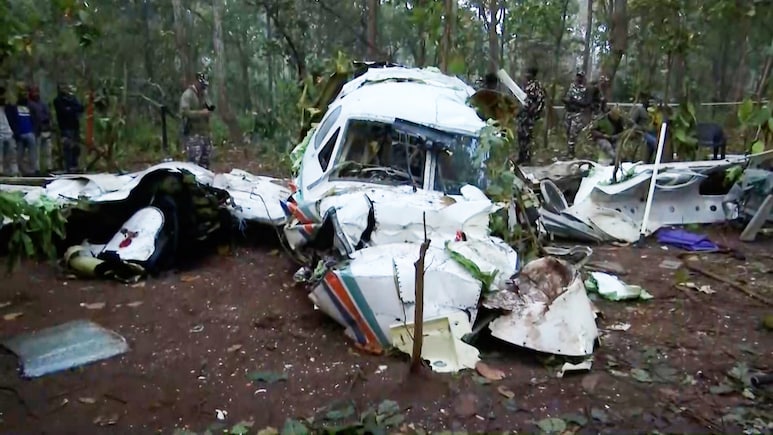
Seven people on board an air ambulance in Jharkhand were killed after worsening weather triggered a rapid sequence of events, causing the aircraft to go down just minutes after its last contact with air traffic control.
The Aircraft Accident Investigation Bureau (AAIB), in its initial findings into the February 23 crash, has reconstructed the final moments of the Redbird Airways flight. The report highlights multiple weather-related deviations before a sudden loss of communication and the subsequent crash.
“The information is preliminary and subject to change,” the report noted, adding that the investigation is focused on determining the root cause.
What Happened?
The Beechcraft King Air C90A aircraft was operating a non-scheduled air ambulance flight from Ranchi to Delhi. It crashed near Chatra district at approximately 7.24 PM.
All seven people on board, including two pilots, two medical personnel, a patient, and two attendants, died in the crash. The AAIB underlined that these findings are initial and subject to further review.
What Led To The Crash?
While the exact cause is yet to be determined, the preliminary findings point to a combination of factors:
Rapid weather deterioration is forcing multiple deviations.
Sudden loss of communication within minutes of last contact.
Possible severe turbulence or loss of control in storm conditions.
The aircraft crashed about five minutes after the last ATC contact, indicating a swift and catastrophic turn of events.
Weather Concerns Before The Crash
The pilots appear to have been actively navigating adverse weather conditions. The final moments show repeated weather-related deviations followed by a sudden loss of contact.
Even before settling on a course, the crew had requested to deviate from the planned route. “Aircraft requested ATC… to continue on Runway heading… due to weather,” the report said.
Meteorological data shows thunderstorms, haze, and cumulonimbus clouds in the region. Visibility dropped to as low as 3,500 metres with “TSRA” (thunderstorm with rain) conditions developing. The multiple heading changes and a request to reduce altitude suggest the crew was attempting to avoid severe weather cells.
No Black Box And Failed Beacon
Investigators may face challenges due to a lack of onboard recording systems. The report notes the aircraft “was not equipped with Flight Data Recorders (CVR/FDR).”
Additionally, “the ELT of the aircraft did not get activated.” This means the emergency locator beacon did not transmit after the impact, which may have delayed the detection of the crash site.
Timeline: From Take-Off To Crash
7:07 PM: Aircraft takes off from Ranchi after being refuelled. It had earlier completed a Delhi to Ranchi leg with “nil snag” reported in the technical logbook.
Just after take-off: Pilots seek deviation from the planned route, requesting to continue on runway heading due to weather. “Aircraft requested ATC… to continue on Runway heading… due to weather,” the report said.
7:09 PM: Aircraft establishes contact with Kolkata ATC, reporting a climb past 5,000 feet.
7:15 PM: Pilots request a further deviation, a right turn to heading 330 degrees, indicating continued weather avoidance. ATC approves.
7:18 PM: Pilots request to level off at a lower altitude (FL140 instead of FL160), suggesting possible turbulence or storm cloud avoidance. ATC approves.
7:19 PM: ATC instructs the aircraft to report when in contact with Varanasi. The crew acknowledges. This was the last VHF communication between the aircraft and ATC Kolkata.
Between 7:19 PM and 7:24 PM: The aircraft stops responding to ATC calls. No further transmissions are received despite repeated attempts.
7:24 PM: The aircraft crashes in Chatra district, approximately five minutes after the last contact.
7:58 PM: ATC triggers the uncertainty phase after the loss of contact. The crash site is later confirmed by locals, and a rescue response is initiated.
Aircraft And Crew Clearances
The aircraft held a valid airworthiness certification and had undergone recent inspections. Both pilots held valid commercial licences and had adequate flying experience. The same crew had flown the Delhi to Ranchi leg earlier that day with no issues recorded.
Wreckage Suggests High-Impact Crash
The aircraft was completely destroyed, with debris scattered over a one-kilometre area. “The aircraft wreckage was found scattered within a kilometre from the main wreckage,” the report stated. Key components, including both engines and the tail section, were found separated from the fuselage, pointing to a high-impact crash.
Probe Underway
Investigators have collected wreckage, engine components, fuel samples, and ATC data for analysis. Weather data from multiple airports is also being examined.
The AAIB said it is coordinating with stakeholders and international agencies, including the ICAO and the US National Transportation Safety Board, to determine the root cause. “The investigation… is in progress,” the report said, adding that records from various sources are currently being scrutinised.
Track Latest News Live on NDTV.com and get news updates from India and around the world

