




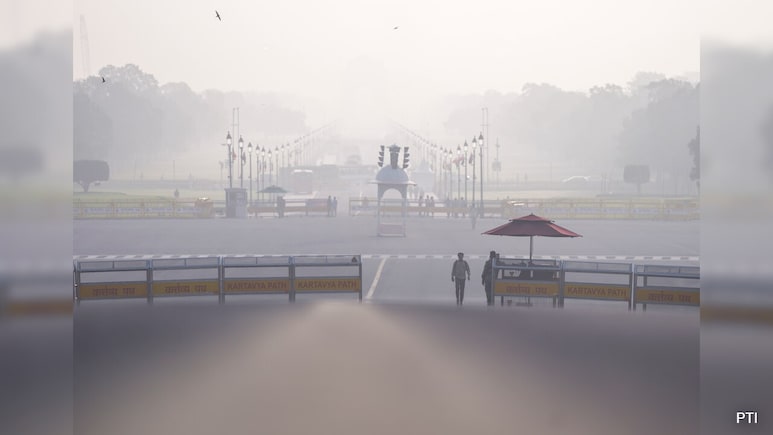
A layer of smog shrouded Delhi on Monday, as the national capital recorded its first 'very poor' air quality of the season, and three air quality monitoring stations logged pollution levels in the 'severe' category.
The city's Air Quality Index (AQI) settled at 324 in the 'very poor' category, the highest since February 4 this year, when it stood at 339. This marks the highest pollution level in nine months, after 271 days.
Three monitoring stations recorded 'severe' air quality at 4 pm. Jahangirpuri reported the worst AQI at 436, followed by Rohini at 415 and Punjabi Bagh at 413.
Of the city's 58 stations, 37 recorded 'very poor' air quality, 17 were in the 'poor' category, three reported 'severe' air quality and only one station recorded 'moderate' air quality.
According to the Central Pollution Control Board (CPCB), an AQI between zero and 50 is classified as 'good', 51-100 as 'satisfactory', 101-200 as 'moderate', 201-300 as 'poor', 301-400 as 'very poor' and 401-500 as 'severe'.
PM2.5 remained the dominant pollutant in the national capital, the CPCB said.
PM2.5, or fine Particulate Matter measuring 2.5 micrometres or less, can penetrate deep into the lungs and even enter the bloodstream. These particles are primarily generated by vehicular emissions, industrial activities, construction and road dust, waste burning and other combustion sources.
The air quality readings come on the second day of the restrictions imposed by the Delhi government to curb pollution in the city.
According to the Air Quality Early Warning System for Delhi, the city's AQI is likely to remain in the 'very poor' category from November 3 to 5. It is expected to improve marginally to the 'poor' category over the subsequent six days.
According to the Decision Support System (DSS) for Delhi, the transport sector contributed 19.2 per cent to Monday's pollution, while industries in Delhi and peripheral areas accounted for 4.2 per cent.
Among other sources within Delhi, residential activities contributed 4.9 per cent, energy 1.8 per cent, waste burning 1.8 per cent and other sectors 1.3 per cent.
Among the neighbouring National Capital Region districts, Jhajjar accounted for 6.9 per cent of the pollution, followed by Sonipat at 5.1 per cent, Gurugram at 2.9 per cent, Rohtak at 2.7 per cent, Ghaziabad at 2.6 per cent, Baghpat at 2.4 per cent, Panipat and Bhiwani at 2 per cent each, and Gautam Buddha Nagar at 1.9 per cent.
Stubble burning accounted for 8.4 per cent of the pollution, while other sources contributed 20.7 per cent, according to the DSS estimates.
(Except for the headline, this story has not been edited by NDTV staff and is published from a syndicated feed.)
Track Latest News Live on NDTV.com and get news updates from India and around the world

