



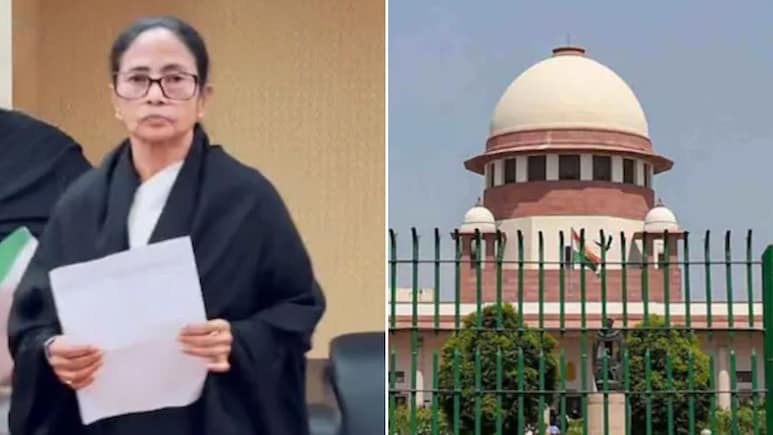
Mamata Bannerjee made history Wednesday by arguing a case – the challenge to the Election Commission's special intensive revision of voter lists – in the Supreme Court as a 'common citizen'.
In her typically fiery oratory style she denounced the EC for inflicting "unprecedented hardship and distress upon ordinary citizens across Bengal".
The Bengal Chief Minister, a black coat over her trademark white saree, waited her turn patiently, sitting for over two hours in the rear of a courtroom led by Chief Justice Surya Kant.
When her time came, she made a fervent appeal to the Chief Justice; "Justice is crying behind closed doors", she thundered, telling the court the Bengali people had not received justice.
"I, personally, wrote six letters (to the poll panel) but never got a reply…" she said.
The Bengal Chief Minister wanted five minutes to present her side.
The Chief Justice, mindful, perhaps, of the optics, gave her 15 minutes.
Why Mamata approached the top court
Her request was simple enough; she asked the court to rule that the voter lists for the March/April election be based on data from 2005 and not from the 2026 SIR.
This, she said, was because lakhs of legitimate voters – many of whom traditionally vote against the BJP – had now been excluded by poll body officials acting on directions from the ruling Bharatiya Janata Party, a charge levelled by opposition parties in other states and across India.
"A process (the SIR) that takes two years… they (i.e., the EC) want to complete it in three months? Bengal is being targeted! Why is this process not being carried out in Assam?"
Mamata Banerjee also pointed to the 8,300 'micro observers' deployed across the state by the EC, calling them "BJP officers" and labelling their appointments "unconstitutional".
In an emotional appeal, she flagged the situation facing an estimated 63 lakh people who face exclusion from rolls over 'logical discrepancies' in the preparation of electoral rolls.
She also sought directions to the Election Commission to publish – on its website and in a machine-readable format – the names of all 1.4 crore who had been struck off the roll.
And finally she also asked the court to instruct the poll body to accept the Aadhaar, a federal government-issued identification that includes biometric data, as proof of a person's identity.
What is 'logical discrepancy'
The issue cropped up after it emerged voters were being deleted on basis of a mismatch between biographic details, such as mismatch with a parent's surname or typos.
The court noted minor mismatches do happen when Bengali names are translated to English and pointed to many surnames could be spelt differently. Datta could become Dutta, the court said, noting also different spellings exist for common names like Bandhopadhyay.
This cannot be a reason for deletion, the court noted. Bannerjee also pointed to media reports about a woman being struck off the list because she changed her surname after marriage.
"Even that is a 'mismatch' for the EC," she declared, "Daughters who have shifted to their in-law's place… even their names have been deleted. Sometimes poor people shift homes or addresses for work but, under 'logical discrepancy', even their names have been deleted."
She asked the court to rule that those excluded for 'logical discrepancy' reasons be re-included in the voter rolls without being summoned for a hearing.
Claiming a conspiracy, she called the EC a 'WhatsApp Commission' for sending notices via WhatsApp to people who, she claimed, then had to stand in queues for over three hours.
On BLOs' deaths
The Chief Minister also had much to say about the deaths of BLOs, or booth level officers, who are officials appointed by the Election Commission to carry out the special intensive revision.
The opposition has argued that immense pressure is being placed on BLOs to administer the revision in what, they claim, is a manner favourable to the ruling party.
"More than 100 BLOs have died… because of the harassment of the EC… and many others have been hospitalised. Bengal is being targeted," she told the Chief Justice, "Sir, tell me… why not Assam (which also holds an election this year? Why not the northeast?" she asked passionately.
What her written submissions said
Mamata Banerjee was also represented by lawyers.
Senior Advocate Shyam Divan pointed out that only four days remain for the publication of the final list and that over 1.36 crore persons included in the 'logical discrepancy' list had yet to be heard. It is impossible to complete this before the due date publication…" he said.
Divan also submitted the EC had not displayed reasons for inclusion in this list.
What the EC said
Senior Advocate Rakesh Dwivedi, arguing for the poll body, submitted it had to appoint micro-observers since the state did not spare sufficient officers for SIR work despite reminders.
What the court said
Calling the issues raised by Bannerjee "genuine", the court ultimately issued notice to the Election Commission on the Chief Minister's plea and sought their response by Monday.
Regarding the issue of micro-observers, the bench said if the state could give a list of available officers who could be spared for SIR duties, then the micro-observers could be removed.
The Chief Justice also asked the EC to instruct its officers to act in a "sensible manner" regarding notices issued over spelling mistakes to prominent citizens, such as Nobel laureate Amartya Sen and acclaimed poet Joy Goswami, as well as Trinamool MP Dipak Adhikari.
And, Solicitor-General Tushar Mehta submitted there is an 'atmosphere of hostility' in the state against EC officials. He requested the bench to list with this matter a plea filed by Sanatan Sangsad which seeks protection for officials. The court agreed to list it for Monday.
Track Latest News Live on NDTV.com and get news updates from India and around the world

