





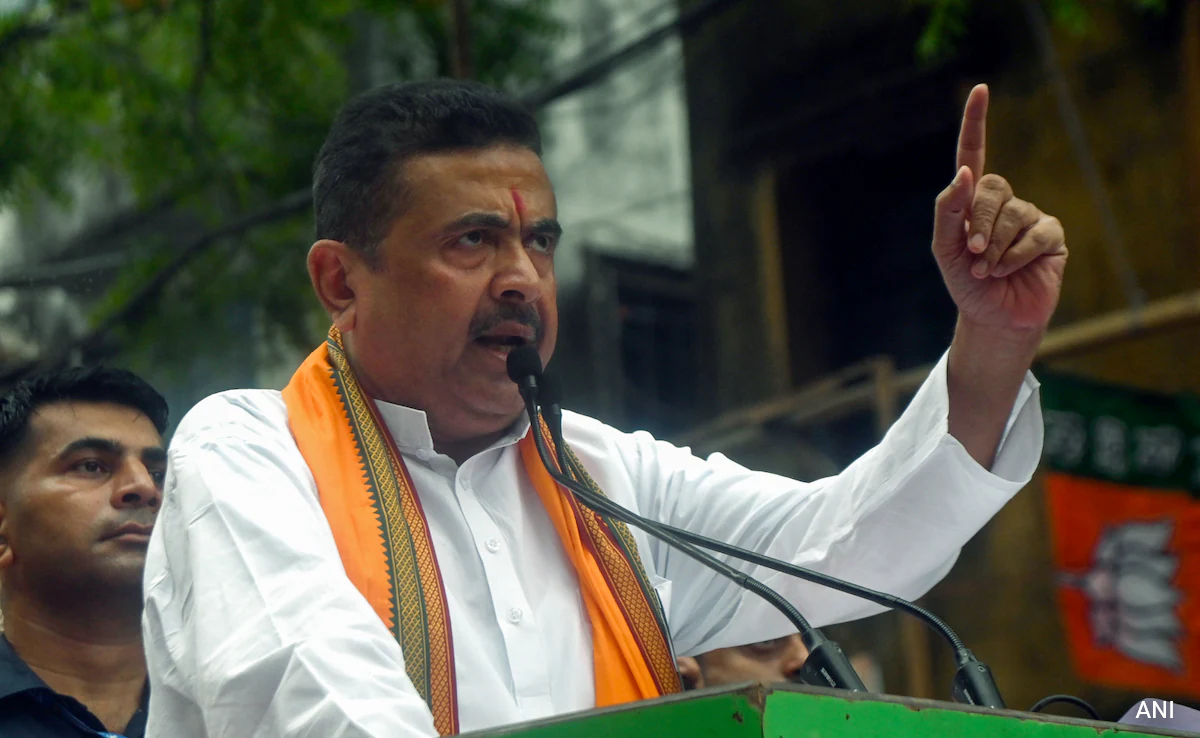
Indian political history is replete with examples of lieutenants turning on their generals, including, most recently, Eknath Shinde and Ajit Pawar taking on Uddhav Thackeray and Sharad Pawar. Few friendships-turned-rivalries, however, can match the saga of Mamata Banerjee and Suvendu Adhikari, two firebrands whose war is playing out in what is arguably India's most hotly contested political battleground - West Bengal.
While Banerjee rose through the ranks of the Congress before deciding to forge her own path and form the Trinamool Congress, Adhikari belonged to a powerful political family. His father, Sisir Adhikari, was a prominent politician in the Congress and a former Union minister under Prime Minister Manmohan Singh. Such is the family's influence in its turf of Purba Medinipur (East Midnapore) that they are often described as the "political monarchs" of the area.
Following in his father's footsteps, Suvendu Adhikari began his political journey with the Congress and was elected as a councillor in the Kanthi municipality of East Midnapore. He joined Banerjee's Trinamool Congress in 1998 and entered the Bengal assembly as an MLA from the Kanthi Dakshin constituency in 2006.
A year later, in 2007, Adhikari made a name for himself and emerged as Banerjee's chief organiser when he spearheaded the Nandigram agitation alongside the Trinamool Congress chief. Violence had broken out in the area, also part of the East Midnapore district, during protests against the Left Front-led government's plan to create a chemical hub run by the Salim Group of Indonesia. The hub was part of a Special Economic Zone (SEZ), which would require the acquisition of 10,000 acres of land.
Adhikari led the Bhumi Uchhed Pratirodh Committee (Committee Against Land Evictions), which was at the forefront of the agitation. On March 14, 2007, an attempt to break up the protests led to 14 demonstrators dying in police firing, which sparked outrage across the state. The project was shelved soon after.
The Nandigram controversy and the protests against the Tata Motors plant in Singur in the neighbouring Hooghly district catapulted the Trinamool Congress to power in the 2011 Bengal Assembly elections, ending the Left Front's 34-year rule in the state.
Central Stint, Return To Bengal
After the victory, Adhikari was rewarded with a ticket to contest the Lok Sabha elections. He won from the Tamluk constituency in 2009 and 2014, all while cementing his place as one of Chief Minister Banerjee's most trusted lieutenants.
After the Trinamool's second straight win in 2016, the chief minister asked Adhikari to return to Bengal and inducted him into the cabinet, giving him charge of the key transport portfolio. He was later given the responsibility of other ministries as well.
Differences Emerge, And The Switch Happens
Adhikari came to be seen as the second most powerful person in the Trinamool Congress, but found his power diminishing as the stature of Mamata Banerjee's nephew, Abhishek Banerjee, grew within the party. He also had differences with political strategist Prashant Kishor, who began working with the party after the 2019 Lok Sabha elections and slowly began gaining influence.
The Trinamool Congress made several attempts to placate Adhikari when he started making his displeasure clear, and things came to a head in November 2020, when he quit as the minister for transport and irrigation. He left the party soon after, and joined the BJP in December 2020, just months before the Assembly elections the following year.
BJP Loses, But 'Deserter' Wins
In a bid to prove that loyalty in Nandigram lay with her and not Adhikari, whom her party branded a 'deserter', Mamata Banerjee decided to contest the 2021 Assembly elections from the seat.
A high-profile campaign followed and while the BJP could only win 77 of the state's 294 constituencies against the Trinamool's 215 (polling was not held in two seats because candidates died), Adhikari made headlines and proved his worth to his new party by defeating Banerjee.
Throwing Down The Gauntlet
Cut to 2026, and Adhikari, 55, is the Leader of the Opposition in the Bengal Assembly and is being seen as one of the main contenders for the chief minister's post if the BJP wins in Bengal this year.
Mirroring his former party chief's 2021 strategy, Adhikari is now contesting not only from Nandigram but also challenging Banerjee in her home turf of Bhabanipur - the seat she contested from, and won, after her last election loss.
Banerjee, who lives in Kalighat in the Bhabanipur constituency, has framed Adhikari's move as an attempt by the BJP to "disturb the peace" of her home.
"I have lived in this house (in Kalighat) my whole life. I know every lane. Someone who comes from Midnapore to fight here thinks the people of Bhabanipur can be bought or intimidated, but they will give a fitting reply," the chief minister said at a rally.
Hitting back, the BJP leader has alleged that the Trinamool Congress is running a 'syndicate raj' and the people of Bhabanipur are tired of its extortion.
"They call me an outsider in my own state's capital? Every inch of West Bengal belongs to every Bengali. I am a 'bhoomiputra' (son of the soil) of Bengal, whereas their ideology is imported from elsewhere to divide us," he has said.
Like in Nandigram in 2021, the Bhabanipur battle promises to be bigger than the larger war for Bengal.
As of 10 am on Monday, Mamata Banerjee is leading in the seat even though the BJP has crossed the majority mark in the state in early leads.
Track Latest News Live on NDTV.com and get news updates from India and around the world

