





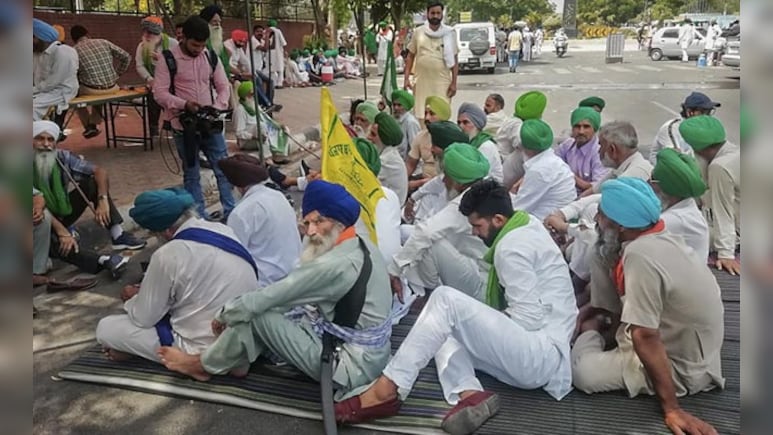
The 2020-2021 farmers' agitation had compelled the then Union government to repeal the three farm laws. It was the first time that over 400 farmer unions from across the nation, under the umbrella of the Samyukt Kisan Morcha (SKM), gathered and fuelled the farmer politics.
Of the 400 farmer unions, over 32 were from Punjab and were at the forefront of the agitation.
They also attracted the attention of Punjabis living abroad. Logistical and financial help poured in, fuelling the agitation for one-and-half years.
The developments had created an illusion of invulnerability among farmer unions. The unification swept them up in a bandwagon effect and blinded them with collective hubris.
The farmer union leaders mistook the emotional clamour of an agitation for genuine electoral strength and decided to contest the 2022 assembly elections.
Twenty-two of the 32 farmer union leaders plunged directly into electoral politics. They announced the formation of a political party named the Sanyukt Samaj Morcha (SSM), led by veteran farmer leader Balbir Singh Rajewal (President of BKU-Rajewal).
They also aligned with the Sanyukt Sangharsh Party (SSP), formed by Haryana-based farmer leader Gurnam Singh Charuni. The alliance fielded candidates in 117 assembly constituencies across Punjab. As the farmer unions could not register the Sanyukt Samaj Morcha (SSM) with the Election Commission of India (ECI as a political party, their nominees contested the election as Independents.
Psephologists say the farmer union leaders suffered from groupthink and a false sense of efficacy. Accordingly, the Sanyukt Samaj Morcha (SSM) and Sanyukt Sangharsh Party (SSP) faced a shameful defeat, failing to win a single seat and securing a dismal vote share of just around 1.5 per cent.
Prominent farmer union leaders suffered a complete rout under the AAP wave, with every key figure failing to win a seat or even save their security deposit.
Balbir Singh Rajewal, head of BKU (Rajewal) and SSM's Chief Minister face, contested from Samrala and secured just 4,676 votes. Harmeet Singh Kadian of BKU (Kadian) polled about 3,800 votes from Sahnewal; Rashpal Singh Jaddian of the All India Kisan Sabha (Punjab) received around 2,200 votes from Chamkaur Sahib; Bogh Singh Mansa of BKU (Mansa) polled roughly 2,000 votes from Maur, while Prem Singh Bhangu of the All India Kisan Federation managed only 1,681 votes from Ghanaur.
Facing a shameful drubbing, the farmer leaders realised that heading a union and collecting donations and rations were easier than contesting an election.
A particular farmer union's supporters came from various constituencies and not from a single constituency. The leaders who lost the election offered different explanations to mask their defeat.
Prominent farmer union leader Balbir Singh Rajewal said they contested the election on public demand to save Punjab. "We didn't contest the election for power but to improve the system," he said.
Another prominent farmer union leader, Joginder Singh Ugrahan, who heads Bharatiya Kisan Union (Ekta Ugrahan) -- the strongest single union in the Malwa belt of Punjab -- opposed politicisation of the farmer agitation and maintained that farmer unions should remain apolitical. "We will continue to work as a pressure group," he said.
Gurnam Singh Charuni, Head of BKU-Charuni & Leader of Sanyukt Sangharsh Party, who contested the Haryana assembly poll in October 2020 from Pehowa, polled 1,170 votes and lost his deposit.
"Unlike the mainstream political parties which have both money and muscle power, we contested the election purely on moral support. We understand that contesting an election requires not only massive resources but also a party machinery," Gurnam Singh Charuni said.
"The imbalance carried clear political consequences. When farmer leaders tried to convert street power into votes in the 2022 Assembly elections, the lack of full backing from the farmer-union stronghold Malwa - especially BKU (Ekta-Ugrahan) - proved decisive. The Sanyukt Samaj Morcha's total rout underlined a basic truth: Punjab's farmer organisations can still challenge the Centre at Delhi's borders, but their internal strength remains heavily skewed towards Malwa," said Prof Varinder Sharma, Director, Institute for Development and Communication (IDC), PU, Chandigarh.
Malwa Remains the Citadel of Punjab's Farmer Power politics
Prof Pramod Kumar and Prof Varinder Singh, Chairman and Director, respectively, at the Institute for Development and Communication (IDC), PU, Chandigarh, have conducted extensive research on Punjab's polity and economy. They say the presence of various farmer unions, the largest in the northern region, shows the unions are based on differences in opinion and issues.
"From the pre to post Green Revolution periods, there were differences in political ideology among farmers and antagonism between tenants, labourers, and landlords. Unions always remained left- and right- centric. After recent farmers' protests, farmers remained united to save the farm economy, but the different unions do not stick to a single political ideology," said Prof Varinder Sharma.
Punjab's farmer union landscape is sharply uneven. Of the 32 major unions that coordinated during the 2020-21 farm law agitation, the overwhelming majority - roughly 22 to 25 - were primarily rooted in the Malwa region, which has 69 out of 117 assembly constituencies.
Malwa accounts for 60-70 per cent of the state's active farmer union cadre and organisational strength. Districts such as Bathinda, Mansa, Sangrur, Barnala, Muktsar and Ferozepur form its core. This region became the strongest base of farmer unions due to larger landholdings, deeper agrarian distress and a long history of radical peasant mobilisation.
Punjab's largest farmer union, BKU (Ekta-Ugrahan), draws its primary strength from Malwa alongside BKU (Dakaunda), Kirti Kisan Union, Krantikari Kisan Union, BKU (Rajewal), BKU (Mansa), and several smaller factions.
Doaba has 23 assembly constituencies and has only a moderate presence, with about four to six farmer unions of significance. This region has smaller landholdings compared to Malwa; high NRI remittances and sugarcane cultivation shape a narrower focus. BKU (Kadian), the Doaba Kisan Committee and sugarcane growers' associations are the main farmer unions which focus on local issues such as MSP and irrigation rather than mass cadre mobilisation.
Majha, with 25 assembly constituencies, has the thinnest density of farmer unions. With just three to four unions, the influence of farmer politics is limited to strategic border pockets. The Kisan Mazdoor Sangharsh Committee (KMSC) is the most significant organisation in this region, followed by the Jamhoori Kisan Sabha and a scattered presence of other groups.
Having a bitter electoral experience in 2022, farmer union leaders may not contest the 2027 assembly elections with the same enthusiasm. The enthusiasm seen in 2022 is missing in 2026, as not even a single farmer union has announced its desire to contest the 2027 assembly elections.
The unification of farmer unions witnessed in 2022 during the agitation against the three farm laws was missing in later agitations. Many leaders, including Balbir Singh Rajewal of BKU Rajewal, besides others, opposed the proposed India-US Free Trade Agreement individually.
The Kisan Mazdoor Sangharsh Committee (KMSC), with three to four splinter unions, tried to march towards New Delhi to protest the India-US Free Trade Agreement but was stopped at the Shambhu border and later suspended.
Track Latest News Live on NDTV.com and get news updates from India and around the world

