





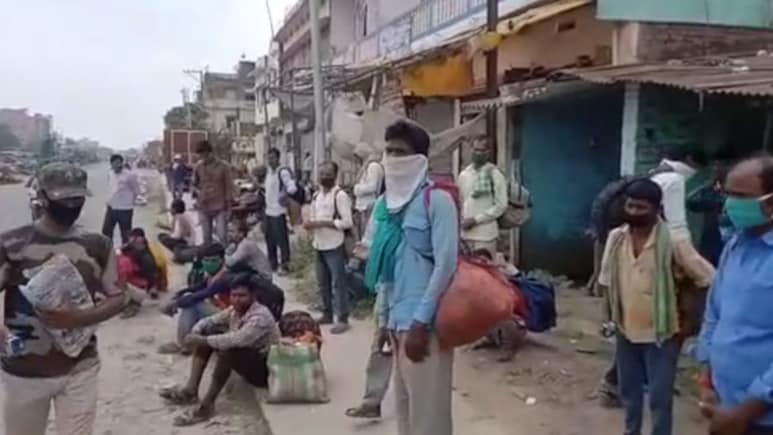
- The number of migrant labourers in Punjab grew from 4,000 in 1971 to 3.3 million today
- About 70 per cent of migrant workers are in industries, the rest in agriculture
- Migrants face identity, language, and organisational barriers, limiting their political participation
Migrant labourers, who form the backbone of Punjab's economy today, had started making a beeline for the state in 1960s and early '70s, when the Green Revolution started. Today, from 4,000 in 1971, their numbers have reached an estimated 3.3 million. Around 70 per cent of them work in industrial units and the rest in the farm sector. Even so, their presence is largely ignored by political parties during the state elections.
Government data shows that migrant labourers account for 12 to 15 per cent of Punjab's population; the majority (80 to 90 per cent) come from Bihar and Uttar Pradesh.
The only Bihari MLA in the Punjab assembly is Kunwar Vijay Pratap Singh, a former Punjab cadre IPS officer who was elected from Amritsar North on an AAP ticket. Born in Karsghat village in Bihar's Gopalganj district, he served Punjab in various capacities and resigned as the IGP.
The political parties that dominated UP and Bihar politics had tried their luck in Punjab and failed.
The BSP, which has an alliance with the BJP, won one seat from Nawanshahr in 2022. It was an improvement on the 2017 and 2012 elections, when they failed to win a single seat.
The BSP's vote share, which was 4.29 per cent in 2012, slipped to 1.52 per cent in 2017 and 1.77 per cent in 2022.
The Samajwadi Party had fielded 18 candidates in Punjab's migrant labourer stronghold constituencies as a token presence but secured only 0.03 per cent of the votes.
There were no top-tier leadership rallies in Punjab. The Janta Dal United had fielded two candidates in 2022 but lost their security deposits.
While Mayawati addressed a lone rally in Nawashahr, Nitish Kumar and Tejaswi Yadav skipped campaigning. Yogi Adityanath also skipped campaigning in Punjab.
Five Reasons Why Migrant Labourers Are Politically Sidelined
It is not clear why migrant labourers, who helped Punjab shape its economy, remained politically sidelined and were not given representation in the state assembly and local self-government.
While the Election Commission does not maintain separate data for migrant labourers whose names are included in the local Punjab voter list, hundreds of migrants are also unable to transfer their votes due to a lack of requisite documents. The labourers who seasonally migrate to Punjab, retain their voting rights in their respective states.
Political parties also treat them as a transient workforce, not as a vote bank.
Another reason migrants have failed to enter Punjab's polity is their lack of Punjabi identity. Most of them are either Hindu or Muslim, not Sikh.
The migrants are also unorganised. The majority work as farm labourers, construction workers or in small unorganised units. They lack strong unions or political patrons. Without collective bargaining power, parties have little incentive to address their housing, schooling or wage concerns.
The fear of native backlash also prevents them from entering politics in Punjab. Punjab's polity is sensitive about demographic change, land and cultural identity. Actively organising migrants as a distinct bloc carries the risk of triggering local anxiety and counter-mobilisation.
Parties therefore treat them as an economic necessity rather than a political constituency.
Migrant voters have limited outreach and face everyday exclusion.
Language barriers, weak knowledge of local administration and absence from neighbourhood patronage networks keep them outside everyday circuits of politics. Parties invest little in registering, informing or integrating them.
NDTV tried to speak with some labourer unions, but they were unwilling to speak on the record. One labour union leader, Darshan, who heads the Bhatta Mazdoor Union, was also hesitant.
"The labourers are not united; they belong to fragmented groups. They fear a backlash and are not assertive. They can only become a force if they are united," Darshan said.
Surge in Anti-Migrant Sentiment:
The same community of migrant labourers that sustains Punjab's economy has been subject to hatred and racist remarks. They are also subject to exploitation and public policing by the vigilante Nihang groups. Videos of the ill-treatment meted out to the migrant labourers are viral on social media.
September 2024 witnessed an exodus of migrant labourers from Punjab when so-called vigilantes targeted the entire population after a migrant labourer allegedly raped and killed a five-year-old in Hoshiarpur. The incident triggered a fresh wave of "Bhaiye bhajao, Punjab bachao" slogans, viral videos of families heading to railway stations, and open hostility.
Similar flashpoints occurred earlier as well.
The 2009 Ludhiana riots saw migrant colonies attacked after payday muggings; the 2007 Shingaar Cinema bomb killed six when a Bhojpuri film was being screened; the late-1980s massacre of farm workers by militants and more recent incidents such as the February 2026 Moga roadside firing claimed as a "protest" against migrants.
Village panchayats have occasionally posted rules restricting movement, attire or tenancy.
Each episode leaves scars and feeds a narrative that outsiders are changing Punjab's cultural fabric - even when factories and farms would grind to a halt without them.
Associations of Bihar and Purvanchal origin, along with intellectuals, artists and farmer groups, have repeatedly urged calm, stressing that migrants form the backbone of Punjab's agriculture and industry and that crimes must not be used to stigmatise entire communities.
As 2027 approaches, the deeper challenge is whether Punjab's politics can absorb the fact of their permanence without turning economic interdependence into permanent mutual suspicion.
Track Latest News Live on NDTV.com and get news updates from India and around the world

