





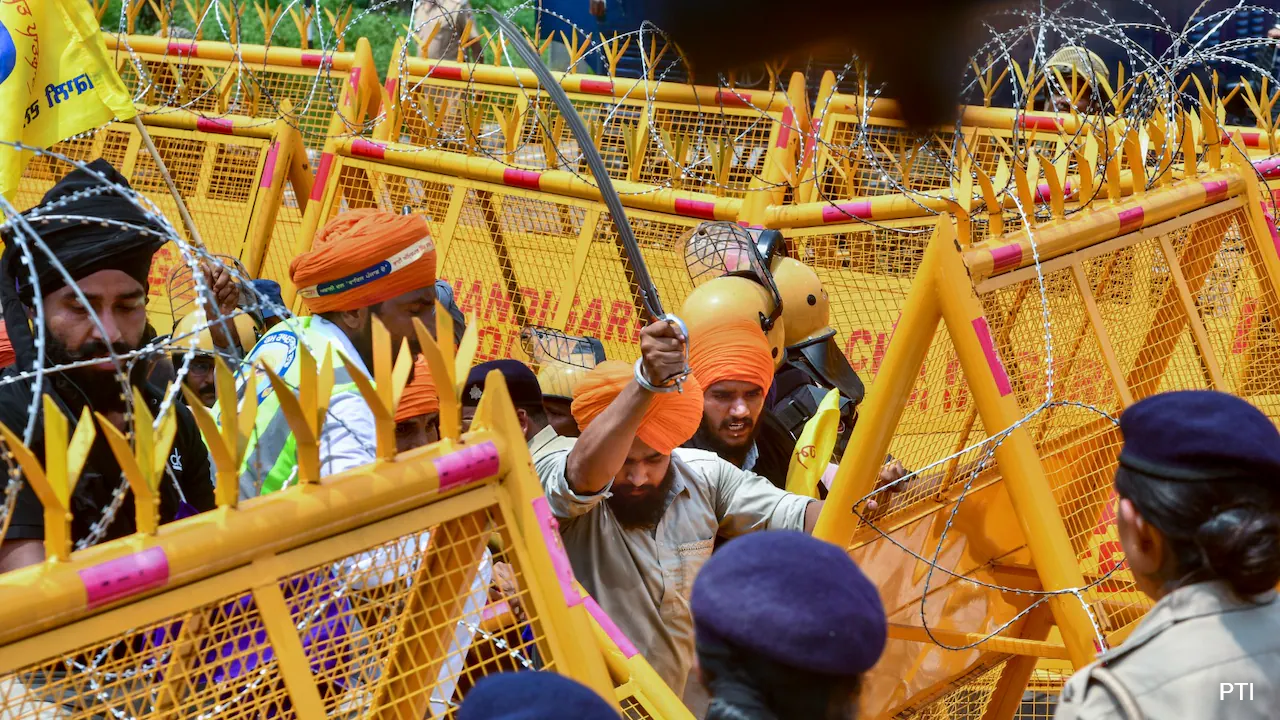
One mobilisation alone may not establish a new political order, but the Akali Dal Waris Punjab De's massive march in Chandigarh has unmistakably signalled that Panthic politics remains a potent force in Punjab. More importantly, it has underlined that the vacuum created by the decline of the Shiromani Akali Dal is now being actively contested.
The July 29 rally, organised to demand the release of jailed Khadoor Sahib MP Amritpal Singh, was not merely a protest. It was the first major public demonstration of organisational strength by the party and a declaration that it intends to emerge as the principal political vehicle for Panthic aspirations.
Shiromani Akali Dal's Dominance
The significance of the mobilisation lies not just in the numbers but in what it represents. Until a few years ago, such a show of strength in Chandigarh would have been almost unthinkable outside the Shiromani Akali Dal. For decades, the Akali Dal enjoyed an unrivalled hold over Sikh religious and political issues, commanding the cadre, the organisational network and the legitimacy to mobilise thousands on Panthic causes.
That political dominance has steadily unravelled following successive electoral defeats, the fallout of the 2015 sacrilege controversy, internal dissent, and the party's fractured leadership.
The Akali Dal today is grappling with organisational weakness, while multiple breakaway factions have further fragmented the traditional Panthic vote. Yet none of these splinter groups has managed to emerge as the undisputed successor to the Akali Dal's Panthic legacy.
Waris Punjab De's Opportunity
That is precisely where Waris Punjab De sees an opportunity.
The Chandigarh march demonstrated that the appeal of Panthic politics has not diminished with the decline of the Akali Dal. Instead, it has exposed that the constituency continues to exist, waiting for a political force capable of articulating issues relating to Sikh identity, religious institutions, federal rights and the continued detention of Sikh prisoners.
The choice of Chandigarh was equally symbolic. Unlike district-level protests in Punjab, a mobilisation in the joint capital carries greater political visibility and sends a message not only to the Punjab government but also to the Centre. Bringing thousands of supporters to the city despite heightened security and administrative restrictions reflected organisational capability that many had not associated with the party.
Challenge For Punjab's Mainstream Parties
The development also presents a challenge for Punjab's mainstream political parties. The Aam Aadmi Party has attempted to balance governance with outreach to Sikh religious institutions, while the Congress has largely stayed away from aggressively pursuing Panthic issues.
The BJP, despite expanding its footprint in Punjab, continues to have limited resonance on Sikh religious politics. With the Akali Dal weakened, no established party today enjoys a monopoly over the Panthic narrative.
The timing of the mobilisation is equally significant. It comes amid renewed debate over sacrilege legislation, repeated interventions by the Akal Takht on political issues, and demands surrounding Sikh prisoners and Centre-state relations. These issues continue to evoke strong emotional responses across sections of Punjab's electorate, making them politically relevant despite the state's growing focus on governance, employment and drugs.
Whether Waris Punjab De can translate emotional mobilisation into electoral success remains an open question. Sustaining momentum, building a state-wide organisation and broadening its agenda beyond symbolic issues will be crucial tests before the 2027 Assembly elections.
Yet, irrespective of its electoral prospects, the Chandigarh gathering has already altered the political conversation. It has demonstrated that Panthic politics remains a mobilising force in Punjab and that the battle to inherit the space once dominated by the Shiromani Akali Dal has well and truly begun.
Track Latest News Live on NDTV.com and get news updates from India and around the world

