





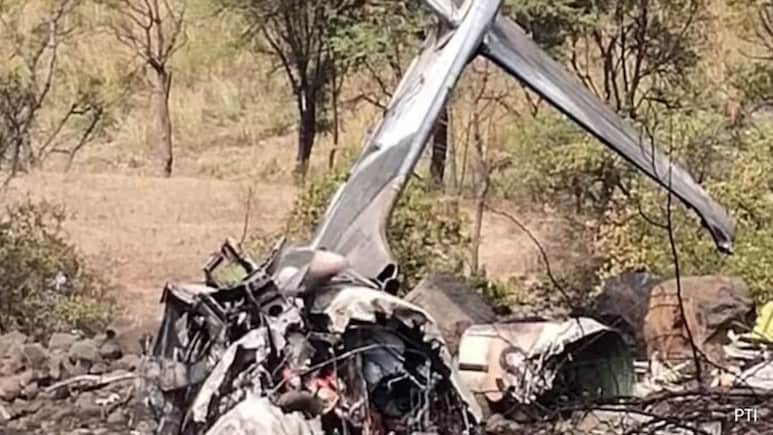
- The Baramati crash raises concerns over uncontrolled airfields for VIP movements in India
- Reports cite missing air traffic control, navigational aids, and local weather support at these airfields
- Around 150 uncontrolled airports exist, many lacking basic safety infrastructure for landings
The recent plane crash in Maharashtra's Baramati that killed five including deputy chief minister Ajit Pawar has once again put the spotlight on uncontrolled airfields, and raised serious questions over whether they are fit for VIP movements at all.
An NDTV review of all 68 final accident reports published by the Aircraft Accident Investigation Bureau (AAIB) since its creation in 2012 shows at least nine serious crashes at, or in the immediate vicinity of, uncontrolled airfields, many during landing attempts.
These accident reports are primarily training flights and sorties operated by flying training organisations (FTOs) over the past decade. While investigators cite different accident-specific causes in each case, the reports do flag missing air traffic services, lack of local weather assessment, inadequate surveillance, and absence of basic navigational aids at these airfields.
Baramati airport is classified as 'Class G', meaning it lacks basic navigational aids and doesn't have a full-time air traffic controller (ATC) system and fire trucks, unlike other commercial airports. The ATC functions at Baramati are handled by instructors and pilots from the two private flying schools based there - Redbird Aviation, and Carver Aviation - rather than an independent, full-time ATC unit.
"There are around 150 uncontrolled airports in India. The issue is whether these airfields should be used for VIP transfer when they lack basic aids. Training flights and sorties have crashed here, some of them fatal," a pilot who has flown this sector said.
"In that situation, it is imperative to revisit which airfields are deemed fit and which are not. Some of these airfields see periodic VIP and private activity," the pilot said.
Pawar had reportedly asked for amenities such as a precision approach path indicator (PAPI), a light system that provides visual guidance to the runway for safer approaches; night-landing aids, and a regular ATC.
Missing Aids
Final AAIB reports from 2013 onwards document multiple serious and fatal FTO accidents at uncontrolled airfields, or while trying to land at airports that lacked one or more of the following: air traffic services, on-site meteorological support, surveillance systems, and basic navigational or approach aids. These deficiencies did not always directly cause the crashes, but they recur as concerns and feature in safety recommendations even as the probable causes cite pilot errors among other reasons.
On January 5, 2023, a fatal night training sortie operated by an FTO crashed after missed approaches to Rewa aerodrome as the crew could not see the runway due to low visibility. The chief flight instructor (CFI) headed towards Varanasi, but was told over the radio that the runway there was closed due to an official notice to airmen (NOTAM). The interpretation of the instructor in respect to the communication made with the ATC controller regarding the NOTAM was incorrect, the investigation found.
The CFI then turned back to Rewa for another landing attempt, but because of heavy fog and poor visibility, the crew was unable to find the airfield and crashed at Umri village, located around 1.6 km from the aerodrome. In this process, the crew had gotten disoriented and kept on descending the aircraft to identify any visual cues, the report notes. The CFI died in the crash.
Rewa airport lacked a dedicated meteorological facility, so visibility was estimated based on India Meteorological Department (IMD) reports from Varanasi and Jabalpur airports, which showed visibility of about 2,000 metres with haze, a common issue in north India during January. The AAIB report mentions that as per the statement of the eyewitnesses, student pilots and instructors, the visibility at night in Rewa was 2,000 metres, which was assessed based on visibility of a school tower (used as visibility marker), which eventually kept deteriorating.
The investigation team later verified this phenomenon, noting that even an ATC tower just 60 metres away became invisible. The airfield also lacked navigational aids. Among other causes behind the accident, the AAIB noted the "lack of specific arrangements for assessing local visibility at Rewa". "There was a lack of planning or preparedness to respond to the emergency situations such as these," the report noted.
In another crash on January 21, 2022 of a FTO training flight went down on agricultural land near Aligarh aerodrome. Investigators later highlighted ambiguity in the civil aviation regulator DGCA's instructions that allowed night flying below standard visual flight rules (VFR) conditions amid low-visibility at an uncontrolled airfield.
The report identified a separate accident-specific probable cause, distinct from the infrastructure observations. Aligarh airport has the physical infrastructure of an ATC tower and an Airports Authority of India (AAI) representative, yet the tower remains non-functional. As an uncontrolled airfield, it lacks the essential navigation and safety tools required for precision landings, specifically missing an Instrument Landing System (ILS), PAPI, and dedicated meteorological or ATC services.
"DGCA may consider issuing instructions for commissioning of ATCs at uncontrolled Airports where ATC towers are available, to facilitate a safe flying training environment and better control of flying activities at FTOs," the AAIB said in its safety recommendations.
In another fatal accident report in February the same year, the AAIB recommended that the Directorate General of Civil Aviation (DGCA) should immediately require all uncontrolled airfields to record radio conversations (VHF communications) between the tower and aircraft, and conduct an audit of the Nagarjunasagar airfield from where the aircraft had flown before crashing at Thungathurthy village. The exact cause of the accident couldn't be ascertained, and investigators believed that it was likely due to technical issues in the aircraft. However, it said there was "lack of guidance available over VHF in case of emergency".
Similarly, in another fatal training accident in July 2021 where the student pilot lost his life, the airfield was found to have only a single windsock and no additional navigational aids even though the probable cause of the accident among others was noted to be non-adherence to standard operating procedures (SOPs).
On June 29, 2020, an FTO-operated aircraft crashed in Odisha's Birasal, killing two. The investigation reiterated the need for CCTV installation at uncontrolled airfields. A May 2, 2015 fatal accident involving an FTO training sortie at Begurkolli grass strip in Karnataka's Coorg again underscored limitations of operating from an uncontrolled grass strip with no navigational aids or windsock. The probable cause of the accident was found to be modifications in the microlight as well as a delayed touchdown on the glass strip.
Similarly, the August 7, 2013 accident involving a training motor glider at the Deoghar uncontrolled airstrip noted the lack of an on-site meteorological facility, with weather information sourced from Ranchi.
This was not Baramati's first crash. In a September 2021 crash, investigators stated that the absence of CCTV footage, VHF communication recordings, or retrievable data from the Garmin G3X system prevented full corroboration of witness accounts. Wreckage analysis indicated the trainee pilot had not followed the correct landing procedure after becoming airborne again.
Baramati saw an FTO training accident in June 2013, where loose pebbles were found near the threshold of Runway 29, raising concerns over runway condition monitoring rather than contributing to the specific probable cause.
"Lessons should be taken from these crashes and safety recommendations should be made now, especially after the Baramati crash for laying down basic infrastructures at airstrips that see traffic over and above the FTO operations," another pilot who files for a private operator said.
Track Latest News Live on NDTV.com and get news updates from India and around the world

