



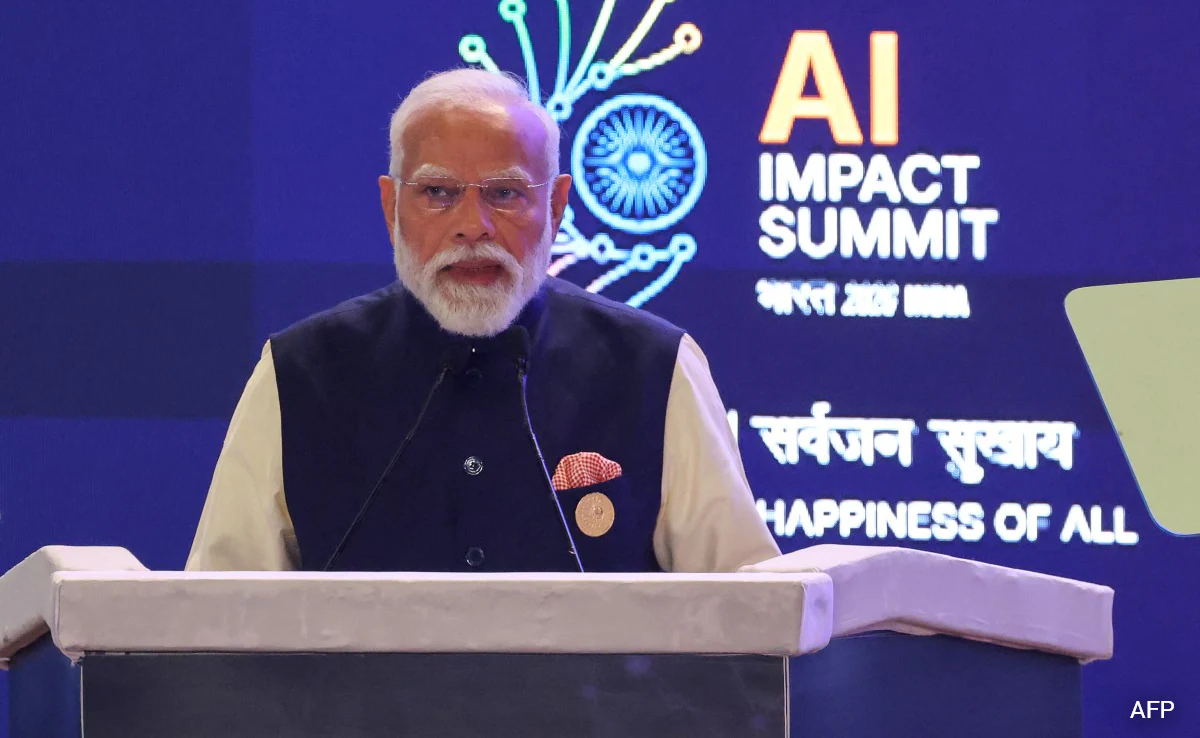
After six days of intense deliberations, demonstrations, and cross-border dialogue, the AI Impact Summit concluded this week at Bharat Mandapam in New Delhi with the adoption of the AI Impact Summit Declaration, a sweeping statement of intent that places human welfare, shared prosperity, and global cooperation at the heart of the artificial intelligence revolution.
Held from February 16 to 21, the summit brought together delegates from more than 85 countries and international organisations, marking one of the broadest multilateral engagements on artificial intelligence to date. The Declaration itself was finalised during the leaders' sessions on February 18 and 19 and formally released on Saturday, setting out a vision for how AI should evolve-not merely as a tool of efficiency or profit, but as a public good aligned with humanity's collective aspirations. The AI global event celebrated as a festival in India saw participation of over 300,000 people, making it the biggest technology-linked event on the planet.
Rooted in the Sanskrit maxim "Sarvjan Hitaye, Sarvjan Sukhaye" -- welfare for all, happiness for all-the Declaration frames AI as a defining force of this century and warns that today's policy choices will determine whether its benefits are widely shared or narrowly concentrated. Participants acknowledged that AI represents an inflection point comparable to the industrial revolution, demanding new forms of international cooperation that cut across governments, industry, academia, and civil society.
Seven Pillars For A Shared AI Future
The Declaration is structured around seven "Chakras", or pillars, that guided discussions throughout the summit. These include human capital development, social empowerment, trust and security, energy efficiency, AI for science, democratisation of AI resources, and the use of AI for economic growth and social good.
Rather than proposing binding rules, the Declaration emphasises voluntary, non-binding frameworks designed to foster shared understanding while respecting national sovereignty. This approach reflects the summit's effort to bridge divergent national priorities - particularly between advanced AI economies and developing countries seeking access to foundational technologies.
A central theme running through the text is democratising AI resources. Delegates underscored that robust digital infrastructure, affordable computing power, and meaningful connectivity are prerequisites for inclusive AI adoption. Inspired by the idea of "Vasudhaiva Kutumbakam"-the world as one family-the Declaration takes note of the Charter for the Democratic Diffusion of AI, a voluntary framework aimed at widening access to foundational models, datasets, and compute while supporting locally relevant innovation.
From Innovation To Impact
On economic growth and social good, the Declaration highlights the transformative potential of AI across healthcare, agriculture, education, climate resilience, and public service delivery. Open-source approaches and accessible AI models were repeatedly cited as tools to ensure scalability and adaptability across regions.
In this context, the Global AI Impact Commons was acknowledged as a practical platform to help countries replicate and scale successful AI use cases. By focusing on real-world impact rather than abstract capability, summit participants signalled a shift toward outcome-driven AI cooperation.
Trust and security formed another major pillar. The Declaration recognises that public confidence in AI systems is essential for widespread adoption. While noting the evolving nature of AI-related security risks, participants emphasised industry-led voluntary measures, technical safeguards, and policy frameworks that protect the public interest without stifling innovation. The Trusted AI Commons, a collaborative repository of tools, benchmarks, and best practices, was welcomed as a shared resource adaptable to national contexts.
Science, Skills, And Society
The role of AI in accelerating scientific discovery received special attention. The Declaration calls for removing structural barriers to AI research infrastructure and promoting international scientific collaboration. The proposed International Network of AI for Science Institutions aims to connect researchers across regions, pooling expertise and computational resources to tackle global challenges - from drug discovery to climate modelling.
Equally prominent was the emphasis on human capital. Delegates agreed that AI's promise cannot be realised without large-scale investment in skills, reskilling, and public awareness. The Declaration takes note of voluntary guiding principles for reskilling in the age of AI and a playbook on AI workforce development, designed to help governments and institutions prepare workers and public officials for an AI-driven economy.
For social empowerment, the text highlights AI's potential to expand access to knowledge, services, and economic opportunities, particularly for marginalised communities. A proposed collaborative platform for sharing learning and scalable practices aims to accelerate inclusive AI adoption across borders.
Sustainability At The Core
Acknowledging the growing energy and resource demands of AI, the Declaration places sustainability at the centre of future development. Participants stressed the importance of energy-efficient models, resilient infrastructure, and affordable systems that can spur local innovation without exacerbating environmental pressures. Voluntary guiding principles on resilient, innovative, and efficient AI, along with a playbook on resilient AI infrastructure, were recognised as reference tools for policymakers and developers alike.
A Broad Coalition, A Shared Direction
The Declaration is endorsed by a wide coalition spanning every continent, including major economies, emerging markets, small island states, and international organisations. This breadth lends political weight to its core message: that AI governance cannot be shaped by a few actors alone.
In its concluding note, the Declaration affirms that the AI Impact Summit has strengthened international cooperation and a multistakeholder approach to AI governance. While stopping short of enforceable commitments, it reflects a growing global consensus that the future of AI must be guided by shared values, practical collaboration, and a clear focus on human well-being.
As delegates departed New Delhi, attention turned to implementation. The real test of the AI Impact Summit Declaration will lie not in its language, but in whether its principles translate into concrete action - turning aspiration into impact in an AI-enabled world now rapidly taking shape.
Track Latest News Live on NDTV.com and get news updates from India and around the world

