

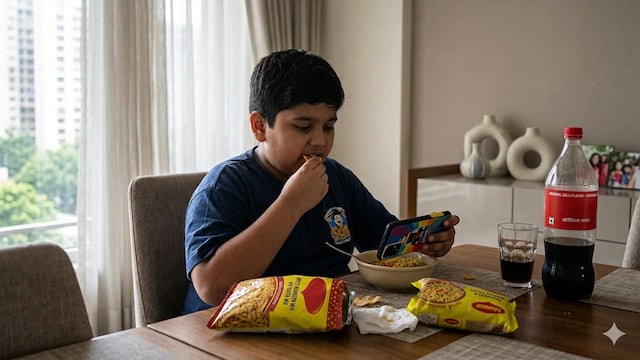
India ranks second globally in childhood obesity and it is a rapidly escalating public health crisis. As WHO issues its first global guidelines to treat obesity among children and adolescents, Indian experts explain what parents need to know; from food and lifestyle changes to metabolic health and weight-loss medicines.
For generations in India, a chubby child was culturally celebrated as a "Khate-peete ghar ka bachcha", but today childhood obesity can no longer be dismissed as "puppy fat" or something a child will automatically grow out of. For Indian parents, one of the first challenges may simply be recognising when weight has actually become a health concern. "Indian parents and grandparents don't understand the seriousness of the issue and often don't want to accept that the child is overweight. We have to explain them that childhood obesity can lead to metabolic disorders and obesity in adulthood", says Dr (Maj) Manish Mannan, Senior Director & HOD, Paediatrics and Neonatology, Paras Hospital, Gurugram.
Overweight and obesity among adolescent girls increased from 2.4% to 5.4%, while among adolescent boys it rose from 1.7% to 6.6%, according to NFHS data highlighted by UNICEF India. Among children under five, overweight increased from 1.5% to 3.4% between NFHS-3 and NFHS-5.
As per the NFHS 6 (2023-24), 1.3 percent children under 5 were found to be overweight.
Let's look at the global numbers as well to understand the severity of childhood obesity. The prevalence of obesity in this age group has quadrupled since 1990, rising from 2% to 8%. WHO also estimates that around 400 million children and adolescents aged 5 to 19 were overweight in 2024.
With the first global guidelines for managing obesity in children and adolescents, what does that actually mean for an Indian child?
When Is A Child's Weight Actually A Problem?
"Any child who is one standard deviation above the median is considered overweight, and any child who is two standard deviations above it is considered obese", adds Dr (Maj) Mannan.
The new WHO guidelines put structured dietary interventions, physical activity and behaviour-change interventions at the centre of childhood obesity management.
But this isn't simply a prescription to "eat less and exercise more".
India's children may eat dal, roti and sabzi but also have biscuits, packaged snacks, sugary drinks and other processed foods through the day. UNICEF India has highlighted how fast foods, ultra-processed foods and drinks high in fat, sugar and salt are increasingly replacing fruits, vegetables and traditional diets, alongside the influence of marketing and easy availability. "As per the NFHS 6 (2023-24), only 15.3 children age 6-23 months receiving an adequate diet. Essential macronutrients like protein, healthy fats, vitamins and minerals are missing in their plate. There might be mitigation of calorie hunger, but mitigating protein and hidden hunger remains a challenge", shared Basanta Kumar Kar, known as the Nutrition man and author of Malnutrition: Fed or Misled? The Truth Beyond Food.
Hence India faces the undernutrition as well as excess weight can together. Mr Kar addresses malnutrition as a spectrum that includes undernutrition, micronutrient deficiencies and obesity. "Thinking that an overweight or obese child is necessarily a well-nourished child is a blunder. An overweight or obese child can be and often is malnourished. With rising incidence of pre-diabetic condition and overnutrition among the children, India must take serious note on childhood overweight and obesity", adds Mr Kar.
READ | WHO Issues First Guidelines For Child Obesity: Focus On Behaviour, Not Drugs
As per the WHO- Childhood obesity is associated with a higher chance of premature death and disability in adulthood. Overweight and obese children are more likely to stay obese into adulthood and to develop noncommunicable diseases (NCDs) like diabetes and cardiovascular diseases at a younger age. This has both inter and intragenerational impacts.
Childhood obesity isn't just about appearance. The WHO guidance highlights obesity as a disease that can affect children's health, functioning and wellbeing. "A child can look completely healthy, active and symptom-free and still have obesity-related metabolic abnormalities. Obesity can silently affect the blood pressure, cholesterol, blood sugar and liver. A routine paediatric check-up can detect these changes early when they are often reversible," shared Dr Neelam Mohan, Senior director, Pediatric Gastroenterologist Hepatologist, Medanta Medicity Gurugram and President Indian Academy of Pediatrics.
There is an emotional dimension too. Stigma around body weight can affect children's wellbeing. Parents need if deal with that angle as well. "We love you exactly as you are but your doctor has noticed that your body is growing in a way that may put extra stress on things like your heart, blood sugar or liver. Let's work together on healthy habits that will help your body feel and function well by working on our meals, sleep and fun activities together," adds Dr Mohan on how to put the message to children.
WHO does not recommend pharmacological treatment for children aged 0-9. For adolescents aged 10-19, approved obesity medicines may be considered when supervised, multimodal lifestyle interventions have not produced the desired results. In severe adolescent obesity, bariatric surgery may be considered under specific conditions. Dr Manish Manan says, "The guidelines are quite clear: these medicines should not be given to children unless they are genuinely indicated and recommended by a doctor. GLP-1 medicines and other weight-loss drugs can have side effects, and parents should understand that these are not quick-fix solutions. Medication should be considered only for children who meet the appropriate criteria and under close medical supervision."
READ | Can A Junk Food Tax Make India Healthier? Here's What Evidence Say
The final question goes beyond doctors' clinics and individual homes.
UNICEF India has pointed to changing food environments, availability of ultra-processed products and marketing to children as important influences on food choices especially with India projected to have more than 27 million children and adolescents living with obesity by 2030. Dr Vivek Virendra Singh, Health Specialist, UNICEF India, adds "India cannot place the burden of preventing childhood obesity on families alone. Parents need support from systems that make the healthy choice the easy and affordable choice from healthy school food standards and daily physical activity to food environments that protect children from the marketing and easy availability of foods high in sugar, salt and unhealthy fats. WHO's new guidance reinforces that prevention and care must go together across health, education, food systems and urban policy."
The WHO guidelines don't mean every child with obesity needs medicine. The bigger message is to recognise obesity early, visit your doctor and move towards sustainable changes in nutrition, physical activity, sleep, behaviour and the wider family environment.
Remember that the goal isn't simply a thinner child. It's a healthier child, without making food, weight or their body a source of shame.
READ | Screen Time, Gaming And Smartphones: Are They Fuelling India's Child Obesity Crisis?
THE NDTV LIFELINE PARENT CHECKLIST
Ask your paediatrician:
- Is my child's growth pattern appropriate for their age?
- Should BMI-for-age or another growth assessment be done?
- What changes should our whole family make?
- Does my child need evaluation for obesity-related health problems?
- How much activity and sleep are appropriate for their age?
- How do we make changes without shaming the child?
- If lifestyle interventions aren't enough, when should specialist treatment be considered?
Disclaimer: This content including advice provides generic information only. It is in no way a substitute for a qualified medical opinion. Always consult a specialist or your own doctor for more information. NDTV does not claim responsibility for this information.