

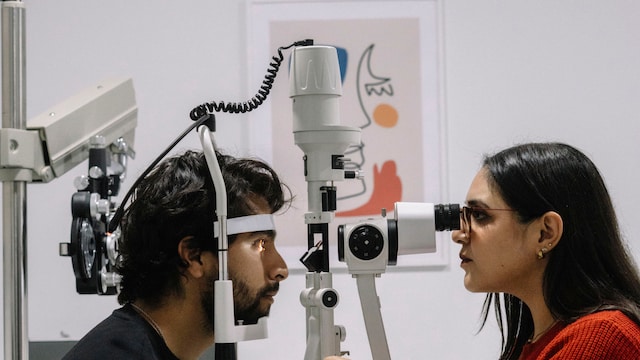
Glaucoma does not always announce itself with high pressure or blurred vision. Here is how the brain masks early damage, and why a basic optician check can give a false sense of security.
When people imagine losing their sight, they picture sudden darkness, pain or blurring that would send them straight to a clinic. Glaucoma rarely works like that.
In open-angle glaucoma, which is the most common form, there is no redness, no ache, and no obvious change in how you see. You continue to drive, read on your phone and go to work, unaware that delicate nerve tissue at the back of your eye is being damaged.
That is why doctors call it the silent thief of sight. The early damage stays hidden partly because of where it starts, and partly because our brain is very good at covering it up.
The Blind Spot You Cannot See
Your optic nerve is a bundle of more than a million microscopic fibres carrying visual signals to the brain. In glaucoma, these fibres are slowly worn down.
The damage starts at the outer edges of your vision. It affects the peripheral field you use to spot movement or navigate a crowded room, long before it touches the sharp central vision you use to read or recognise faces.
Your brain makes this harder to catch. When a cluster of nerve cells stops sending signals, you do not see a black patch. The brain fills in the gap with colour and detail borrowed from the surrounding area. Your vision still feels complete, even though parts of it are gone.
By the time someone notices tunnel vision or a missing area, close to half the optic nerve fibres may already be lost permanently.
Why "Normal" Pressure Can Be Misleading
Most people assume that if their eye pressure is normal, they are safe.
That is not how glaucoma behaves.
Lowering eye pressure is the basis of every proven treatment, but glaucoma is fundamentally a disease of the optic nerve, not just a pressure problem. Many people develop progressive damage while their pressure stays within the normal range on every check-up.
This is called normal-tension glaucoma and it is far more common than most realise. In these eyes, the optic nerve may have weaker structural support, or it may be vulnerable to poor blood supply.
A ten-second puff test or a routine prescription check at an optical shop cannot pick this up. Proper screening needs a specialist to examine the optic nerve head directly, assess its structure, and run an automated visual field test to check how it is actually functioning.
Who Needs To Be Careful?
Glaucoma can affect anyone, but some factors clearly raise the risk:
- Age:
Risk rises steadily after 40 and increases with every decade.
- Family History:
Having a parent or sibling with glaucoma significantly raises your own risk. The genetic link is strong.
- High Myopia:
Heavy short-sightedness changes the shape of the optic disc and makes it more vulnerable to stress and damage.
Long-Term Steroid Use: Prolonged use of steroids, including allergy eye drops, nasal sprays, inhalers and oral tablets, can raise eye pressure over time.
- Diabetes:
Diabetes is an independent risk factor. Chronic high blood sugar damages the small blood vessels that nourish the optic nerve. This poor microcirculation makes the nerve less resilient to pressure and more likely to suffer progressive damage, even when pressure readings look normal.
Circulatory and Vasospastic Disorders:
Anything that reduces stable blood flow to the optic nerve increases risk. This includes Raynaud's phenomenon, vasospastic disorders, a strong history of migraine with vasospasm, very low systemic blood pressure, and marked nocturnal dips in blood pressure. Fluctuating perfusion leaves the nerve head repeatedly short of oxygen.
Other Important Factors: Obstructive sleep apnoea, previous eye injury, a naturally thin central cornea which can mask true pressure readings, and optic disc haemorrhages are also linked to higher risk.
Catching It Early Changes Everything
Vision lost to glaucoma cannot be brought back. But if caught early, progression can almost always be stopped.
Treatment usually starts with daily pressure-lowering drops or a quick, painless outpatient laser procedure called Selective Laser Trabeculoplasty, or SLT, which helps fluid drain more efficiently from the eye. For more advanced disease, minimally invasive glaucoma surgery, known as MIGS, and traditional surgical options provide reliable long-term control.
People who are diagnosed early and stay regular with follow-ups almost always retain useful sight and independence for life.
If you are over 40, have a family history, have diabetes, have a history of eye trauma, migraines, Raynaud's or vasospasm, or have not had a comprehensive dilated eye examination in the last two years, get your eyes checked. Do not wait for blur. The best time to check your eyes is exactly when you feel nothing is wrong.
When To Book A Comprehensive Eye Exam (Even With Normal Eye Pressure)
Schedule a routine dilated screening if:
- You are 40 or older and have not had a full dilated eye examination in the past two years.
- You have a first-degree relative (parent or sibling) diagnosed with glaucoma.
- You have significant nearsightedness (high myopia).
- You have a history of chronic steroid use in any form, including allergy eye drops, nasal sprays, inhalers, or oral tablets.
- You manage systemic conditions that affect micro-circulation, such as diabetes or chronic blood pressure issues.
Seek prompt specialist evaluation if:
- You notice subtle changes in your spatial awareness, such as bumping into doorframes or missing objects at the edges of your view.
- You notice difficulty navigating in dim lighting or stepping down curbs, even if your central reading vision feels completely normal.
A routine optical checkup notes an asymmetrical, enlarged, or suspicious optic disc appearance, regardless of whether your eye pressure reads normal.
Disclaimer: This content including advice provides generic information only. It is in no way a substitute for a qualified medical opinion. Always consult a specialist or your own doctor for more information. NDTV does not claim responsibility for this information.