



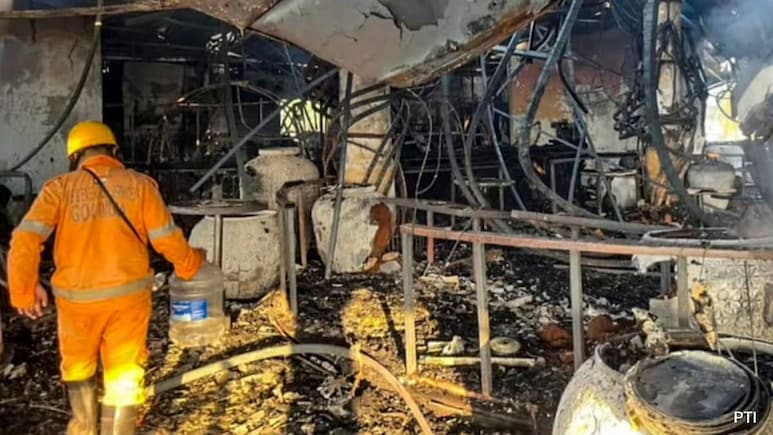
The early-December 2025 fire at the popular nightclub in Arpora, Goa, later identified as Birch by Romeo Lane, has left the nation reeling. Reports now indicate that of the 25 people who lost their lives, only a handful died from burns. The majority succumbed to suffocation, trapped in dense toxic smoke in the basement and kitchen area. This painful revelation echoes a broader, often misunderstood fact: In fires, death usually comes not from flames, but from smoke. Medical and forensic studies worldwide, across burn units, emergency medicine, and fire-science research, repeatedly show that inhalation of toxic gases and oxygen depletion account for 50-80% of fire-related fatalities.
Understanding why smoke, not fire, kills is critical to prevent future tragedies. It demands stricter building safety norms, better ventilation, reliable fire-exits, smoke detection and public awareness. The Goa incident offers a grim but important reminder of smoke's silent lethality. Here's how smoke kills and how modern fire safety must adapt to save lives.
Smoke, Not Flame: How Fire Kills Via Suffocation
Flames consume, and smoke suffocates
When a fire ignites in a confined or enclosed space - like a basement, club, auditorium or building - it rapidly consumes oxygen. Meanwhile, burning materials release a complex mix of smoke, hot gases, particulate matter, and toxic chemicals. As oxygen levels drop and toxicity rises, victims inhale air that becomes progressively unbreathable.
Studies show that smoke contains asphyxiants (like carbon monoxide and hydrogen cyanide), respiratory irritants, and heated particulate matter. These impair oxygen delivery to vital organs, damage the respiratory tract, and can incapacitate a person within seconds, often before flames ever reach them.
Evidence: Inhalation injuries cause most fire-related deaths
Multiple clinical and forensic studies underscore that inhalation injury is a far more lethal threat than burns. For instance:
- A study of 130 burn-unit patients found that those with inhalation injury had a mortality rate of 41.5%, compared with just 7.2% in patients without inhalation injury.
- According to a review of fire deaths, 50-80% of deaths in enclosed-space fires are due not to external burns, but to smoke inhalation and associated toxic gas exposure.
- Fire science research confirms that when fires reach "flashover", the point when most combustible surfaces ignite and smoke saturates the space, smoke toxicity becomes the primary killer, not flame or thermal burns alone.
Toxic components in fire smoke are especially dangerous through the following mechanisms:
- Carbon monoxide (CO) binds to haemoglobin up to 200 times more readily than oxygen. This leads to hypoxia almost immediately.
- Hydrogen cyanide (HCN), released when synthetic materials or nitrogen-rich fabrics burn, may be even more lethal, sometimes up to 35 times more than CO.
- Victims often become unconscious in minutes. Autopsies commonly find high blood-cyanide or carboxyhaemoglobin levels.
Thus, in many cases, victims don't die from external burns. Their lungs and internal organs suffocate long before their skin is harmed.
What The Goa Nightclub Fire Reveals
The preliminary investigation into the Arpora night-club tragedy reflects this pattern. According to police sources:
- Of the 25 victims, 23 had no visible burn injuries; only two were badly charred.
- Those who died were trapped in the basement or underground kitchen, areas lacking adequate ventilation or emergency exits. There was reportedly no way out once smoke filled the space.
- The club had only two exit gates. Narrow exits, wooden interiors and combustible furniture contributed to rapid smoke build-up and prevented timely escape.
- Several forensic experts and fire-safety bodies have already underlined that in crowded indoor venues, limited exit routes and flammable interiors exponentially raise the risk of asphyxiation.
In short, the tragedy wasn't primarily a "burn disaster". It was a smoke disaster.
Broader Lessons From Fire-Injury Science
The insidious nature of smoke inhalation injury:
- Smoke inhalation injuries often strike silently. Victims may remain conscious and even attempt to escape, but smoke rapidly disorients, suffocates and incapacitates.
- Medical complications can be acute, respiratory failure, airway swelling, chemical poisoning, or delayed, including acute respiratory distress syndrome (ARDS), pneumonia, or long-term lung damage.
- Because of this, modern burn-unit protocols emphasise early detection of inhalation injury, prompt administration of humidified oxygen, aggressive airway management, fluid therapy, chest physiotherapy and, when needed, mechanical ventilation.
Synthetic interiors make fires deadlier:
Today's buildings and nightclubs use materials like plastics, synthetics, treated woods, polyurethane furniture, vinyl, carpeting that, when ignited, produce greater volumes of smoke, higher levels of CO and HCN, and faster spread.
Fire-science research shows that "flashover" occurs quicker in such environments, leaving occupants little time to flee. Smoke toxicity often peaks before flames fully engulf the space, meaning deaths from asphyxiation precede destruction by fire.
What this means for safety and prevention
The Goa tragedy, and decades of fire research, point toward critical reforms needed to prevent future smoke-related fatalities:
- Strict building and fire-safety codes: Public venues like clubs, auditoria, bars must comply with fire-safety norms: multiple exits, clear exit signage, ventilation, sprinklers, fire extinguishers, and functional smoke alarms. The fact that Birch by Romeo Lane reportedly lacked adequate exits and ventilation is a stark warning.
- Use of fire-resistant, low-smoke materials: Interiors and furnishings should avoid synthetic materials that release toxic gases when burned. Plastic surfaces, upholstered furniture, treated wood or vinyl should be replaced with fire-retardant and low-smoke alternatives.
- Public awareness and early detection: Patrons should mentally note exits on entering any venue. In case of fire or smoke, stay low (smoke rises), cover mouth with cloth, avoid lifts, and head to staircases or exits quickly. As many victims lose consciousness within minutes, early reaction (or better, prevention) is often the only chance.
- Fire-safety enforcement and regular audits: Local authorities must conduct periodic safety audits of entertainment venues, ensure compliance, and penalise owners who flout norms, especially in high-occupancy, high-risk spaces.
The deadly fire at the Arpora nightclub in Goa has laid bare a grim truth: in enclosed indoor fires, smoke, not fire, is usually the killer. In the tragic disintegration of Birch by Romeo Lane, most victims had no burn injuries, yet lost their lives within minutes, trapped in dense toxic smoke without escape. The horror is not just in the collapse of the structure, but in the silent suffocation that people often do not foresee.
Medical research and forensic data strongly support what happened in Goa. Inhalation injuries, from carbon monoxide, hydrogen cyanide, heated particulate matter and oxygen depletion, are responsible for the majority of fire deaths worldwide.
This should prompt a rethinking of what fire-safety truly means: not just flame-retardant walls or extinguishers, but safe exits, ventilation, smoke detection, low-smoke interiors and public awareness. For grief to truly transform into prevention, fire-safety regulations must be more than recommendations, they must be enforced with rigor, especially in entertainment venues. Only then can we hope to prevent such tragedies from recurring.
Disclaimer: This content including advice provides generic information only. It is in no way a substitute for a qualified medical opinion. Always consult a specialist or your own doctor for more information. NDTV does not claim responsibility for this information.
Track Latest News Live on NDTV.com and get news updates from India and around the world

