





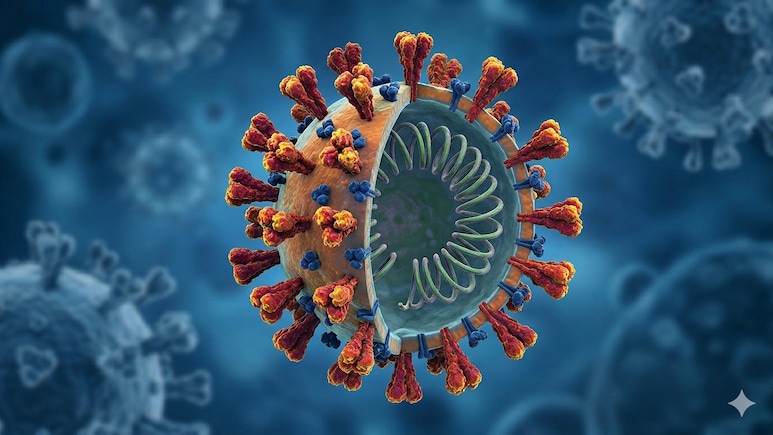
- New Covid-19 subvariant BA.3.2 Cicada is spreading across 29 US states and 23 countries
- BA.3.2 carries 70-75 spike protein mutations, more than the original Omicron strain
- WHO classifies BA.3.2 as Variant Under Monitoring with low overall global risk
New Covid-19 subvariant BA.3.2, nicknamed Cicada, has been spreading across the United States. It is a heavily mutated variant which belongs to the Omicron family. The World Health Organisation has designated BA.3.2 as a Variant Under Monitoring, meaning it is under close observation to see if it becomes more dangerous. However, global health bodies have assured that the overall risk remains low. Cicada carries 70 to 75 new mutations in the spike protein, which is significantly more than the 30 mutations found in the original Omicron strain. It is a descendant of the older BA.3 lineage that was last common in early 2022.
While there is currently no evidence that it causes more severe disease, BA.3.2 mutations in the spike protein have the potential to evade protection from a previous infection or vaccination.
Is the current Covid-19 vaccine effective against the Cicada variant?
Research indicates that the BA.3.2 Covid -19 subvariant carries 70 to 75 new mutations in the spike protein, which is significantly higher than that observed in the more prevalent variants that emerged in 2023. it may be less affected by current vaccines, which were designed for the JN.1 and LP.8.1 lineages. However, researchers have also emphasised that vaccination still provides strong protection against severe disease and death.
Additionally, Cicada still belongs to the Omicron family of viruses, suggesting it may retain some genetic similarities to more recent variants.
According to WHO, there is an anticipated reduction in neutralisation by antibodies generated from current vaccines due to the significant number of mutations in the BA.3.2 spike protein.
WHO has also mentioned that the level of immune escape for BA.3.2 is estimated to be significant, potentially comparable to or exceeding that of previously dominant variants like BA.2.86 or JN.1.
"As a pulmonologist, I've been closely observing the Covid-19 BA.3.2 'Cicada' variant currently spreading across several US states. It is a highly mutated Omicron sublineage, but so far, it appears to cause only mild symptoms such as cold, cough, and fever, especially in children, without any significant rise in severe cases or hospitalisations."
"Regarding vaccines, the current 2025-26 formulations targeting JN.1 and LP.8.1 may offer partial protection due to the variant's mutations, but they continue to be very effective in preventing severe disease, hospitalisation, and death, particularly with booster doses," says Dr. Avi Kumar, Senior Consultant Pulmonology at Fortis Escorts Heart Institute, Okhla.
What should people at risk do?
WHO continues to recommend Covid-19 vaccination, particularly for high-risk groups, as the primary strategy to prevent severe illness, hospitalisation, and death, even as new variants like BA.3.2 emerge.
"My advice, especially for high-risk individuals like the elderly and those with comorbidities, is to stay updated on boosters and follow basic precautions such as masking in crowded places. While the risk in India is currently low, we must remain cautious and proactive. Always consult your doctor for personalised guidance," Dr. kumar adds.
The BA.3.2 subvariant was first detected in South Africa in late 2024. The variant has been detected in at least 23 countries worldwide. While cases began increasing in September 2025, it hasn't yet become the dominant strain worldwide. In the US, it has been detected in patients and the wastewater systems of 29 states.
Disclaimer: This content including advice provides generic information only. It is in no way a substitute for a qualified medical opinion. Always consult a specialist or your own doctor for more information. NDTV does not claim responsibility for this information.
Track Latest News Live on NDTV.com and get news updates from India and around the world

