





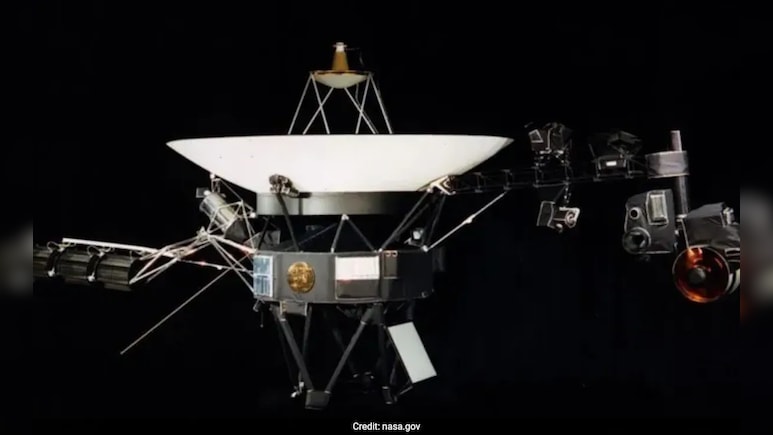
NASA's deep-space probe, Voyager 1, will reach a major milestone in November 2026, when it will be one light-day from Earth. Launched in 1977, the spacecraft has spent over 48 years travelling through interstellar space, where it is currently over 25 billion kilometres away from Earth, moving at an average speed of about 16.99 kilometres per second.
With Voyager 1 at a distance of one light-day, a signal sent from Earth will take a full day just to reach the probe, highlighting the gargantuan scale of the universe. One light-day is equivalent to 26 billion kilometres.
Voyager 1 has two radio transmitters, but has been using only one for years, called an 'X-band'. However, the other transmitter - the 'S-band' - uses a different frequency which has not been employed since 1981. Notably, the probe sends back data at a very low 160 bits per second, or a data rate similar to dial-up internet.
Voyager 1 was launched after Voyager 2, but because of a faster route, it exited the asteroid belt earlier than its twin, and it overtook Voyager 2 on December 15, 1977. The spacecraft is the first human-made object to venture into interstellar space.
Also Read | NASA's Largest Library To Permanently Close On Jan 2, Books Will Be 'Tossed Away'
Voyager 1's Journey
Voyager 1 was initially designed to last only four years, but it continued drifting into space after the completion of its primary mission. In the process, it became the first human-made probe to cross the heliosphere, the boundary where the influences from outside our solar system are stronger than those from the Sun.
Voyager 1 has made significant discoveries during its planetary flybys, including a thin ring around Jupiter and two new Jovian moons, Thebe and Metis. At Saturn, it discovered five more moons and a new feature called the 'G-Ring'. Today, the probe operates on a decaying nuclear battery, a radioisotope thermoelectric generator, which loses approximately four watts of power annually as it travels through interstellar space.
Scientists operating Voyager 1 are hopeful that the probe may also reach its 50th anniversary in 2027 after achieving the November milestone.
Track Latest News Live on NDTV.com and get news updates from India and around the world

