





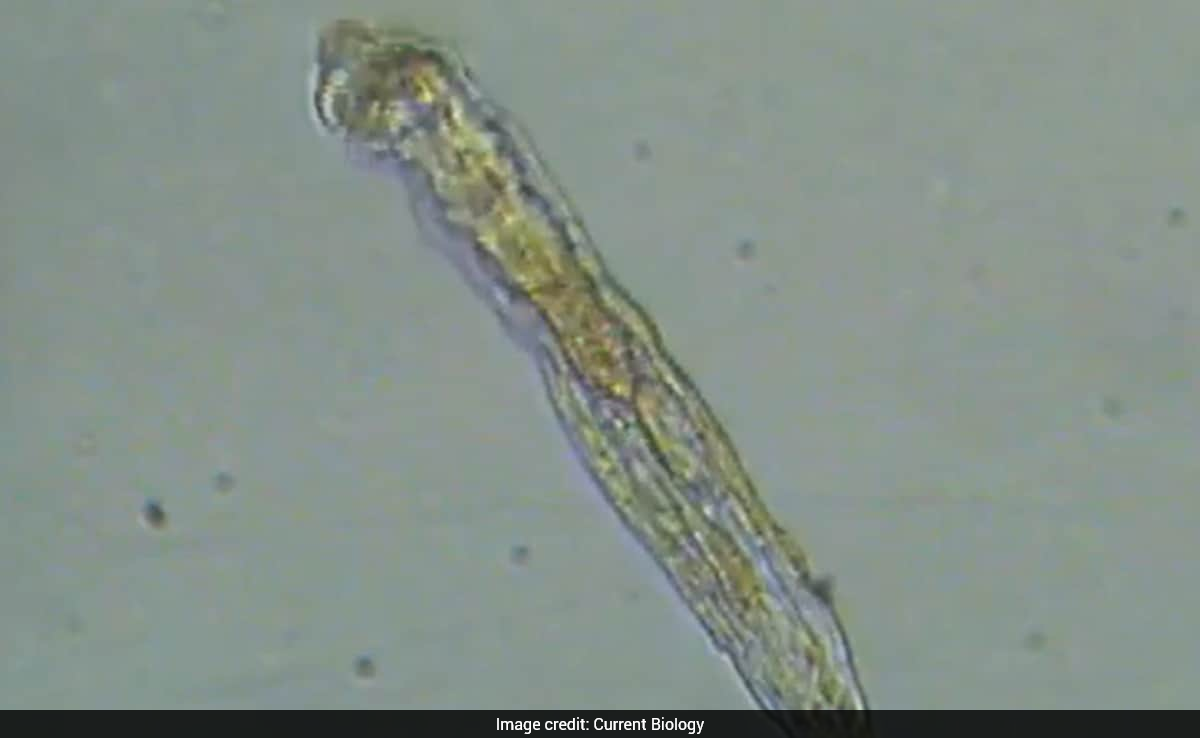
Scientists brought a 24,000-year-old microscopic animal, "Zombie Worm", back to life after it spent millennia locked in Siberian permafrost. The experts were left even more stunned after revival, when the tiny creature began reproducing, offering a rare glimpse at how complex life can survive near-total shutdown for tens of thousands of years, FOX News reported. The study published in the scientific journal Current Biology revealed that the organism is a bdelloid rotifer, which is a multicellular "wheel animal" commonly found in freshwater habitats worldwide.
Russian scientists recovered it from soil below the surface near the Alazeya River in Yakutia, northeastern Siberia. Radiocarbon dating of nearby plant material placed the sample at 23,960 to 24,485 years old, from the Late Pleistocene, a time when woolly mammoths still roamed.
Also read | Physicists Suggest Mysterious "Fifth Force" May Exist In Our Solar System
"The core contained ice-rich loam from the Late Pleistocene Yedoma formation (also called the Ice Complex)," the scientists explained in a study published in Current Biology in 2021.
"The shape, good development and wide distribution of ice wedges, and occasional finding of well-preserved mammal mummies support syncryogenetic formation of the Ice Complex, i.e. that layers of sediments were frozen relatively quickly after their formation and have never melted."
"Our report is the hardest proof as of today that multicellular animals could withstand tens of thousands of years in cryptobiosis, the state of almost completely arrested metabolism," study author Stas Malavin of the Soil Cryology Laboratory said in a statement at the time.
The permafrost formation, called Yedoma, kept the rotifer frozen solid at around -20 degrees C for the entire period. When researchers gently thawed it in the lab, the animal didn't just twitch.
It resumed feeding, moving and within days, started reproducing asexually, as bdelloid rotifers do. All offspring were clones of the original.
Also read | Leaked Documents Claim US Lab Studied UFOs, Linked To Disappearance Of Scientists
The process is called cryptobiosis, in which metabolic activity slows to almost zero, allowing organisms to endure freezing, dehydration and zero oxygen. Bdelloid rotifers were already known to survive a decade frozen at -20 degrees C.
"Our report is the hardest proof as of today that multicellular animals could withstand tens of thousands of years in cryptobiosis, the state of almost completely arrested metabolism," study author Stas Malavin said in a statement at the time.
Unlike bacteria or spores, rotifers have nerves, muscles and a gut. Their survival suggests complex animals can preserve cellular structures and DNA integrity for far longer than scientists thought possible.
"The takeaway is that a multicellular organism can be frozen and stored as such for thousands of years and then return back to life - a dream of many fiction writers," Malavin added.
"Of course, the more complex the organism, the trickier it is to preserve it alive frozen and, for mammals, it's not currently possible. Yet, moving from a single-celled organism to an organism with a gut and brain, though microscopic, is a big step forward."
Despite headlines calling it a "zombie worm," the rotifer wasn't dead and reanimated. It was alive, just paused.
Track Latest News Live on NDTV.com and get news updates from India and around the world

