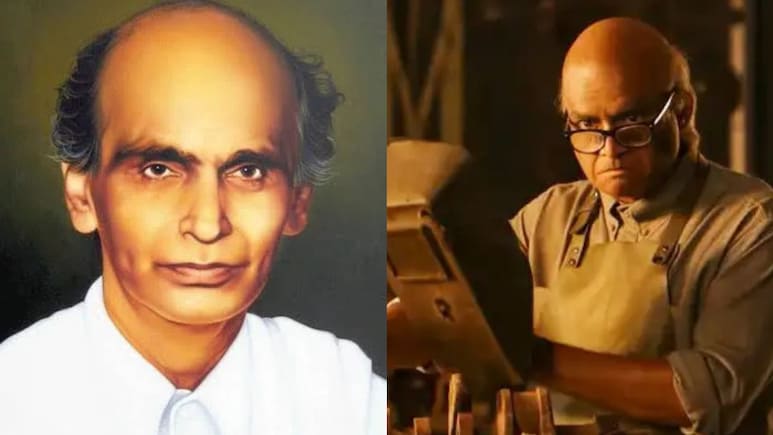
- GD Naidu was a self-taught inventor who built India's first indigenous electric motor in 1937
- He revolutionised public transport in southern India through the Universal Motor Service
- Naidu developed diverse inventions including motorised razors, vote-recording machines, and a petrol car
Some people invent machines. Others change the way a nation thinks. GD Naidu managed to do both.
Long before India became synonymous with startups, innovation and homegrown technology, there was a self-taught inventor from Coimbatore who believed the country could build its own machines instead of depending on imported ones.
He designed electric motors, experimented with automobiles, revolutionised public transport, cultivated new crop varieties and even imagined technologies that were far ahead of their time.
Yet, despite his extraordinary contributions, his name rarely finds a place alongside India's most celebrated innovators.
That may soon change.
The recently released trailer of GDN, starring R Madhavan, has sparked fresh curiosity about the remarkable life of Gopalaswamy Doraiswamy Naidu, better known as GD Naidu.
Set for a worldwide theatrical release on July 17, the film promises to revisit the life of a man whose achievements earned him the title of the "Edison of India" but whose story has remained largely absent from mainstream conversations.
So, who exactly was GD Naidu?
The Boy Who Hated School But Loved Taking Machines Apart
Born on March 23, 1893, in Kalangal near Coimbatore, GD Naidu did not fit the image of a conventional academic.
He reportedly disliked attending school and often found himself in trouble during his childhood. Formal education failed to capture his imagination, but curiosity certainly did.
Fascinated by machines, Naidu learned through observation, experimentation and relentless hands-on work.
Determined to own a motorcycle, he took up a job as a server at a hotel in Coimbatore. After saving enough money to buy one, he did something few would think of doing: he dismantled the motorcycle piece by piece, only to put it back together again.
That exercise became his classroom, laying the foundation for a lifetime of innovation.
Building India's Transport Revolution
Naidu entered the transport business in 1920 after purchasing a single automobile coach, which he operated between Pollachi and Palani.
What began as a modest venture soon grew into the Universal Motor Service (UMS), which eventually became one of the country's most efficient public transport networks.
At a time when organised road transport was still developing in India, Naidu introduced systems that emphasised efficiency, discipline and customer service, helping transform public transportation in southern India.
His entrepreneurial instincts would eventually extend far beyond buses.
The Inventor Who Refused To Think Small
GD Naidu believed that technology should be practical, affordable and accessible.
In 1937, he developed India's first indigenous electric motor alongside D Balasundaram Naidu. The achievement would later inspire the establishment of companies such as Textool and, eventually, Lakshmi Machine Works, one of India's leading engineering manufacturers.
But that was only one chapter in an astonishing list of innovations.
Naidu developed motorised razors powered by dry-cell batteries, designed ultra-thin shaving blades, created a distance adjuster for film cameras, invented a fruit juice extractor, built a tamper-proof vote-recording machine and even introduced a kerosene-operated fan.
He also announced plans to manufacture affordable radio sets in India and, in 1952, unveiled a two-seater petrol-powered car that cost only around Rs 2,000. However, the project never entered large-scale production after the government declined to grant the required licence.
Many of his ideas reflected an inventor constantly searching for solutions rather than recognition.
An Innovator Whose Interests Extended Beyond Engineering
Naidu's curiosity wasn't confined to machines.
He conducted extensive research in agriculture and developed improved varieties of cotton, maize and papaya through hybrid cultivation.
His agricultural experiments attracted the attention of eminent scientists, including CV Raman and M Visvesvaraya, both of whom visited his farm to witness his work.
His ability to move effortlessly between engineering, manufacturing and agriculture earned him a reputation as one of India's most versatile minds.
A Global Traveller With Remarkable Encounters
Naidu travelled extensively during a period when international travel was far from common.
During his journeys, he documented major historical moments with his camera. He filmed the funeral of King George V in London and also met Adolf Hitler during a visit to Germany.
His camera also captured several prominent Indian leaders, including Mahatma Gandhi, Jawaharlal Nehru and Subhas Chandra Bose.
Despite briefly contesting elections, Naidu largely remained outside active politics, preferring to focus on industry, education and technological advancement.
The Educator Who Believed Students Deserved Better
Education was another area where Naidu left an enduring impact.
His efforts and financial contributions helped establish India's first polytechnic institution, the Arthur Hope Polytechnic, as well as the Arthur Hope College of Engineering, which later became the Government College of Technology in Coimbatore.
Naidu even served as the institution's principal in 1945. However, he believed engineering education could be taught far more efficiently than existing models allowed.
Arguing that four-year programmes unnecessarily prolonged learning, he proposed shorter, more intensive courses.
The proposal was rejected by the British administration, prompting his resignation.
Even today, his commitment to practical, skill-based education remains central to his legacy.
A Philanthropist Who Believed Success Meant Giving Back
After retiring from his transport business in 1944, Naidu increasingly devoted himself to philanthropy.
He funded research scholarships, introduced welfare initiatives for employees and extended financial support to economically disadvantaged communities.
He also played an important role in efforts to bring Siruvani water to Coimbatore, a project that would have a lasting impact on the city's development.
His contributions went well beyond personal wealth, focusing instead on creating opportunities for future generations.
Why Was He Called The 'Edison Of India'?
The comparison with Thomas Edison wasn't merely because of the sheer number of inventions Naidu produced.
Like Edison, Naidu possessed an extraordinary ability to identify everyday problems and engineer practical solutions.
He combined scientific curiosity with entrepreneurial thinking, transforming imported technologies into affordable products designed specifically for Indian needs.
His influence stretched across electrical engineering, automobile manufacturing, industrial design, agriculture, education and public infrastructure, making him one of the country's earliest multidisciplinary innovators.
It is little surprise that many continue to regard him as one of India's greatest engineering minds.
Why GDN Could Finally Bring His Story To A Wider Audience
For decades, GD Naidu's story has largely remained confined to history books, engineering circles and Coimbatore's industrial legacy.
That could change with GDN, directed by Krishnakumar Ramakumar and headlined by R Madhavan. The recently released trailer hints at a film that explores not only Naidu's inventions and achievements but also the controversies, political resistance and personal struggles that shaped his life.
From accusations of tax evasion to allegations of treason and conflicts with the colonial establishment, the film promises to examine both the triumphs and hardships of a man who consistently challenged convention.
As the trailer declares, he was "Feared by the British. Forgotten by his countrymen."
Whether GDN succeeds as a biopic remains to be seen. But if it encourages a new generation to discover the extraordinary life of GD Naidu, the inventor, educator, entrepreneur and visionary who imagined an industrial India long before it became a reality, it will already have achieved something significant.
