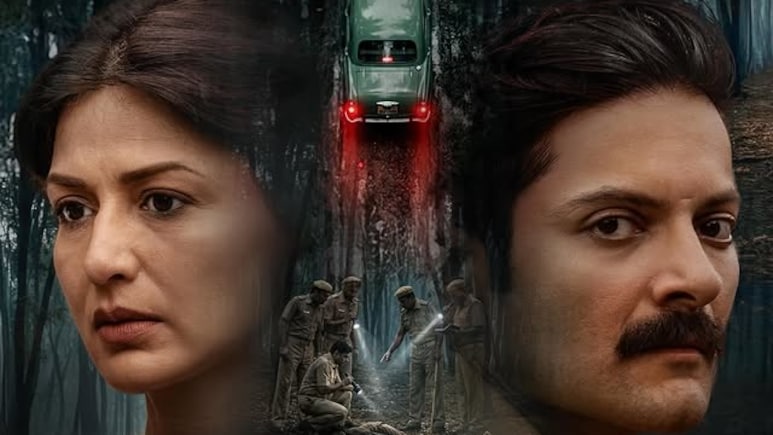
Prosit Roy's investigative thriller Raakh is deeply unsettling. Loosely based on the notorious 1978 Ranga Billa case, in which two teenagers were abducted and brutally murdered, the series keeps you questioning basic morality and suggests humanity was - and continues to be - a lost cause.
Acclaimed writer, producer and director Prosit Roy stays true to authentic storytelling, delivering a solid gut-punch for viewers. The director of Paatal Lok fame does not hold back in depicting the gritty, unapologetic criminal underworld of 1970s Delhi, and it leaves you scarred.
Unlike most procedural dramas that have several interlinked crime stories, Prosit Roy focuses on the Ranga Billa case, the monstrosity that shook the nation. Every death that is reported thereafter, is invariably linked to the two killers on the run.
The eight-episode series follows two siblings, Suman (Divya Sharma), 16, and Sahil (Vivaan Sharma), 14, who leave home to reach the radio station. Unaware of the horrors that await them, they never make it on air; their parents, Roma (Sonali Bendre) and Ashok (Aamir Bashir), wait for Suman's soulful vocals, but evening turns into night and the children do not return. A terrifying chain of events begins to unravel. What follows is a wild goose chase led by Sub Inspector Jayprakash (Ali Fazal), who struggles to prove his worth as a police officer while navigating a complicated relationship with father Ghanshyam *(Rakesh Bedi), a constable of thirty years, and an ambiguous connection with a journalist.
A rewind to 2025 reminds us that the 2025 prison drama Warrant starring Zahaan Kapoor, was also inspired by the same tragic case. The original events date to August 26, 1978, when kidnappers hijacked a car in New Delhi carrying the two siblings - children of a senior naval officer - who were tortured to death and their bodies dumped in a forest ridge.
Director Prosit Roy deserves credit for incorporating key elements of the original case with acute precision in Raakh. The Ranga Billa case marked the first in-depth forensic investigation carried out by Delhi Police, and you see plenty of that throughout the series. The trajectory of the suspects - from Bombay to Agra and back to the financial capital - is spaced out and never feels disjointed.
Ali Fazal as Sub Inspector Jayprakash shows great depth. Burdened by the unforgivable crime, he refuses to give up until he cracks the case. As he unearths the disturbing past of Rajjo (Ramandeep Yadav) and Babu (Akash Makhija), who portray the menacing abductors, you are left in shock at how far these 'daityas' (demons) will go. The emotional highs and lows Fazal portrays keep you transfixed; you can feel the pain coursing through him as the criminals keep slipping from his grasp like quicksand.
Sonali Bendre is a delight to watch. The intensity with which she plays a bereaved mother tugs at the heartstrings. In complete denial, she goes about her life as if nothing has happened until reality strikes and she is shattered. Her silence speaks louder than any dialogue. Her searing, empty gaze conveys how the toll of such rampage falls on the families of the deceased. Aamir Bashir, as her husband and a senior army officer, has his moments too. His deafening cry when the bodies of his children are discovered, soiled in mud and unrecognisable, is a masterclass in unvarnished grief.
The eerie feeling of bygone Delhi gnaws at you; disaster seems poised to unfold around every corner. Rakesh Bedi, who has always been in his element, brings adds gravitas to Raakh. He plays retired constable Ghanshyam, famous for his mutton curry and habit of delivering home-cooked food to officials. His phrase - "sabse bana ke rakhna chahiye" (be good to everybody) - and his visits to his son Jayprakash add a textured maturity to the series and win over the audience with intense scenes that show him as both father and seasoned observer of human vileness.
Prosit Roy interestingly divides each episode into chapters, naming them - for example, Raakh: Gumshuda for the children's disappearance in the first episode, followed by Raakh: Jaanwar when the gruesome killing details are revealed.
The most shocking part of the series comes when Babu's backstory - him being the more dangerous of the two criminals - is revealed. It plants the seed of how his macabre fascination with killing stems from an ingrained childhood incident. When Jayprakash meets Babu's mother in search of answers, he is left speechless by her fate at the hands of a son lost to life's cruelty.
Ali Fazal is the fulcrum of Raakh, while Sonali Bendre makes a strong impact in the sequences that show her life after the tragedy. His fury when he finally catches the culprit and beats him until he bleeds feels both inevitable and unnerving - uncontrolled, unabashed, when mercy has run out. The final episode delivers the answers: what really happened that day to two children simply on their way to the radio station. All the dots connect as the director lays out the chronology, leaving you stunned. The only justice: in both real and reel life, the perpetrators were sentenced to death for the sadistic nature of their crime. The original sentence was carried out in 1982 in Tihar Jail - but that is no compensation for the moral decay that the victim's family was also sentenced to, for a lifetime.
You know Ramandeep Yadav as Rajjo and Akash Makhija as the terrifying Babu have done a good job, because that's how they make you hate them for their actions.
Prosit Roy does an impressive job in a sensitive portrayal of an incident that isn't and shouldn't be forgotten as it is a constant reminder of how mankind can transpire to become a terror, in the face of emotional rejection.
The editing could have been a little crisper, with the number of episodes probably reduced a bit. But the consistent flow makes up for it.
Raakh boils your blood. Till the very end, and long after it has ended, the scar doesn't fade.
-
Ali Fazal, Sonali Bendre, Rakesh Bedi, Aamir Bashir, Ramandeep Yadav, Akash Makhija
