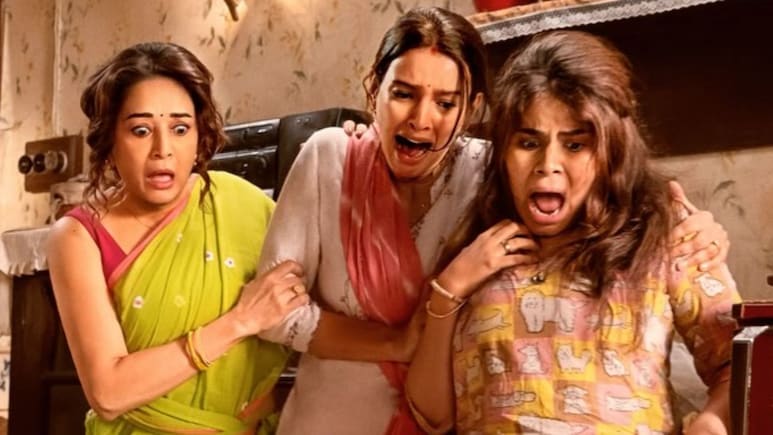
- Maa Behen is a dark comedy directed by Suresh Triveni starring Madhuri Dixit and Triptii Dimri
- The story centers on Rekha, a defiant mother judged by societal norms, and her two daughters
- The plot involves a murder mystery when Rekha claims her neighbour was killed in her house
What happens when women refuse to play by society's rules? Maa Behen attempts to answer that with humour, chaos, and a murder twist. But does it land successfully? Let's find out!
Maa Behen, directed by Suresh Triveni, brings together Madhuri Dixit, Triptii Dimri, and debutant Dharna Durga in a dark comedy that attempts to blend satire with family drama. The film also stars Ravi Kishan, Geetanjali Kulkarni, Arunoday Singh, and Shardul Bharadwaj in key roles.
Set around a dysfunctional mother-daughter trio, the film follows Rekha (Madhuri Dixit), a woman who has spent her life not caring about society's expectations. From her choice of clothes to her unapologetic attitude, Rekha is constantly judged by her surroundings. As one line in the film sharply underlines, "Dayaan ki umar nahi badhti, (A witch never ages.)" pointing to how society continues to scrutinise women regardless of age.
Rekha lost her husband at 25 and has lived on her own terms ever since. Her two daughters - Jaya (Triptii Dimri) and Sushma (Dharna Durga) - share a strained relationship with her, shaped by resentment, misunderstanding, and their own personal struggles. Jaya is stuck in a suffocating, patriarchal household, burdened by domestic expectations, while Sushma projects confidence online but wrestles with emotional confusion.
The story kicks into motion when Rekha calls her daughters one night, claiming her neighbour, Gupta ji, played by Ravi Kishan, was "killed" in her house. What follows is a chaotic spiral of panic, cover-ups, and questionable decisions. The discovery of a dead body, combined with wedding chaos at Gupta ji's house (his daughter is getting married), sets the stage for a dark comedy that tries to balance humour with emotional tension.
While the film uses this murder setup as a narrative hook, its core lies in the relationships between the three women. Their interactions - sharp, messy, and often uncomfortable - show the generational conflicts and the emotional baggage they carry.
The film also makes repeated commentary on how women are labelled, judged, and defined. Terms like "man-eater," "witch," and "firoti" (extorter) are casually thrown at Rekha, revealing the deep-rooted misogyny she faces.
Madhuri Dixit leads the film with a confident and charismatic performance. She brings both grace and defiance to Rekha, especially in moments where the character calls out regressive thinking. In one scene, when questioned about her choice of clothing, she responds, "Yeh kya behuda baat hai, hamari blouse se iska kya matlab? (What nonsense is this? What does my blouse have to do with any of this?)" - a line that effectively sums up the film's stance on moral policing.
Triptii Dimri delivers a convincing performance as a woman trapped within the rigid structures of a traditional household, where even basic agency is denied. Her character's frustration feels real, particularly in scenes that reflect everyday sexism.
Dharna Durga, making her debut, adds fresh energy, holding her own alongside more established actors.
Ravi Kishan, as the neighbour, stands out in parts, balancing humour and unease. The supporting cast contributes to the film's chaotic tone, though the screenplay often gets crowded with too many subplots.
That is where Maa Behen begins to falter. Despite a strong premise, the film struggles with coherence. The narrative moves from one situation to another without fully developing its conflicts. The satire, though loud, lacks the sharpness needed to leave a lasting impact. The tonal shifts - from domestic drama to dark comedy - feel inconsistent at times.
On paper, the film has all the elements of a sharp feminist satire. In execution, however, it feels a bit stretched and uneven at times. The humour works, and the emotional beats land, but the storytelling lacks tightness.
Still, the film deserves credit for addressing themes like patriarchy, social judgement, and women's autonomy without becoming overtly preachy. At its best, Maa Behen is messy, chaotic, and intermittently engaging - much like the lives of its central characters.
Ultimately, while the film may not be flawless, Maa Behen finds its voice in the way it takes on patriarchy - calling it out as "behuda baat" and refusing to play by its rules. It may stumble along the way, but its defiant, unapologetic stance ensures it leaves an impact as a bold, women-led story that isn't afraid to push back. Last but not least, the Madhuri Dixit film also packs in a cameo that might just catch you off guard.
Also Read: How Madhuri Dixit's Maa Behen Brings Back Iconic Nirma Jingle Nostalgia Of 1970s
-
Madhuri Dixit, Triptii Dimri, Dharna Durga, Ravi Kishan, Geetanjali Kulkarni, Arunoday Singh, Shardul Bharadwaj
