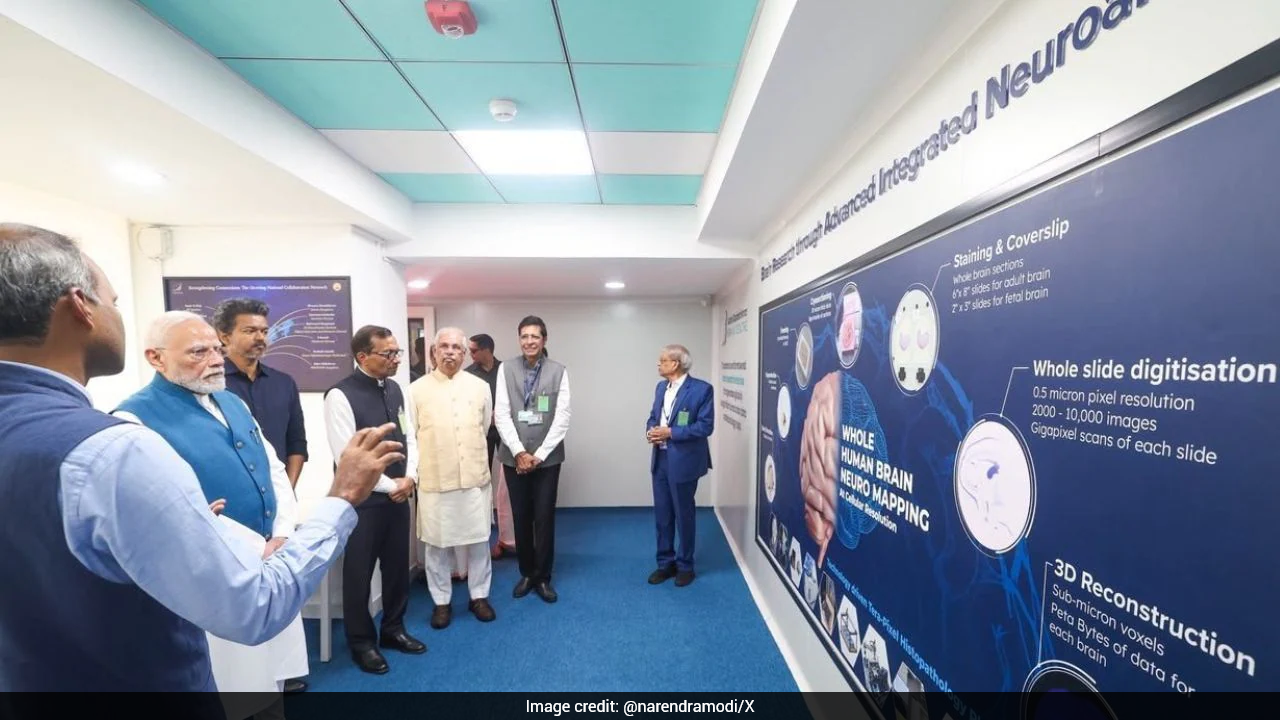

The Indian Institute of Technology Madras (IIT Madras) has launched an ambitious mission to create three-dimensional (3D) atlases of more than 100 human brains at cellular resolution across the human lifespan. The initiative also includes the release of C-STROKE, the world's first human ischemic stroke atlas. Marking a significant milestone in India's neuroscience research, Prime Minister Narendra Modi dedicated the Sudha Gopalakrishnan Brain Centre (SGBC) at IIT Madras to the nation during his visit to the institute on October 11.
The Prime Minister said the Sudha Gopalakrishnan Brain Centre marks an important step towards advancing cutting-edge research and innovation in healthcare.
He also witnessed the launch of the Centre's mission to create 3D brain atlases at cellular resolution and the release of C-STROKE, a resource designed to advance research into ischemic stroke.
According to IIT Madras, the Centre combines advanced brain imaging, computing, and multidisciplinary scientific and technological expertise to make high-resolution brain maps accessible to researchers and medical professionals worldwide. These resources are expected to deepen understanding of brain structure and neurological diseases while opening new avenues for neuroscience and neuromedicine.
IIT Madras Releases World's First Human Ischemic Stroke Atlas
During the Prime Minister's visit, the Sudha Gopalakrishnan Brain Centre released C-STROKE as an open-access global resource for studying ischemic stroke.
According to IIT Madras, the atlas bridges clinical magnetic resonance imaging (MRI) scans with microscopic, whole-brain imaging, offering insights into stroke-related changes at the cellular level. It features more than 1,000 annotated brain sections and maps key cellular markers associated with neuronal health, neuroinflammation, blood-brain barrier disruption, hypoxia, and axonal injury.
Developed with support from IIT Madras alumnus V Prem Watsa, the atlas provides an open-access platform for researchers and clinicians worldwide to investigate cerebrovascular diseases and explore potential therapeutic targets.
