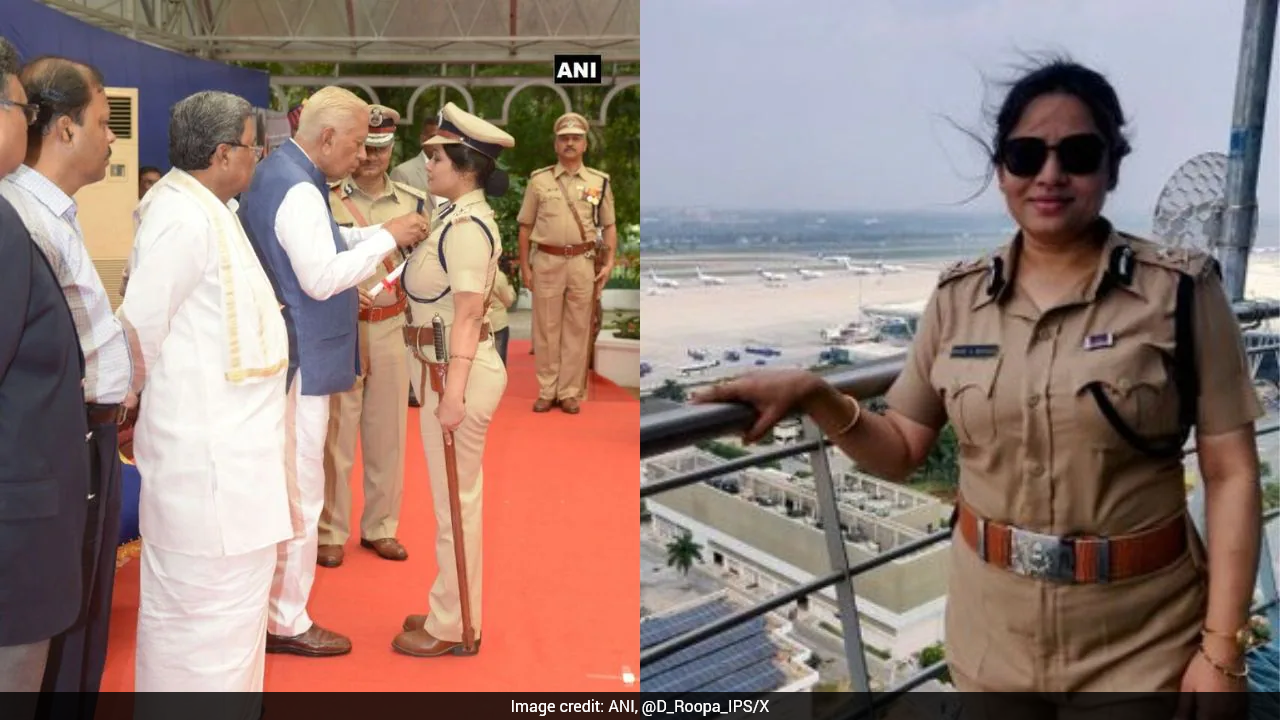

D Roopa Moudgil, a 2000-batch Indian Police Service (IPS) officer, has built a career marked by challenging assignments, leadership roles, and frequent transfers. She secured the 43rd rank in the Union Public Service Commission (UPSC) Civil Services Examination. She is a recipient of the President's Police Medal.
She is currently serving as Additional Director General of Police (ADGP) with the Bangalore Metropolitan Task Force (BMTF).
Over the course of her career, she has been transferred more than 40 times and has held several key positions, including Karnataka's Home Secretary, Deputy Inspector General (DIG) of Prisons, and Managing Director of the Karnataka State Handicrafts Development Corporation Limited (KSHDCL). She is married to IAS officer Munish Moudgil.
Speaking at Josh Talks, Roopa spoke about the childhood experiences that shaped her ambition, her decision to join the IPS after securing a high rank in the UPSC Civil Services Examination, and the challenges she faced during her early postings.
How A School Question Shaped D Roopa's Career Choice
Recalling an incident from her school days, Roopa said her ambition to join the civil services began when she was in Class 3. Her teacher had asked the students what they wanted to become when they grew up and instructed them to discuss their career choices with their parents before answering the next day.
When Roopa asked her mother, she suggested that she become a doctor. However, Roopa was not interested in medicine. Her father, on the other hand, suggested that she consider becoming an Indian Administrative Service (IAS) or IPS officer.
Explaining how her father's advice influenced her, Roopa said he told her that an IAS officer could become a District Magistrate (DM) or Deputy Commissioner (DC), while an IPS officer could become a Superintendent of Police (SP).
"I liked this leadership role so much that I gave this answer in the class the next day. I was the only student who gave this answer. This made my teacher happy, and she asked everyone to clap for me. Because of this, I thought that IPS must be special. And then I decided that I will become an IPS or an IAS," she said.
Choosing An Unconventional Path
Roopa hails from Davanagere, Karnataka, where she said engineering and medical careers were popular choices among students. Growing up in a conservative Brahmin family, she said, she had limited exposure to the civil services initially.
She recalled that some relatives questioned her father's decision to support her ambition of joining the police force. However, her parents, who worked in different Central Government departments, encouraged her to pursue her goals.
"My parents have progressive minds. My parents were Central Government employees working in different departments. So I had to be a working woman, but what will I be? The seeds of this were sown by my father. He gave me a dream, but how it will be achieved or how will I do it, even he had no knowledge of it," she said.
Roopa added that she gradually gathered information about the IAS and IPS despite growing up in an environment where few people around her were familiar with these services.
How NCC And A Magazine Helped Her Understand UPSC
Roopa said her interest in the National Cadet Corps (NCC) grew during her school years. She earned A, B and C certificates and represented her school at a competitive NCC camp in Delhi when she was in Class 9.
During the camp, she heard a speech by Kiran Bedi, the former IPS officer, which further inspired her to join the police service.
"I got inspired. NCC and the khaki influenced me so much that even after getting the 43rd rank in UPSC, I chose IPS," she said.
The camp also helped her understand the civil services examination. While preparing for its general knowledge tests, she came across Competition Success Review, a magazine that carried interviews with IAS and IPS officers. Reading these interviews helped her learn about the examination, its subjects, and its level of difficulty.
Roopa said she began considering Psychology and Sociology as subjects for her future UPSC preparation while she was still in Class 9.
Choosing Humanities Despite Excelling Academically
After completing Class 10 under the state board, Roopa secured the 23rd rank in her state. Despite her academic performance and the additional marks she received through NCC, she chose humanities in Class 11 rather than pursuing engineering or medicine.
She recalled that her decision surprised several people, some of whom considered it unwise to give up the conventional career options available to a high-performing student.
However, Roopa said she wanted to study subjects that matched her interests rather than follow a career path simply because she had the academic scores to do so.
"I am happy about the fact that according to my childhood dreams, I chose my subjects according to my interests, gained the knowledge, and crossed one round at a time and got selected," she said.
She also credited her participation in extracurricular activities, including essay writing, speeches, debates, quizzes, and singing, as well as learning Bharatanatyam, with helping her develop a strong general knowledge base.
Roopa said she was self-motivated and did not need her parents to remind her to study. Her varied interests and activities, she added, helped her build the knowledge that proved useful during the civil services examination.
Early IPS Career: Challenging Postings And Administrative Responsibilities
Roopa was 24 when she cleared the civil services examination with the 43rd rank and opted for the IPS. Her first posting was in Dharwad, Karnataka, where she was still learning the intricacies of administration when she encountered a major challenge.
She recalled that the Hubli court had issued a non-bailable warrant against the sitting Chief Minister of Madhya Pradesh at the time. She described the incident as a defining early test in her career.
One of her other significant assignments was in Yadgir, a district carved out of Gulbarga, where she served as its first district head.
"Handling a new district is like handling a newborn baby," she said, describing the challenges of establishing administrative systems and maintaining law and order in a newly formed district.
Roopa said she took preventive measures early in her tenure, which helped maintain peace in the district for three years.
However, the posting also brought personal challenges for her family. As Yadgir was a newly formed district, suitable residential quarters for the Superintendent of Police were not available, and she could not find a house on rent.
Her husband, IAS officer Munish Moudgil, was also holding an additional charge in the district and had access to government accommodation in a village. The family moved there, and their daughter began her formal education at a rural school nearby.
Roopa recalled that her daughter had to sit on the floor during her first two years of school because proper seating arrangements were unavailable.
She said such experiences challenged the popular perception that IAS and IPS officers always enjoy comfortable working and living conditions, with air-conditioned offices, official vehicles, and domestic help.
"There are different challenges," she said, pointing to the realities of serving in difficult postings and managing family responsibilities alongside demanding administrative duties.
